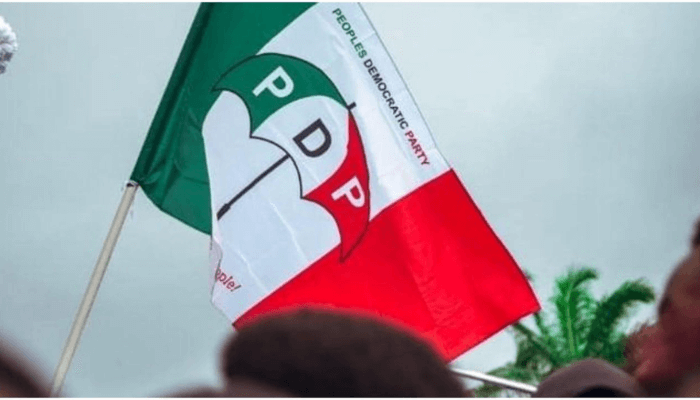
The gale of defections by Nigerian politicians from one party to another is a grave matter for concern, especially for the leading opposition party, the People’s Democratic Party (PDP). But there are no tears for the umbrella party.
PDP was the go-to party in Nigeria post-military era. It enjoyed unfettered and uninterrupted power for 16 years, spanning 1999 to 2015 when the main opposition party then, All Progressives Congress (APC), riding on the ruling party’s inability to get its house in order, won the 2015 election.
Since the last 10 years of losing power, the umbrella party has been a shadow of itself and their actions present party politics in Nigeria as a mega-comedy with layers of tragedy, throwing up some characters whose clowning capacity qualify them only for the theatre of the absurd.
The APC government in the country in the last 10 years has been a disaster that has foisted on the citizens and the economy the highest and worst level of negatives, creating a fertile ground for any serious opposition, in this case PDP, to take back power from the floundering ruling party.

Rather than reengineer and reinvent itself to stage a comeback to reckoning, the party engaged itself in internal wranglings, interpersonal squabbles, and pursuit of selfish interests that run counter to the over-all interest of the party, all tearing the umbrella into shreds.
Read also: Atiku blasts Tinubu, defends political alliances amid PDP defections
From being an umbrella that was big enough to accommodate everybody, PDP has become a loathsome entity boiling from its bowels and throwing up its contents like a violent volcano.
Over the years, the party has had its membership depleted as many of them have left and joined the ruling party, the APC. This came to a head recently when what looked like a whirl wind blew across Delta State, sweeping the governor, Sheriff Oborevwori, his predecessor, Ifeanyi Okowa, and many other prominent party members in the state to the ruling party as new members.
The defection of Oborevwori as a sitting governor and Okowa who was the vice-presidential candidate of the party in the 2023 elections, from PDP to APC, has been described as a watershed in the run up to the 2027 elections. It is a sad development.

But how did this once “largest political party in West Africa” arrive at this sorry passe. “It’s the Law of Unintended Consequences that turns History’s chronology into drama,” Agu Onwuzuruoha, a public affairs commentor says, citing Theodore White’s magnus opus In Search of History.
Onwuzuruoha reasons that PDP’s march into perdition started when they jettison their zoning system to shut out the South East, adding that it was an unforced error by Northern power mongers and hegemons, and in hubristic twist to the tale trampled on Wike’s over-bloated ego.
Wike, according to him, a tragic hero, tried to correct what he believed was a great error, but ended up bringing greater error and calamity to his party.
Wike, who lost his presidential ambition to Atiku Abubakar and his vice-presidential bid to Okowa, then governor of Delta State, was justifiably enraged for what seemed to be a betrayal having single-handedly funded the party’s resuscitation when it was going into extinction.
Wike’s actions, which can be likened to volcanic eruptions, are part of the major undoing of the PDP and this, coupled with the self-seeking tendencies of its members, is tearing the party apart and denying it the opportunity of taking over power from APC in 2027.
This is why most Nigerians are not bothered about what is happening in the party, especially the gale of defections that has it like a thunderbolt. To Atedo Peterside, the founder of Stanbic IBTC Bank and Anap Business, what is happening in the political space is not so much to bother oneself about.
Peterside, who spoke at a television programme monitored in Lagos on Thursday, noted however that it was good that many of them that are alleged to have some baggage are gathering in one party, adding that that is the way Nigerians will know who is who among the politicians.
Dele Momodu, a veteran journalist and social commentator, has described what happened in Delta as “a survival tactic rather than a genuine shift in political ideology.” Momodu at an interview on Channels TV on Wednesday, said the move did not come as a surprise, noting that Nigeria’s political history is filled with similar episodes of defections.
“I’m a very good student of Nigeria’s political history, so nothing can surprise me about our politicians. The history of Nigerian politics is replete with stories of defections,” he said.
Even though Bukola Saraki, former Senate President, is optimistic that PDP will come out of its present travails stronger, political pundits argue that the party has been severely dismembered, as it is speculated that more PDP governors across the country are gearing up to dump the party and join APC.
What is happening in PDP now is big lesson on how not to manage success. During the 16 years of PDP as the ruling party, Nigerians saw executive arrogance and lawlessness as well as legislative recklessness. Though the economy was relatively buoyant then with petro-dollar rolling in, it did not translate into the wellbeing of the people because government’s other name then was profligacy.
Some analysts are, however, of the view that it is not over for PDP yet if only it can put its house in order and members place the party’s interest above personal interests. According to the analysts, APC has given Nigerians enough pain for them to seek a breath of fresh air which a strong opposition like PDP would have provided if they had not, by omission or commission, allowed the big umbrella to tear almost irreparably from the seams.