…Oil Palm Growers see huge economic benefits
Nigeria’s Oil Palm sector has got boosted with the purchase of 3.5 million sprouted nuts (oil palm seeds) for Cross River State by Governor Bassey Otu.
The oil palm seeds purchased from the Nigerian Institute for Oil Palm Research (NIFOR) are for the establishment of nurseries across the state in order to make certified high yielding tenera seedlings available to small holder farmers.
With the sprouted nuts, about 24,000 hectares of ageing plantations across the state would be replanted.

As Nigeria continues to explores opportunities in the non-oil sector, the palm oil industry has become a significant area for growth.
The Oil Palm Growers Association of Nigeria (OPGAN) plans to revamp the industry by replanting 1.5 million hectares of land over the next 5 years across the 27 major oil palm producing States in Nigeria.
This is contained in the Oil Palm Development Strategy for Nigeria 2024 – 2029 which OPGAN developed to propel Nigeria’s oil palm industry from its current 5th position to the 3rd rank in global palm oil output.
The plan will also revitalize and elevate Nigeria’s oil palm industry, positioning it as a global 3rd leader through proper planning, investments, sustainable practices, innovative technologies and inclusive growth strategies.
Read also: Oil palm growers to replant 1.5m hectares on rising appetite

Special convention for Oil Palm Growers Association
The Oil Palm Growers Association of Nigeria (OPGAN) in their national convention lauded Governor Otu for his support of smallholder oil palm farmers in Cross River state.
Joe Onyiuke, national president, OPGAN stated this during a special convention for Oil Palm Growers Association, OPGAN held in Abuja.
He referred to Governor Otu as the “Peoples’ Governor” and revealed that OPGAN plans to award him the best governor in oil palm production.
Onyiuke also called on other governors to follow Prince Bassey Otu’s laundable example by providing similar support to small holder oil palm growers in their states to enhance oil palm production for both local consumption and export.
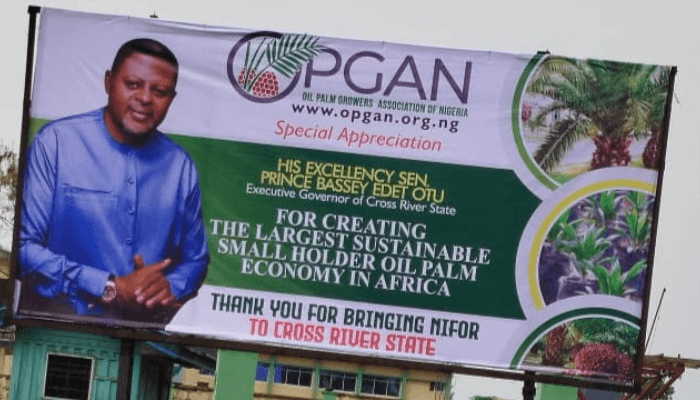
He stated, “The biggest support has come from Cross River State Governor, Prince Bassey Otu. He’s the best governor in Nigeria for oil palm production, the best and he deserves a national award. “Nobody has ever done that. His support is unparalleled. We want other governors to emulate Prince Bassey Otu.”
Onyiuke highlighted that Governor Otu’s contributions goes beyond this initiative, and noted, “He’s doing a lot in agriculture. The support from Cross River State is encouraging. To show appreciation, OPGAN has put up billboards across state capitals at their own cost to support the laudable programmes of the governor. Other governors are engaging with OPGAN to discuss similar initiatives”.
Onyiuke emphasised the need for Nigerian to be patriotic and patronise Nigeria. “Despite all the false propaganda and de-marketing of our own dependable NIFOR by some unpatriotic people with different interest about the capacity and viability of NIFOR materials, the wise governor was able to navigate through smoke screen and purchased sprouted nuts from the Nigeria Institute for Oil Palm Research (NIFOR). He paid directly to NIFOR at a very good discounted rate, and for the benefit of the people. So he is truly the people’s governor, indeed.
Onyiuke also commended the Federal Government for its support through the Federal Ministry of Agriculture and Ministry of Industry, Trade and Investment in addressing the challenges faced by the association.
Historically, Nigeria was a leader in palm oil exports but now faces significant gap in production relative to consumption, with a current deficit filled with hundreds of millions of dollars spent annually on importation.
Read also: Nigeria’s largest oil palm maker hands shareholders with record gains
Reiterating President Bola Tinubu’s administration’s commitment to the agricultural sector
Kingsley Uzoma, Senior Special Assistant to the President on Agric-business reiterated the commitment of President Bola Tinubu’s administration’s to the agricultural sector.
The SSA who was represented by Shuhdah Ahmed, Special Assistant to the President on Projects, emphasised the importance of collaboration in advancing Nigeria’s palm oil industry, with focus on sustainability and sustainable agricultural practices.
Uzoma added that strong partnerships between the government and organizations like OPGAN are crucial for creating an environment that supports palm oil farmers through access to resources, technology, and favorable policies.
He therefore expressed confidence that the convention would encourage growth and prosperity for Nigeria’s oil palm sector.
The dedication of farmers and industry players is seen as a driving force for the future of Nigeria’s palm oil sector. Through strategic initiatives and strong collaboration, there is optimism for unlocking opportunities that will benefit both rural communities and the nation as a whole”, Uzoma stated.
NIFOR emphasises importance of scientific research in development of oil palm industry
In his remarks, Isona Gold, Director General, Nigerian Institute for Oil Palm Research (NIFOR) emphasised the importance of scientific research in the development of Nigeria’s oil palm industry.
According to Gold, countries like Malaysia and Indonesia have leveraged science to expand their oil palm industries, while Nigeria was still dependent on traditional methods.
He said: “Malaysia cultivated over 100,000 hectares annually, while we were still dependent on wild collection”.
He further stated that NIFOR was established to bridge the gap by providing scientific solutions to farmers, by enabling them access to high-quality, disease-resistant palm varieties at affordable prices.
“In the international market, sprouted seeds sell for $2, but we offer them at ₦200 because we are a public institution supporting farmers,” he added.
He revealed that there is an increase in foreign interest in NIFOR’s work, especially with Indonesia and China seeking cooperation to access drought-resistant oil palm varieties due to challenges of climate change.
“The Indonesians are afraid that droughts could wipe out their industry. They are looking to Nigeria, the centre of oil palm diversity, for solutions,” Gold revealed.
He further stressed NIFOR’s role in developing resilient materials for Nigerian farmers, even as he noted that many foreign-imported materials are unsuitable for the local environment.
“We send our scientists regularly to help farmers combat diseases caused by foreign materials that are not adaptable to our climate,” he stated.
Gold further said that NIFOR will is working to introduce new high-yield, disease-resistant palm varieties by 2025. One such product, known as “Varicense,” is expected to gain prominence in the international market due to its light-colored oil, which requires minimal processing.
“This is a game-changer for Nigeria. We are ready to launch these materials to support farmers in achieving commercial success,” Gold added.
He therefore urged stakeholders to continue supporting NIFOR’s efforts, highlighting that the institute has been at the forefront of oil palm research in Nigeria for over 85 years.
“We have over 130 research scientists working to improve the industry. Together, we can achieve greater success,” Gold stated.
Read also: Nigeria’s top oil palm firms’ shareholders see higher gain
The five-year plan
The Oil Palm Growers’ Association of Nigeria (OPGAN) seeks the promotion of a 5 year Oil Palm Development Strategy, aimed at elevating Nigeria from its current 5th position to the 3rd in global palm oil output by 2029.
To achieve the above, Nigeria must elevate oil palm industry through sustainable practices and innovative technologies, targeting the replanting of 1.5 million hectares across the 27 oil palm growing states by targeting replanting 302,025 hectares each year from 2025 to 2029, supported by effective seed production,land acquisition strategies and processing capabilities. The huge economic projections anticipate cumulative net margins of N319.8 trillion and tax revenues of N31.9 trillion over five years, significantly boosting economic growth and government revenue.
Not without challenges
Key challenges include lack of certified seedlings, land tenure issues, limited processing capacity, infrastructure deficits, access to finance for smallholders, and pest pressures. OPGAN has mapped out strategies and targeted interventions to mitigate these challenges by emphasizing coordination among stakeholders—government, financial institutions, and development partners.
Empower NIFOR
OPGAN noted the need to empower the Nigerian Oil Palm Research Institute (NIFOR) to produce high-quality sprouted nuts and encourage PPP arrangement with them for establishment of nursery centres nationwide for the yearly production of 60 million certified seedlings needed to achieve the above ambitious and achievable national target.
This, according to them is in addition to the need to implement land acquisition strategies that empower smallholders, fostering inclusive growth – youth/women and market integration.
“There is need to commission a national mapping exercise to enable the nation know precisely our total planted holdings (both large scale and small holders) and un-planted ones to enable the nation plan and predict our national out puts and investment opportunities. This will position oil palm farming with attractive business cases to attract grants, subsidies, and low-interest loans. The above is done in all the major oil palm producing countries.
“Empower NIFOR to research and to continue the development of high-yielding, disease-resistant varieties and improve processing technologies. Also empower extension officers to provide comprehensive support to smallholder farmers thereby enhancing productivity, technical skills, identify high-potential export destinations and ensure compliance with international standards to enhance competitiveness especially R.S.P.O.,” OPGAN president noted.
Read also: Nigeria’s top oil palm producers reap big amid naira slump
Potentials of small holder oil palm farmers
The OPGAN president further noted that the small holder oil palm farmers hold the key to elevating Nigeria from being a net importer to net exporter.
“There is urgent need to increase local production, and he urged members to engage in replanting/repopulating their plantations especially as many existing trees are old and unproductive.
“Luckily, we have the best planting materials in the market by reason of NIFOR which the colonial masters established in 1939 to feed the entire West Africa, so we cannot allow NIFOR to die,” Onyiuke said.
According to him, the special convention aims to organise oil palm farmers, to make them bankable, focusing on funding, processing, and exporting oil palm products to meet international demands.
Onyiuke highlighted the long-term benefits of investing in oil palm, stating, “Oil palm is a long-term business. Once you get it right, for the next 25 to 30 years, you will reap significant financial rewards.”
He further noted the extensive value chain associated with oil palm, which supports various industries such as food, cosmetics, pharmaceuticals, chemical, energy etc.
He reiterated the importance of re-establishing Nigeria’s position in the global palm oil market which will create lot of jobs for our youth and women, boost the GDP of the country, curb rural urban migration as well as significantly contribute to government revenue.
The special convention was vital for electing new national executives to lead OPGAN for the next four years and so the above five-year strategy document was also launched, outlining how to achieve these ambitious goals through collaboration with members, stakeholders and development partners.
“It’s very easy to achieve. It involves serious planning. The strategies are simple: get high-quality materials from NIFOR, cut down old unproductive palm trees and plant the new ones. In the next two to three years, we will see and feel the tremendous results”, Onyiuke stated.