…Parties split into multiple camps
In a move that aims to strengthen the internal democratic mechanisms of political parties, the Supreme Court, in recent judgements, recluse the judiciary from meddling in the internal affairs of the political parties.
BusinessDay checks have shown that the absence of internal democracy has been the greatest bane of Nigeria’s political parties, threatening the peace and stability of the democratic practices.
The incidence of godfatherism manipulating political parties and entrenched interests have worked against the rule of law and internal party democracy.

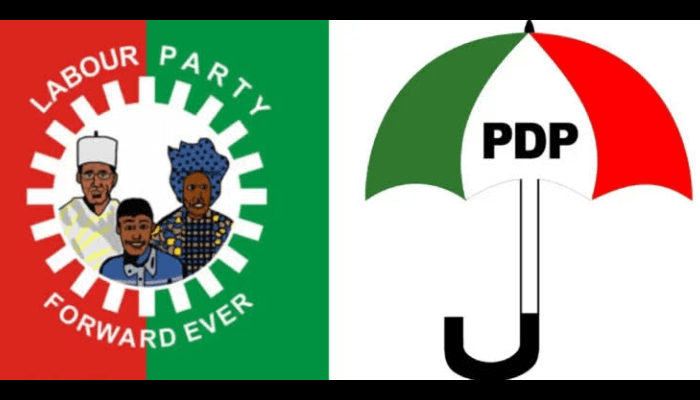
The current crises has torn the Labour Party into three main camps, mainly into those loyal to Julius Abure, the Obidient group and the Nigeria Labour Congress NLC group.
The PDP on the other hand is split amongst those loyal to Samuel Anyanwu, loyalists of Sunday Udeokoye and the onlookers group, who are monitoring developments from the sidelines.
Auwal Ibrahim ( Rafsanjani) Executive Director, Civil Society Legislative Advocacy Center CISLAC sees the development as unhealthy for democracy, ahead of the 2027 general election.
” What we are witnessing is unhealthy for our democracy, especially as we seek better and robust political engagements to keep the ruling party in the right direction, ahead of the 2027 elections”.
According to him, ” Unless the opposition parties are able to put their house in order by allowing the principles of the rule of law and robust internal mechanisms for tackling their differences, it will be difficult for them to convince Nigerians to vote for them.

” A political party exists to give credible alternative to the electorates, but they cannot do so if they constantly engage in rancour”.
Sections 221 to 229 of the 1999 Constitution of Nigeria, as amended, spelt out how political parties are to be organised, including the establishment, funding and management, based on agreed rules and norms spelt out in the political parties’ constitutions.
Read also: Edeoga dumps LP, returns to PDP, extols Mbah’s leadership style
Specifically, Section 223 of the Nigerian Constitution, 1999, as amended, deals with the Constitution and rules of political parties, as follows; (1) The constitution and rules of a political party shall-
(a) provide for the periodical election on a democratic basis of the principal officers and members of the executive committee or other governing body of the political party; and
(b) ensure that the members of the executive committee or other governing body of the political party reflect the federal character of Nigeria.
(2) For the purposes of this section –
(a) the election of the officers or members of the executive committee of a political party shall be deemed to be periodical only if it is made at regular intervals not exceeding four years; and
(b) the members of the executive committee or other governing body of the political character of Nigeria only if the members thereof belong to different states not being less in number than two-thirds of all the states of the Federation and the Federal Capital Territory, Abuja.
Dorcas Odigwe, a Political Scientist, in a recent study titled “ Nigerian political parties and internal democracy”, cited the absence of internal democracy amongst Nigeria political parties, as a negative phenomenon that has stunted the growth of democracy in Nigeria.
In her conclusions, she recommended that Political parties must embrace internal democracy and party discipline, as guide for viability and full development of the parties.
She also recommended that the Nigerian political parties should endeavour to observe internal democracy so as to give room for transparent party primaries, as this would reduce incidences of replacing candidates, thereby promoting an atmosphere for peaceful coexistence, equity and fairness.
According to her” The problem of godfatherism should be drastically reduced to give room to the people to be able to choose the best to represent them as this would go a long way to strengthening the democratic process in the country. Finally, it was recommended that the parties should have strong political ideology as this would serve as a guide to parties’ objectives”.
Both the Peoples Democratic Party PDP and the Labour Party LP, the two strongest opposition parties are currently facing huge internal crises
The current crises in the Labour Party LP, began at the expiration of the tenure of the Julius Abure led leadership in March, 2024.
Abure, in an effort to consolidate his hold on the party, summoned a national convention which returned him as Chairman.
But INEC rejected the convention and refused to send an observer team as required by the law, saying that it does not recognise the party’s March 2024 National Convention, which re-elected Abure as Chairman
Following this development, Peter Obi and Governor Alex Otti convened a stakeholders meeting in Umuahia where they appointed a 29-member caretaker committee, headed by Nenadi Usman to amongst other things organise an all encompassing national convention that will produce a new leadership for the party.
They subsequently wrote a letter to the INEC on September 6, 2024, informing the commission of the purported and non existent leadership crisis in the party.
But Abure and his team kicked against the action, noting that the “purported Labour Party Caretaker Committee emerged through unlawful, illegal, crooked, unconstitutional and mischievous means.
The PDP on the other hand is facing implosion over who occupies the office of its National Secretary, Samuel Anyanwu and Sunday Udeokoye, lay claims to the position.
The Supreme Court also in a recent judgement, set aside the judgments of the Court of Appeal and Federal High Court, which had earlier sacked Samuel Anyanwu as National Secretary of the People’s Democratic Party (PDP).
A five-member panel of the court led by Justice Jamilu Tukur, held that the issue was not justiciable, as it is the internal affairs of the party.