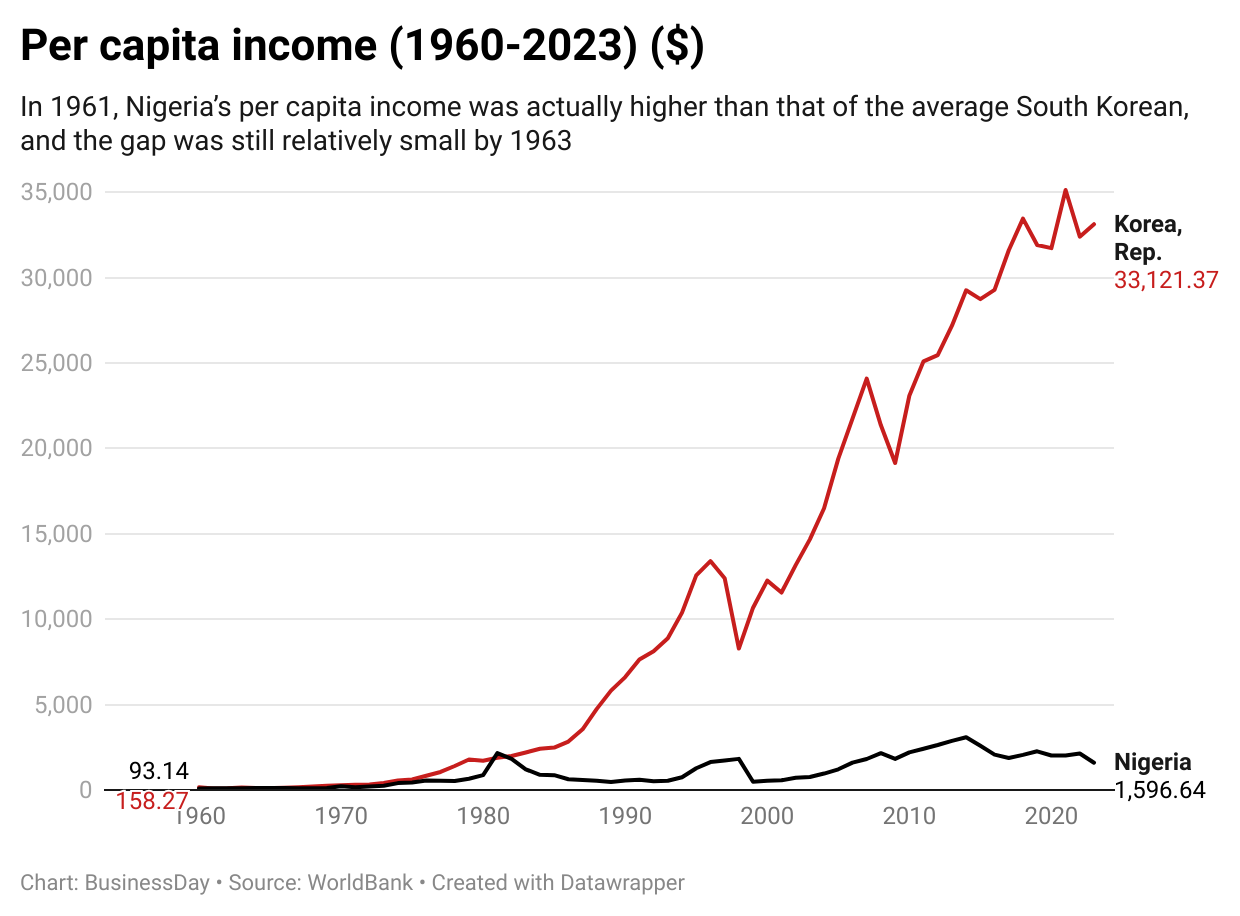
Imagine this: a citizenry empowered not by coercion or inducement, but by conscience, moved to shape the destiny of a nation. Imagine a judiciary unafraid to draw the line when the government oversteps its constitutional bounds. Imagine a legislature that answers not to power or privilege, but to the public it serves, willing to challenge a president when the stakes are democratic principle over political convenience.
South Korea’s institutions stand tall
South Korea, a nation with a per capita income of approximately $33,121, has just demonstrated the strength of its democratic institutions by impeaching its president through a parliamentary vote, later upheld unanimously by the country’s constitutional court. Suspended President Yoon Suk Yeol was removed from office after his controversial declaration of martial law in December 2024 — a drastic move that temporarily grants military authorities control over civilian governance, often at the expense of civil liberties and democratic norms.
When martial law was declared, citizens took to the streets to protest Yoon’s decision. Experts said the protests were not just about the declaration itself, but what it symbolised — a blatant disregard for democratic principles.

The people said no to martial law
According to a political analyst familiar with East Asian democracies, “What happened in Korea speaks volumes. What those people were jubilating for was not just the impeachment, but the principle — the belief that no leader should be able to declare martial authority simply because things aren’t going his way,” the expert said.
Yoon Suk Yeol, once celebrated for his uncompromising stance as chief prosecutor, failed to transition into the role of president in a democratic context. “He had the chance to be a good leader but ruined it because of his stubbornness. Even people who grew up with him say he was always inflexible. He could have worked with the opposition, he could have leaned towards the centre, but he chose confrontation over compromise,” the expert added.
The downfall of his presidency began after his party suffered losses in the parliamentary elections, costing him significant political capital. An emboldened opposition-controlled National Assembly acted decisively. The declaration of martial law was the final straw.

Democracy isn’t just elections
“Like Cory Booker said recently, ‘The power of the people is more than the people in power.’ South Koreans reminded the world of that,” the analyst emphasised. “Nigeria must take note — democracy is not just about voting; it’s about institutions standing strong and people holding their leaders accountable.”
When Peter Obi, the Labour Party presidential candidate in 2023, said, “Nigeria today is not a democratic country. Let’s stop telling ourselves lies. The basic features that make up a democracy don’t exist here,” he was not wrong. In Nigeria today, both the legislature and the executive are in collusion — a situation that undermines the public interest and is fundamentally undemocratic.
South Korea is home to globally renowned companies such as Samsung Electronics, Hyundai Motors, LG, SK Hynix, and POSCO — giants that not only drive the country’s economic strength but also reflect the discipline, innovation, and institutional stability that underpin its democracy.
In contrast, its northern counterpart is virtually absent on the global development stage. South Korea and North Korea were once one, before the Korean Peninsula was divided in 1945. After the division, the North Korean army invaded the South in June 1950, capturing some individuals as they retreated.
Two brothers, two nations
One such story is that of two brothers — Hwang Pyŏng-Wŏn, who remained in the South and worked as a pharmacist, and his brother, a doctor who was taken to the North. They were separated for fifty years and only reunited in 2000, when both Koreas agreed to a limited family reunification programme.
When they met again, the stark contrast in their lives was hard to ignore. Hwang (South Korea) owned a car, had access to communication, and lived freely. His brother, who had worked with the North Korean Air Force, could not own a phone, wore a government-issued coat, and appeared frail and anxious — whispering as if under surveillance. He couldn’t even accept money or clothes from his brother, fearing reprisal.
Institutions make or break nations
This real-life account, as told in Why Nations Fail by Daron Acemoglu and James Robinson, illustrates how nations with shared culture and history can diverge so drastically due to the institutions they adopt. South Korea embraced inclusive institutions — political and economic systems that allow broad participation, uphold the rule of law, and protect private property. These institutions enabled innovation and widespread prosperity.
In contrast, North Korea adopted extractive institutions — centralised power, elite dominance, and the repression of individual freedoms. The result is visible even from space: South Korea glows with light at night, while the North remains shrouded in darkness.
This institutional foundation is what shaped South Korea into a global economic force — home to leading tech companies and a model of democratic resilience. It is a testament to what is possible when power is distributed and every voice counts.
The system of government doesn’t matter
It doesn’t matter what system of government a country claims to practise — whether presidential, parliamentary, or hybrid — if the rule of law is not upheld, if human rights are not protected to enable full political and economic participation, and if institutions are not independent of political control, then such a system is not truly democratic.
This is the rule, and Nigeria cannot shortcut its way to prosperity without embracing this principle. Nations that thrive do so not through rhetoric or reforms on paper, but by building a system where justice is blind, institutions are strong, and power is accountable to the people.
According to Acemoglu and Robinson, countries such as Great Britain and the United States became prosperous because their citizens overthrew entrenched elites, created societies with broader political participation, and held their governments accountable. This enabled ordinary people to access economic opportunities.
As long as politicians in Nigeria remain more powerful than the majority — the people — economic reforms will continue to be nothing more than recurring songs on the lips of the masses. South Korea has shown the world what true democracy looks like in action. Nigeria must learn from this example if it ever hopes to create shared economic prosperity for its citizens.