The rainy season is here again, a season that comes with hope and joy as a result of the boost it gives to living things including humans, animals, vegetation, amongst others
Same season that makes living things yield increase is also seen to be a threat to the socio-economic system especially when it becomes floody.
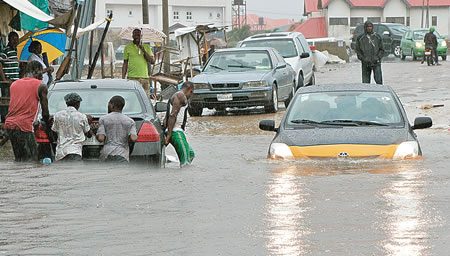
That’s now the case in Delta State as rains have begun to pour down across the state, the latest being that of Wednesday, April 2, where torrential rain and flood erosion along Old Lagos-Agbor Road, Boji-Boji Agbor in Ika South Local Government Area had a devasting effect on lives and property.
Eye witness account said people’s houses were affected, vehicles and motorcycles were also carried away by the heavy flood resulting in the calls on the state government to intervene and salvage the situation.

But reacting through Charles Aniagwu, commissioner for Works (rural) and Public Information, the state government sympathized with those who were affected by the rain and flood. He however called for community engagement and sustainable practices to safeguard lives and properties.
Aniagwu who made the call at a press conference in Asaba, Thursday, called for a collective positive action against natural disasters.
Residents, stakeholders, and organizations should take collective and proactive measures in mitigating the impact of natural disasters, he said.
He noted the increasing threats posed by flooding, erosion, and other environmental hazards and stressed the need for community engagement, preparedness, and sustainable practices to safeguard lives and property.
“We appeal to residents to adopt environmentally friendly practices, adhere to safety guidelines, and work together in building a more resilient Delta State.

“Yesterday (Wednesday), most of you saw and witnessed the very heavy downpour across the state and then the havoc it wreaked on some properties particularly vehicles and motorcycles in the Ika axis.
“I am sure it happened in other places but it wasn’t that devastating and we needed to address it for individuals to know what is expected of them even as government have continued to take actions to mitigate such occurrence.
“We are also happy that in Asaba the rain was also quite heavy but we did not see that level of disturbance. We have before now as a government been able to pay good attention to flood control measures.
“I am happy that all of you are very much aware of it that for majority of the roads we have constructed we ensure that we have dual drains.
“In some instances we have proceeded to build storm drainages. You are also very privy to the fact that this administration have also continued along that trajectory.
“Not long ago you accompanied the governor to inspect the storm drainage across the Ogbeogonogo market which is one of the eight phases of the outcome of a study that was carried out by the previous administration.
“Some of you also accompanied us to area behind the Asaba Specialist Hospital where you also saw a very huge drainage and another storm drainage.
“You are aware of the effort to complete the storm drainage in the Owa-Alero axis and the storm drainage we are building in the Osubi, Okuokoko, Ugolo-Okpe and the Warri axis in addition to the many side drains that we are building along the roads that we are constructing.
“But what we have seen in the course of time as a challenge which we have continued to also emphasize the need for people to become much more responsive and responsible in preventing flood.”
“I sympathize with some of our brothers and sisters whose motorcycles or vehicles were either destroyed or taken away by the flood.
“We have giant drains on both sides of that road to accommodate flood water whenever it rains quite heavily.
“Sometimes these things happen. I am sure in April last year all of you could recall what happened in Dubai of course you cannot see it was because they are not developed or they have not taken pain to control flood.
“You also remember sometime around October last year and November in Spain where splash flood even took away cars and swept away buildings.
Read also: Floods in the South, heatwaves in the North expose Nigeria’s climate crisis
“I am mentioning very advanced societies so that those who may want to now begin to take political advantage rather than joining us to seek ways of addressing these issues so that you don’t allow them to paint pictures that are at variance with reality.
“For quite a long time now as an administration, we have emphasized the need for our people to be very environmentally conscious.
He partly blamed residents, saying:
“Today, you see a number of persons when they come out from their homes, they heap refuse inside these drains hoping that the flood water would help to convey such debris to a natural water course.
“By the time you do that, you have also undermined the current capacity of that water channel to the estuaries and tributaries that feeds into these storm drainages.
“These tributaries that come from different shorter streets, smaller roads, have also been seriously undermined by human factors, even when government have spent billions of Naira building and constructing these drains.
“If you move out, you will see across different places how individuals are undermining the carrying capacity of the drains that were built by heaping refuse in these drainages.
“When they do so, like it’s often said, water must find its level. The moment you have undermined the capacity of a particular drain, it means that that water, in an attempt to find its level, will now take through certain courses, other than the ones that have been provided to channel the water.
“That is part of what happened in Agbor yesterday. It is true that the rainfall was quite intense, and such things could happen once in a while, thereby possibly outsmarting the capacity of the available drains.
“But those drains are big enough, over the years they have been able to accommodate water flow, but because a number of the tributaries that feed into these bigger drains have been seriously undermined by the activities of our people.
“Hence, you now see the water that would have flown through these smaller drains, that have been channeled to empty into these bigger drains, finding its way to the road itself.”