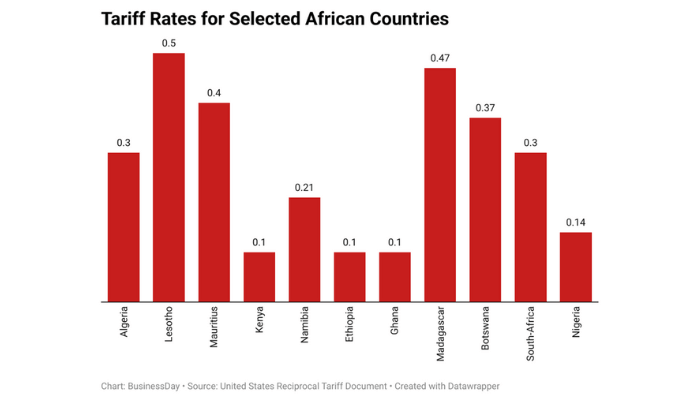
Nigeria faces a multimillion-dollar hike in export tariffs to the U.S. In 2023, Nigeria’s total trade exports to the U.S. were valued at $5.82 billion.
With the 14 percent tariff introduced in 2025, the country could have faced an additional $814.8 million in costs, according to BusinessDay.
If export values remain the same, this will be the impact. However, fluctuations in exports will change the cost proportionally, based on the 14 percent rate. This means that if export values rise or fall, the additional cost will adjust accordingly.
Can even a giant stumble? History shows that the most powerful nations can face unexpected challenges. Just as Goliath met his match with David, could the United States, already in trade disputes with over 25 countries, find itself grappling with the fallout of imposing a 14 percent tariff on Nigerian exports?

Read also: Iweala warns Trump’s tariffs could trigger global trade contraction
Paul Krugman, a Nobel laureate, has long warned that trade protectionism, while seemingly beneficial, is a “seductive but dangerous policy.” It creates the illusion of success, even as the broader economy suffers.
This insight rings true as the U.S. imposes a tariff on Nigeria and others, raising concerns about the economic fallout for both nations.
Muda Yusuf, CEO of the Centre for the Promotion of Private Enterprise (CPPE), suggests that Nigeria and Africa may not need to be overly concerned about the U.S. tariff imposition.
“By imposing this tariff, the U.S. risks limiting the economic benefits derived from its trade with Nigeria, particularly in sectors where American industries rely on Nigerian exports.”

He points out that the bulk of Nigeria’s trade is with Asian countries and Europe, with relatively limited trade volume with the U.S. Yusuf believes that since Nigeria and most African countries are not major trading partners of the U.S., the impact of the tariffs may be minimal.
Bismarck Rewane, CEO of Financial Derivatives Company (FDC), described the tariff as “extremely destructive” in an interview with Arise News.
His view echoes the wisdom of classical economist David Ricardo, who believed that trade allows nations to share resources, innovations, and efficiencies.
Ngozi Okonjo-Iweala, Director-General of the World Trade Organisation (WTO), has emphasised the severe repercussions of escalating trade tensions. She cautioned that retaliatory trade wars, reminiscent of those in the 1930s, could lead to substantial global GDP losses, urging nations to seek resolution through established WTO mechanisms rather than engaging in tit-for-tat measures.
By imposing this tariff, the U.S. risks limiting the economic benefits derived from its trade with Nigeria, particularly in sectors where American industries rely on Nigerian exports.
The numbers behind the trade
The tariff’s impact on Nigeria’s economy is becoming evident. Over the past five years, Nigeria’s exports to the U.S. grew at a modest pace of 1.59 percent annually, from $5.81 billion in 2018 to $6.29 billion in 2023.
Read also: Global stocks extend plunge with deepening US tariff fears
However, Nigeria’s export portfolio remains heavily reliant on oil, with oil products accounting for 92.3 percent of its exports to the U.S. in Q2 2024. This dependence exposes a critical vulnerability; Nigeria has yet to diversify its trade beyond crude oil and related products.
Nigeria’s key exports to the U.S. in 2023 were as follows: crude petroleum valued at $4.73 billion, petroleum gas at $920 million, nitrogenous fertilisers at $167 million, agricultural products such as cocoa, cashew nuts, and animal feed, and other exports including coffee, tea, spices, rubber, and more.
Recent data from September 2024 reveals a concerning decline in Nigeria’s exports to the U.S., dropping sharply from $629.19 million in August to $124.86 million in September, a drop that coincides with the new tariff.
This further underscores the tariff’s potential negative impact on Nigeria’s export sector.
Winners and losers in the new trade landscape
For Nigeria, the 14 percent tariff is a significant setback. The country has been working to expand its non-oil exports, particularly in agriculture and manufacturing.
However, the government must move quickly to transform its economy, rather than just talk about change. Global shocks such as the COVID-19 pandemic, climate change effects, the Ukraine-Russia conflict, and now the 2025 trade war have already posed challenges.
How much longer can Nigeria afford to be held back by these global disruptions?
Read also: Trump pauses US tariff on Mexico for a month after border agreement
The tariff could complicate Nigeria’s efforts to boost non-oil exports, with a sharp decline in demand for Nigerian products in the U.S. as seen in the 80.16 percent drop in exports from August to September 2024.
With the tariff increase, exports could decline further. As a result, the Nigerian government will likely face growing pressure to seek new trade partnerships and diversify its economic base.
For the U.S., the tariff aims to protect domestic industries, but the consequences may not be as beneficial as expected. U.S. businesses relying on Nigerian raw materials could face higher costs, potentially raising prices for American consumers.
Moreover, as Nigeria seeks to strengthen ties with China and Europe, the U.S. risks losing its influence in West Africa, a region rich in resources and economic potential.
Policy shifts and the road ahead
“Nigeria will likely respond by seeking alternative trade agreements or lobbying for exemptions on key products,” says Idris Oyekan, a capital market analyst.
He adds that in the long term, Nigeria may increasingly turn to China, Europe, and other emerging markets, reducing the U.S.’s economic leverage in West Africa.
For the U.S., the tariff raises an important question: Is the pursuit of protectionism truly worth the potential economic costs?
While the policy may protect some domestic industries, it risks damaging broader economic growth, particularly as the U.S. is already engaged in trade tensions with several other nations.
As the dust settles, one thing is clear: trade protectionism comes with risks that often outweigh its benefits. The 14 percent tariff on Nigeria could very well cause more pain than gain, not just for Nigeria but for the U.S. economy as well.
Read also: Nigerian importers want reversal of Trump’s tariffs on China
Whether this move ultimately pays off for either nation remains to be seen, but both countries would do well to consider the broader economic implications before doubling down on protectionist policies.
Oluwatobi Ojabello, senior economic analyst at BusinessDay, holds a BSc and an MSc in Economics as well as a PhD (in view) in Economics (Covenant, Ota).