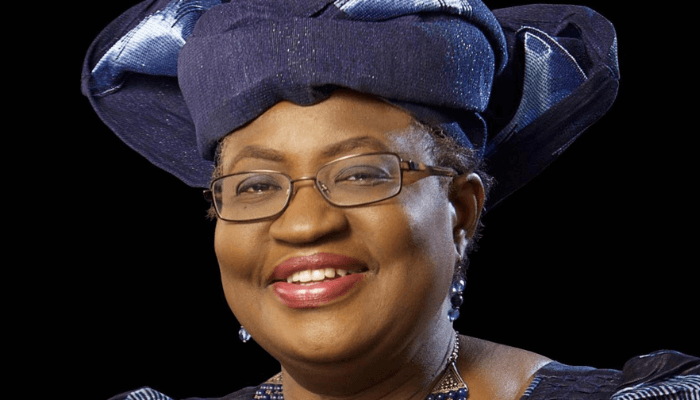
Ngozi Okonjo-Iweala, director-general of the World Trade Organisation (WTO), has warned of a looming contraction in global merchandise trade following sweeping tariffs announced by U.S. President Donald Trump.
In a statement issued on Friday, the WTO chief warned that the rapidly escalating situation could push the world deeper into economic uncertainty and fuel a full-blown trade war.
“The recent announcements will have substantial implications for global trade and economic growth prospects,” Iweala said. “Our initial estimates suggest that these measures, coupled with those introduced since the beginning of the year, could lead to an overall contraction of around one percent in global merchandise trade volumes this year, representing a downward revision of nearly four percentage points from previous projections.”
Despite the downturn, she stressed that most global trade still operates under WTO rules. “The vast majority of global trade still flows under the WTO’s Most-Favored-Nation (MFN) terms. Our estimates now indicate that this share currently stands at 74 percent, down from around 80 percent at the beginning of the year.”

The WTO chief urged member states to act responsibly and avoid an uncontrolled spiral of retaliatory measures. “Trade measures of this magnitude have the potential to create significant trade diversion effects. I call on Members to manage the resulting pressures responsibly to prevent trade tensions from proliferating.”
Read also: Nigerians importers want reversal of Trump’s tariffs on China
Okonjo-Iweala reaffirmed the WTO’s role as a mediator in times of rising tensions, urging member countries to use the organisation’s platform to engage constructively.
“The WTO was established to serve precisely in moments like this, as a platform for dialogue, to prevent trade conflicts from escalating.”
But it might be a little too late.

The warning came just hours after Trump unveiled a barrage of new tariffs targeting a wide swathe of countries. In addition to a 10 percent baseline duty set to take effect from April 5, the United States will begin charging sharply higher rates from April 9.
China was charged with 34 percent on imports, 20 percent on the European Union, 25 percent on South Korea, 24 percent on Japan, and 32 percent on Taiwan.
China has responded with 34 percent retaliatory tariffs on U.S. imports as projected by economists, fuelling a trade standoff.
African nations have also been drawn into the tariff dragnet. Up to 40 countries on the continent feature in Trump’s preliminary tariff list, including Nigeria, which faces a 14 percent tariff. Lesotho, a small southern African country, was hit with as much as 40 percent.
At a White House briefing, Trump defended the decision in a typically combative fashion. “Our country has been looted, pillaged, raped, plundered,” he said. “Taxpayers have been ripped off for more than 50 years. But it is not going to happen anymore.”
Okonjo-Iweala had issued early warnings at the World Economic Forum in Davos in January, when Trump’s threats were still taking shape.
“The tit-for-tat tariff war between countries will have serious consequences on global GDP,” she had cautioned at the time. “We would end up with a 6.4 percent loss in global real GDP in the longer term — it’s like losing the economies of Japan and Korea combined.”
She also referenced a dark historical parallel: the Smoot-Hawley Tariff Act of 1930, which raised U.S. duties on over 20,000 imports. Rather than lifting the economy, the protectionist wave deepened the Great Depression.
“We’ve been here before,” she said. “Instead of boosting the U.S. economy, it worsened the economic downturn by decreasing international demand for American goods.”