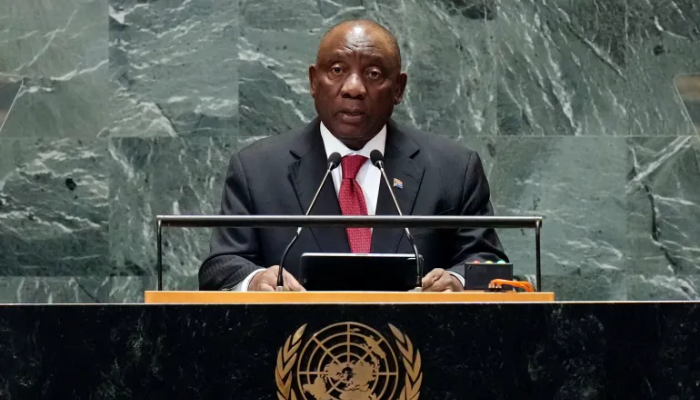
South Africa’s ruling coalition risks unraveling after a dispute between its main members over proposed tax increases deepened, pummeling the rand.
Tensions within the alliance were already running high because of disagreements over a series of contentious laws and exploded after the fiscal framework, which underpins the budget and incorporates a proposal to raise the value-added tax rate, was approved by the National Assembly late Wednesday.
The Democratic Alliance, the second-biggest party in the so-called government of national unity, rejected the move as unprocedural, filed a legal challenge against it and held an initial 90-minute meeting of its top leadership on Thursday to discuss its future participation in President Cyril Ramaphosa’s administration. The discussions are ongoing and a final decision will only be taken once the High Court rules on the lawsuit, which could take some time.
“We are considering options after yesterday,” DA leader John Steenhuisen said by text message on Thursday. His party has rejected tax hikes and called on the National Treasury to do more to fire up the economy and review its spending plans.
The political uncertainty has unnerved investors and weighed on the rand. The currency weakened 2.3% against the greenback on Wednesday — its biggest single-day drop since August 2023. It traded 0.9% higher at 18.7144 by 4:53 p.m. in Johannesburg on Thursday.

Read also: South Africa condemns U.S. expulsion of Ambassador, calls for diplomatic courtesy
“The unprecedented budget impasse has shaken confidence in South Africa’s fiscal stability and put the GNU coalition on thin ice,” said Jervin Naidoo, a political analyst at Oxford Economics. “Growing pains were to be expected, but the way things have played out with the budget erodes the policy predictability many expected under the GNU.”
Ramaphosa formed a coalition after his party, the African National Congress, lost its parliamentary majority in last year’s elections. The marriage has been an uneasy one, with the ANC favoring a bigger role for the state in the economy and the DA pushing for more private-sector involvement and changes to health, education and land-expropriation laws.
“We know that whatever decision we take will have profound implications for South Africa and for our economy,” Helen Zille, chairperson of the DA’s Federal Council, told reporters outside the High Court in Cape Town, where the party filed its lawsuit challenging both the adoption of the fiscal framework and the VAT hike. “So we’re not rushing into anything. We are going to consider all the options, look at all the consequences, and try to predict the unintended consequences, and then make a rational decision on the basis of those.”
Should the DA go into opposition, the coalition would lose it parliamentary majority and the ANC would need to enlist the support of other rivals to retain power. While that could potentially open the door to the the leftist Economic Freedom Fighters or former President Jacob Zuma’s uMkhonto weSizwe Party, both have also voiced their opposition to VAT increases.
The ANC is prepared to work with all parties and won’t force the DA out of the government, said Gwede Mantashe, the ANC’s chairman.