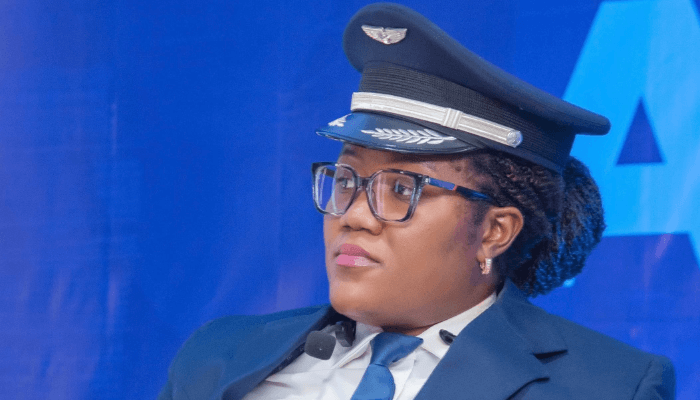
Ibironke Rotimi-Olajide is a captain flying for Air Peace. She is also the first female pilot and captain in Africa to fly the E195-E2 aircraft.
The E195-E2 is designed to maximise efficiency and returns on high-density routes, offering a good balance of capacity and range.
The E195-E2 incorporates sophisticated aerodynamics, novel wing design, and new technologies, making it an aircraft many pilots aspire to be type rated on.
It’s significantly more fuel-efficient than previous generations of the E195, resulting in lower fuel consumption and CO2 emissions.

In an interview with Rotimi-Olajide she said she has been flying for over a decade and married with two children.
She shares some of her success stories as a pilot. “There have been successes I’ve achieved, like becoming the first female to fly the E195-E2 aircraft in Africa. It’s a huge feat for me.”
She however hinted that there is a subtle discrimination when it comes to women in the industry. “It’s there, whether some people see it or not, but it’s there, it’s subtle. However, it’s not something that they’re going to write down. “There’s no profession that is just tailored for the male counterpart. So, if a female feels that she can thrive there, why not? She’s welcome to join that industry. I’ve gone through those challenges from the start, from my training, all the way to this point,” Rotimi-Olajide said.
She said part of the sacrifices female pilots make on the job is that they usually stay longer on jobs before thinking of moving to another job.
Read also: Embraer deepens capacity in Nigeria’s aviation sector with mentorship programme

“For instance, if I want to move somewhere, and then I see the kind of rotation the airline has, maybe I have to work for two months on, one month off; the next thing that comes to my mind is, ah, where will my children be if I accept this job?
“So, I’ll probably have to think of moving there with my children. So, by the time you think about all those movements, you made use to just stay back except they have a good plan about the movement and relocating, then the female pilots can now move,” she explained.
Speaking on the reducing number of pilots globally, Rotimi-Olajide said more people need to come into the industry to take up the piloting job.
She advised aspiring female pilots to avoid the fear factor and pursue their dreams, acquire knowledge and skills irrespective of the prevailing challenges.
“You mustn’t start from being a pilot. There are other places one can start. You can start as a cabin crew, a flight dispatcher and other fields, then gradually progress to becoming a pilot. “Once a pilot gets to a certain age, the person has to retire and leave the business. So, we need younger people to fill up those positions, so that we’ll have pilots. Because Nigeria is expanding, airlines are coming up right now, as we’re talking, so we need more pilots,” Rotimi-Olajide said.
She said because there is a limited number of aircraft maintenance facilities in Nigeria as some airplanes need to be ferried to other countries for repairs, this continued to affect the schedules, generally. “To be honest, if we have maintenance organisations here in Nigeria, it’s going to be quite expensive running them here. You know, bearing in mind the situation of your country, you need lots of things, like cost of electricity, manpower and the equipment amongst others.
“I believe that with time, things are going to get better. Aero contractors maintain aircraft, but the truth is that they can’t maintain all types of aircraft. For instance, they do not have the facilities to handle the maintenance of the Embraer 195 aircraft.