|
Getting your Trinity Audio player ready...
|
Beneath the grand dome of Nigeria’s Senate, where power and performance often collide, another political drama unfolded, complete with posturing, grandstanding, and a captive audience hungry for drama.
At the heart of this latest episode was Senator Natasha Akpoti-Uduaghan’s sexual harassment petition against Senate President Godswill Akpabio, a case long buried in the legal graveyard but dragged back to life, kicking and screaming, for one more chaotic showdown.
For weeks, the Senate has clutched its metaphorical rosary, chanting the sacred phrase: “The matter is in court; we cannot sit on it.” And yet, like a stubborn shadow at sunset, the petition followed them relentlessly, championed by Natasha and her camp, who seemed determined to make the Senate break its own rules.
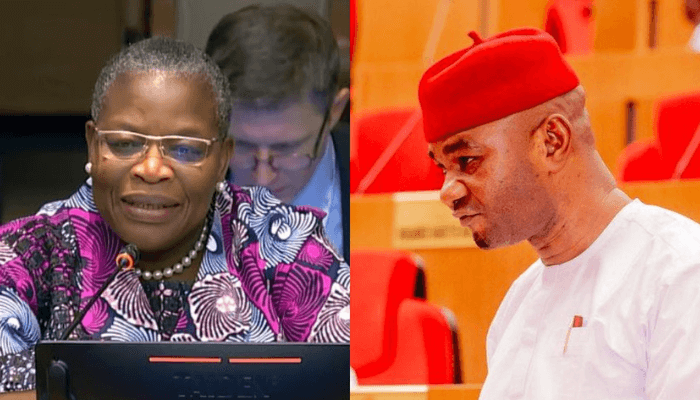
The arrival of former Minister of Education, Oby Ezekwesili, to the Senate hearing was nothing short of a battle march.

Alongside legal counsel Abiola Akiyode and petitioner Zuberu Yakubu, they came, not with open minds, but with sharpened words and preloaded indignation, ready to conquer what they perceived as enemy territory.
Yakubu, the brave messenger of the petition, stood before the Senate Committee on Ethics, Code of Conduct, and Public Petitions, but refused to speak until Natasha, his principal witness, who was suspended and barred from entering the National Assembly for six months was physically present.
His reason? “If the chairman has already declared the petition ‘dead on arrival,’ how can we expect fairness?”
A noble concern, perhaps, if not for the minor detail that the committee had repeatedly informed him that the matter was outside their jurisdiction.
The drama escalated when the committee moved to its standard procedure, administering an oath before testimonies.
This simple act, a tradition as old as the Senate itself, became the first battleground. Ezekwesili and her comrades, possibly fearing that swearing an oath would rob them of their revolutionary powers, refused.
The standoff was reminiscent of a school principal asking a group of rebellious students to recite the national pledge. It wasn’t until the session had descended into chaos; shouting matches, accusations, and enough verbal fireworks to light up Abuja that Ezekwesili, having achieved the reaction she desired, after telling Onyekachi Nwaebonyi, the Senate Whip “hooligan, shut up,” finally agreed to take the oath. By then, the damage had been done.

Senator Nwaebonyi, witnessing the deliberate provocation, flared up like a malfunctioning generator. “You’re a fool, you’re an insult to womanhood!” he roared.
Ezekwesili, never one to back down, fired back, labeling him a “hooligan.” Thus, what should have been a sober petition hearing morphed into an episode of a poorly scripted reality show, with both sides flinging verbal grenades.
The public, watching the spectacle, was left wondering if legislative ethics included a boxing ring.
Meanwhile, outside the Senate’s grand drama, another subplot was brewing.
The Independent National Electoral Commission (INEC) had been painstakingly navigating the labyrinth of Nigeria’s electoral laws in an attempt to verify a petition for Natasha’s recall.
Senator Natasha Akpoti-Uduaghan’s woes did not start with this petition. Her suspension from the Senate was met with a recall process that looked more like a revenge mission than a legitimate exercise of democracy.
INEC, ever the diligent referee in this elaborate match of political football, confirmed that it had received a petition from “concerned constituents” who wanted her removed.
Their grievances? “Gross misconduct, abuse of office, evasion of due process…”all beautifully generic accusations that could apply to at least 80% of the Senate, yet somehow, Natasha was the only one on the chopping block.
But alas, the petitioners had omitted one crucial detail: their contact information. Without this, the entire process was as effective as sending a letter without an address.
How does one gather “over half” of 474,554 registered voters to sign a petition but forget to provide a simple phone number? It’s either a stroke of administrative incompetence or an unconvincing ruse to buy time.
Either way, the recall process had become yet another political tool wielded against the lawmaker.
When INEC finally received the necessary details on Tuesday, they promptly said they would begin verification of signatures, promising a process that was “open and transparent.”
Transparency in Nigerian politics? Now that’s satire in itself. At the heart of this saga, beyond the theatrics and legal gymnastics, lay a deeper question: What, exactly, was feminism in Nigeria becoming? Once a noble cause for gender equity, it seemed to be tilting towards a new sport, bringing down people at all costs, once they refused to follow your line of thought.
A serious case of sexual harassment, if genuinely pursued, deserved thorough legal scrutiny, not a media circus fueled by confrontation and agenda-driven outrage.
Yet, in recent times, feminism in Nigeria has evolved into an all-out war, where men are presumed guilty by default and the courtroom of social media renders judgments before due process can even take its first breath.
The Senate, for all its flaws, had its rules. The judiciary had its role. And yet, Natasha’s camp demanded that the Senate ignore its own regulations and wade into judicial waters, not in the name of justice, but of pressure.
When they refused, the response was to label the institution as compromised. But one must wonder—if justice is truly the goal, why demand a flawed process?
Of course, this is Nigeria, where political sagas rarely end with a satisfying conclusion.
The Senate, tired of being harassed over a case they had no legal standing to adjudicate, dismissed the petition again.
Ezekwesili and her camp, having already secured their dramatic highlight reels, left the chambers victorious in their own minds. And Akpabio, despite all the noise, remained Senate President.
As the issue keeps dragging, Nigerians were left to reflect on the circus that had just unfolded. Was it about justice? Was it about power? Or was it, as is often the case, simply another episode in the grand soap opera that is Nigerian politics?
One thing is certain: whether in the courtroom, the Senate, or the streets or Twitter, the battle for truth will always struggle against the allure of drama.
And so, the show goes on.