The battle to save humanity from climate change harms and the campaign for environment justice has found a missing link; faith leaders.
This is as climate activists have found that climate action is a moral duty, and that now is the time to unite and fight. They have thus recommended the aggressive involvement of religious leaders across faiths to take over the advocacy because in each community, various religious groups exist and control the minds and moral compass of the people.
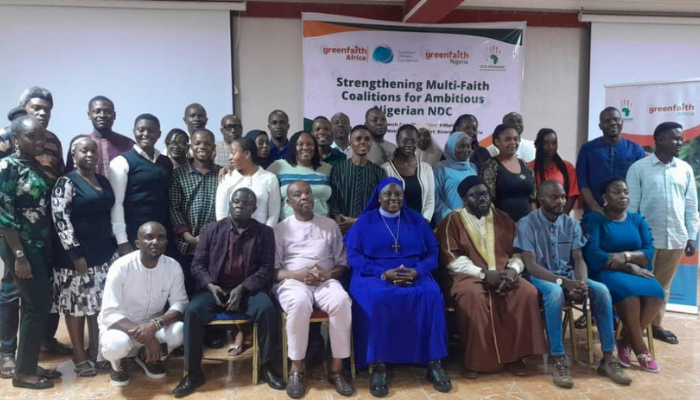
Thus, in Port Harcourt, Rivers State, religious leaders from different faiths gathered for the multi-faith dialogue on ‘Strengthening Grassroots Coalitions for an Ambitious Nigerian NDC’, a meeting aimed at uniting faith communities to push for stronger climate policies in Nigeria.
The dialogue, led by GreenFaith Africa, highlighted the urgent need for religious leaders to use their influence to advocate for climate justice, a just energy transition, and the phasing out of fossil fuels.

GreenFaith Global Programme Director, Meryn Warah, stressed the importance of faith communities in shaping climate policies.
“Faith leaders have a unique moral authority. They can bridge the gap between policy and grassroots action, mobilising their communities to demand stronger climate commitments from the government,” she stated.
Nigeria’s vulnerability to climate change is undeniable, they said. From the desertification of the North to the rising sea levels and oil spills devastating the South, environmental challenges are worsening poverty, food insecurity, and displacement.
Lilian Chibiko, a revered sister, reminded participants that faith-based organisations must act now. “Our values of compassion, justice, and stewardship transcend doctrines. Together, they can become the foundation of a more just and sustainable Nigeria”.
Read also: Ekiti deepens afforestation, distributes seedlings to schools for environmental conservation

The event also served as a training ground, equipping faith leaders with the knowledge and tools needed to engage with policymakers.
GreenFaith Africa’s Programme Manager, Pius Oko emphasised, stressed the need for direct advocacy. He recalled that politicians tap support from religious leaders and their followers, and this must now be translated to push for policies in renewable energy and climate justice.
He also said faith leaders were often the first responders in times of crisis, offering shelter and support to those displaced by floods, desertification, and other climate disasters. They can now take advocacy on this.
One of the key action points was the formation of an ‘Interfaith Climate Action Platform’, where faith leaders and policymakers can meet regularly to discuss environmental issues and hold the government accountable.
There was also a call for religious institutions to lead by example by adopting solar panels and other renewable energy solutions in churches and mosques.
According to Oko, beyond policy advocacy, they are also demanding justice for communities affected by decades of environmental destruction. In the Niger Delta, oil spills have left lands uninhabitable and waters undrinkable.
“This means a total clean-up of affected areas and reparations for the communities that have suffered.”
Also, faith leaders have taken their advocacy beyond Nigeria. They have engaged the Japanese Parliament and other international bodies, urging them to stop funding fossil fuel projects in Africa. “What they call development is actually displacement and destruction,” said Oko.
“Instead of financing drilling and mining, they should support sustainable agriculture, which is the backbone of African livelihoods.”
For many participants, the dialogue was an eye-opener. Aisha Moore, a representative of the Rivers State Council for Islamic Affairs (Women’s Wing) said she gained huge insight in the training that she can give to the grassroots.
As the discussions concluded, the faith leaders reaffirmed their commitment to fighting for a Nigeria where climate policies are not just written but truly implemented.