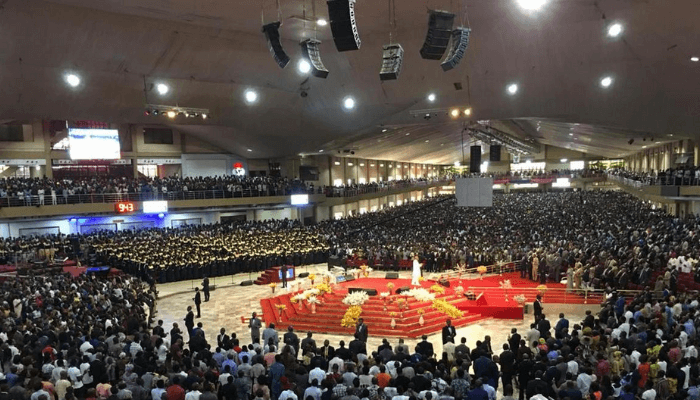
Churches are increasingly leveraging large online followings to fill stadiums and halls, highlighting technology’s impact on religious community growth.
The year was 2020, and the world was in lockdown when Oluwabori Quadri joined the New Season Prophetic Prayers and Declaration (NSPPD) morning prayers for the first time. Like many others, the morning prayers were a way to make sense of the uncertainty that had engulfed the world.
“There were no movements, and people kept sharing the link on their WhatsApp status, so I joined. At first, it was just to pass time, but soon it began helping me in other ways,” she said.
For Tinuke Akintayo, joining Next Level Prayers (NLP) during the COVID period was a way to stay connected with fellow Christian believers. “It was a strange time. Church gatherings were restricted or closed. Joining morning prayers became part of my daily routine,” she said.

Quadri and Akintola are among the many Nigerians who turned to online morning prayers in 2020 and have not looked back. That year, the world was grappling with the COVID-19 pandemic, and lockdowns and social distancing were enforced globally.
Read also: Lagos Church, Dominion City, proposes N1bn support fund for entrepreneurs
Many Nigerian churches, like their global counterparts, pivoted online. “We should just be thanking God that we have the internet now and we can be relating without meeting together,” said Sam Adeyemi, senior pastor of the Daystar Christian Centre, in 2020.
Live streaming, the process of broadcasting video and audio content over the internet in real-time, became the norm. YouTube emerged as the platform of choice, allowing viewers to catch up on missed broadcasts. This shift propelled morning prayer programmes like Pastor Bolaji Idowu’s Harvesters International Christian Centre’s NLP and Pastor Jerry Eze’s Streams of Joy International’s NSPPD into the limelight.
In a 2022 interview with CNN, Eze had described his rise to prominence as accidental. “It wasn’t a goal to reach the world. During the (peak of) COVID-19, there was a palpable fear everywhere and I noticed that a lot of my church people were very scared of coming around the church. So, every morning, my wife and I would come online, spreading encouragement to people,” he said.

NSPPD’s catchphrase ‘What God cannot does not exist,’ has since become prominent. “You couldn’t escape it, it was everywhere on people’s statuses in the morning,” said Victoria Adebiyi, who is a regular listener of the Streams of Joy International’s NSPPD.
High YouTube subscriptions
The newfound popularity of online prayers has skyrocketed YouTube subscription numbers. Pastor Jerry Eze’s channel, which streams NSPPD live, has amassed 2.53 million subscribers in just five years since its launch on November 21, 2019, according to MW Metadata. To date, it has accumulated 539.81 million total views from 2,626 videos.
HarvestersTV, which streams NLP, has 369,000 subscribers and 47.79 million total views from 3,430 videos.
As of Friday, March 21, 2025, Pastor Jerry Eze channel and HarvestersTV ranked as the top two Nigerian YouTube channels with the most live viewers, attracting 219,155 and 109,617 viewers respectively, according to the analytics tool, Playboard.
Generally, Nigeria’s streaming numbers have surged since the pandemic, increasing from 125,149.86 terabytes (TB) in December 2019 to 1,000,930.60 TB in January 2025. A large part of this growth has been driven by video streaming.
The GSMA, a global telecom industry body, noted that approximately 58 million Nigerians – about 29 percent of the population – use mobile internet, and 75 percent use it for free online videos. YouTube, the largest free video platform, attracts over 30 million people in Nigeria aged 18 and above.
“Tapping into this expanding audience is crucial for today’s church,” said Tejumoluwa Taiwo, lead pastor of Word Impact Community Church.
Packed arenas
Even as COVID restrictions have been lifted, online morning prayers continue to thrive, with their organisers now hosting occasional large-scale physical prayer conferences, bringing their online audiences into physical venues.
These conferences are being held locally and internationally. In 2023, NSPPD reportedly drew 70,000 worshippers to the Excel Arena London, the United Kingdom, for a two-day prayer conference. Another 30,000 reportedly gathered at George Brown Event Centre in Houston, Texas, United States, for the NSPPD USA Prayer Conference. Viewers from the UK and the US collectively make up 25 percent of Eze’s livestream audience, according to CNN.
In 2022, NLP reportedly hosted 2,500 worshipers at The Lighthouse on Camberwell Road in London for a prayer conference. NLP conferences have since expanded to the US and Canada. In 2024, NSPPD held a prayer conference at Twickenham Stadium in the UK, while NLP gathered worshippers at OVO Arena Wembley in London.
These international conferences attract large numbers of Nigerian immigrants, who contribute significantly to the online prayer audience. “I attended the NLP London conference last year, and it was packed. I even volunteered,” said Aramide Akanni.
Read also: Cleric says 21st century Church must demonstrate practical love for greater impact
“I don’t stream the prayers, but many of my friends in the UK do. They post links on their status every morning,” said Bisola Ayoola.
This year, both NSPPD and NLP have hosted prayer conferences at Tafawa Balewa Square in Lagos, drawing massive crowds. “I attended the NSPPD conference, and it was jam-packed,” said Lisa Esifio.
“The Next Level Prayer conference also had a huge turnout,” added Adebiyi, earlier quoted.
NSPPD is now planning a conference in Zambia in April, further cementing its global reach. “Streaming platforms have given these morning prayers unprecedented exposure, leading to significant church growth. It’s a numbers game; the wider your audience, the more people you can reach,” explained Victor Onofomi, a pastor and data analyst.
Beyond NLP and NSPPD, religious institutions have fully integrated streaming into their services, tapping into a wider audience and the shifting behavioural pattern of their congregation.
Nine of the top 10 Nigerian YouTube channels with the most live viewers do church-related activities. “There is a larger audience online,” added Onofomi. “COVID-19 was the beginning of many aspects of our lives.”