Nigeria’s political landscape has once again been upended, this time by President Bola Tinubu’s declaration of a state of emergency in Rivers State. The move, ostensibly aimed at restoring order, appears instead to be a calculated power play—one that threatens not only regional stability but also the integrity of the nation’s democratic institutions. At a time when the country struggles with an economic crisis of historic proportions, the administration’s decision to stoke political unrest is as reckless as it is revealing.
“If the Rivers crisis is allowed to spiral unchecked, its impact will reverberate far beyond state boundaries, setting a precedent that could weaken the federation’s delicate balance of power.”
Beyond political conspiracy, this disruption has far-reaching effects. The perceived explosions in the Niger Delta’s creeks run the risk of making Nigeria’s already unstable financial situation worse. With crude oil production stagnating at around 1.5 million barrels per day and global prices fluctuating between $70 and $77 per barrel, any disruption to output could push the economy into deeper distress. A nation already burdened by inflation, job losses, and dwindling investor confidence can ill afford a fresh wave of militant activity. Tinubu’s grand ambition of a $1 trillion economy by 2031, always a long shot, is now at risk of becoming an economic mirage.
At the heart of this crisis lies a fundamental miscalculation—one that speaks to the administration’s growing desperation. Having alienated key Northern political blocs with policies widely perceived as economically ruinous, the presidency now scrambles to consolidate influence in the South, deploying a strategy that is as brazen as it is destabilising. By exerting relentless pressure on opposition governors and orchestrating forced political realignments, the administration reveals a leader more preoccupied with electoral arithmetic than the urgent demands of governance.

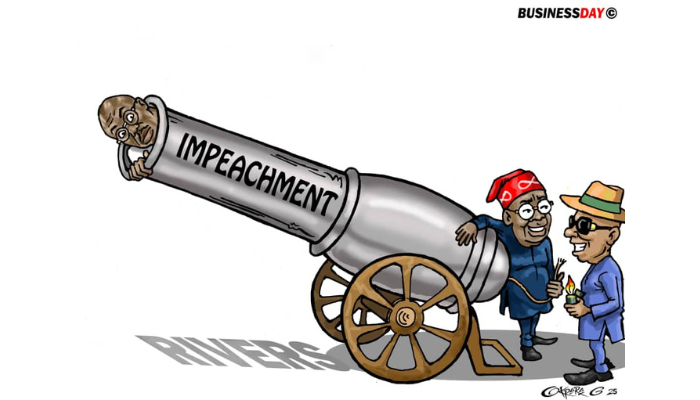
The recent dismissal of Governor Siminalayi Fubara and the Rivers State House of Assembly, cloaked under the guise of restoring order, represents a chilling exercise in executive overreach—one that raises urgent constitutional and democratic concerns. This is not merely a test of political muscle; it is a full-fledged assault on the institutional independence of subnational governments, setting a dangerous precedent for future administrations. The optics are unmistakable: a president willing to erode the very foundations of federalism and constitutional democracy in a desperate bid for political survival. If unchecked, this power grab could mark the beginning of an era where the rule of law is subordinated to political expediency, and governance becomes little more than a tool for consolidating personal power.
Read also: Echoes of the past: Has Tinubu betrayed Nigeria’s democratic principles?
The broader implications of this approach cannot be ignored. History has demonstrated that heavy-handed tactics in the Niger Delta have rarely yielded positive outcomes. The late President Umaru Yar’Adua, recognising the volatility of the region, pursued diplomacy and consensus-building, ultimately brokering an amnesty deal that helped stabilise the area.
Nigeria stands at a crossroads, facing a pivotal moment that will test the strength of its democracy and the resilience of its institutions. If the Rivers crisis is allowed to spiral unchecked, its impact will reverberate far beyond state boundaries, setting a precedent that could weaken the federation’s delicate balance of power. The erosion of democratic norms, the undermining of constitutional processes, and the weaponization of political authority could push the nation further into instability at a time when economic uncertainty and social discontent are already at an all-time high.
The fragility of Nigeria’s democratic framework, the sustainability of its economy, and the credibility of its leadership are all on the line. If President Tinubu continues to prioritise coercion over consensus, intimidation over dialogue, and short-term political gains over long-term national stability, the consequences could be dire—deepening distrust in government, fuelling regional divisions, and triggering a cycle of political brinkmanship that weakens the very foundations of the republic.

Yet, there is still an opportunity to change course. Leadership is not merely about securing power but about preserving the institutions that ensure governance outlives any single administration. Tinubu must recognise that true political strength lies not in forcing submission but in fostering unity, not in suppressing dissent but in embracing the diversity of voices that define Nigeria’s democracy.
Generations to come will be influenced by the decisions taken today. History will not be kind to those who choose their own aspirations over the interests of their country, and the world is watching. Because Nigeria’s future depends on it, the moment has come for statesmanship rather than strongman tactics.