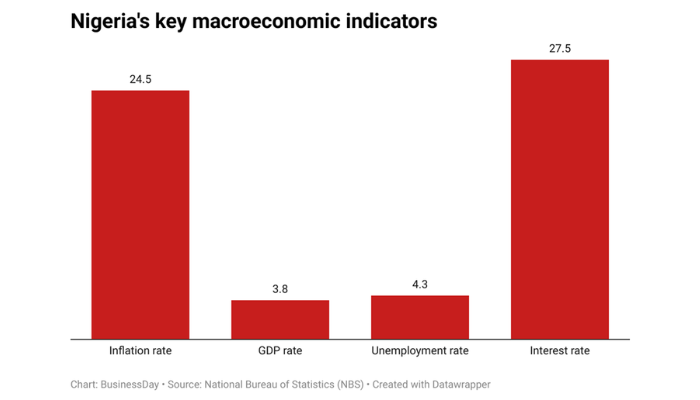
Nigeria’s economy appears to be turning a corner. GDP is rising, inflation is cooling, the naira is gaining ground, and unemployment is falling. But beneath these promising numbers, a crucial question remains: is this a genuine recovery, or just another fleeting rebound?
“Yet for investors, the real issue isn’t the numbers themselves but whether they signal a stronger, more investable business environment or just another fragile rebound.”
Despite these improvements, the Central Bank of Nigeria (CBN) has held interest rates steady at 27.5 percent, following a series of hikes totalling 875 basis points in 2024 to combat high inflation.
Experts warn that lowering rates too soon, before inflation is fully under control, could lead to economic instability similar to Turkey’s recent experience.
On the surface, Nigeria appears to be on a recovery path. But is this momentum strong enough to drive real, lasting economic progress, or is it just another short-lived surge?

Nigeria’s GDP growth is happening, but at a slower pace

In 2024, Nigeria’s economy grew for four consecutive quarters. However, this expansion was slower than in 2023, despite a transition between two administrations, according to the National Bureau of Statistics (NBS).
GDP rose by 0.86 percentage points from Q1 to Q4 2024, compared to a 1.15 percentage-point increase in 2023. While this indicates growth, the slower pace raises concerns about whether businesses and households are truly benefiting.
Notably, Nigeria recorded a 3.84 percent GDP growth in Q4 2024, up from 3.46 percent in Q3, showing resilience, marking the highest quarterly rate in the post-COVID era.

Yet for investors, the real issue isn’t the numbers themselves but whether they signal a stronger, more investable business environment or just another fragile rebound.
A growing economy that’s not creating enough jobs
Nigeria’s economy presents a paradox. Growth is accelerating, driven primarily by the services sector, which expanded by 5.37 percent and now accounts for 57.38 percent of GDP.
Financial services, telecommunications, and trade were the biggest contributors, with financial institutions growing by 27.78 percent. While this expansion is commendable, it has a significant flaw—it does not create enough jobs.
Sectors that employ the largest share of Nigeria’s workforce are either shrinking or growing at marginal rates. Agriculture, a crucial sector in a country battling high food inflation, grew just 1.76 percent, down from 2.10 percent in 2023.
Manufacturing, essential for industrial expansion, inched up by only 1.79 percent—showing little progress in boosting local production.
Even the oil sector, once Nigeria’s economic backbone, grew by just 1.48 percent, reflecting deep structural weaknesses in production and exports.
As one developmental economist at a leading private university in Nigeria put it, “When key industries like manufacturing and agriculture lag, economic growth becomes just a statistic, with little impact on the daily lives of most Nigerians.”
Read also: Nigeria’s GDP Rebasing: A case for the simplification of the land registration process
Foreign investors are returning, but will they stay?
Reforms have drawn investors back, but the real test is retention—will they stay for the long haul, or is this just a short-term bet?
Nigeria has long struggled to attract sustained foreign investment due to policy uncertainty, currency instability, and a difficult business environment.
While recent reforms have encouraged capital inflows, inflation remains a key concern. The easing of inflation, partly due to rebasing, raises another question: Is this a lasting trend or just a temporary dip?
Investors are watching closely to see whether inflation remains under control. At the same time, high interest rates—while necessary to keep inflation in check—are making borrowing expensive, limiting growth for businesses outside the financial sector.
Is this economic growth sustainable?
For Nigeria’s economic expansion to translate into real investor confidence, stronger fundamentals are essential. Persistent power supply issues continue to inflate business costs, as reflected in the energy sector’s 5.04 percent contraction.
Similarly, the construction sector grew by just 2.95 percent, highlighting sluggish infrastructure development—an area critical for long-term stability.
Despite these challenges, Nigeria is moving in the right direction. However, sustaining this momentum will require decisive reforms.
Olusegun Omisakin, CEO of the Nigerian Economic Summit Group (NESG), forecasts that Nigeria’s GDP growth rate will reach 5.5 percent, stressing that stability-focused policies are key to maintaining progress.
His outlook underscores the need for consistent policy execution to ensure that economic growth translates into real opportunities for businesses and households.
A similar sentiment is echoed by the Professional Update Forum, a group of economists and seasoned finance experts based in Lagos: “Nigeria must focus on stabilising the exchange rate, improving access to foreign exchange, reducing regulatory bottlenecks that hinder business operations, and investing in energy, transportation, and industrialisation to create a more productive economy.”
Without such reforms, experts warn, GDP growth will remain just a number rather than a driver of real economic transformation.
Without such reforms, experts warn, GDP growth will remain just a number rather than a driver of real economic transformation.
Numbers alone won’t bring investment
Nigeria’s 3.84 percent GDP growth is encouraging, but it doesn’t answer the most important question: Is the economy becoming more stable and predictable? Without addressing inflation risks, currency volatility, and infrastructure gaps, GDP growth remains just a number on paper, not a sign of lasting investor confidence.
For Nigeria to turn statistical growth into real prosperity, it must build an economy where businesses can thrive. Investors don’t just follow numbers—they seek stability, opportunity, and long-term security.
Oluwatobi Ojabello, senior economic analyst at BusinessDay, holds a BSc and an MSc in Economics as well as a PhD (in view) in Economics (Covenant, Ota).