The Nigerian economy is showing resilience in the face of many shocks that could have thrown the country under after a series of painful reforms triggered the worst cost of living crisis in a generation.
But 2025, especially the first quarter (Q1) could be a defining moment for Africa’s most populous nation as many analysts as well as investors are bullish on the once largest economy in the continent.
Bismarck Rewane, managing director of Lagos-based Financial Derivatives Company (FDC) said in a presentation at a breakfast session held at Lagos Business School that a breakthrough this year would represent the country’s ability to overcome deep-rooted challenges and emerge strongear and more successful.
“A fall through in Nigeria in 2025 would represent the country sinking deeper into its challenges without sufficient mechanisms or opportunities to recover,” Rewane said.

Several economic indices such as the naira’s stability, increasing foreign reserve, and projection in GDP have shown that Nigeria is in its recovery phase.
However, not all Nigerians are feeling the gains of this recovery.
Ayo Teriba, CEO of Economic Associates (EA) said that if the exchange rate continues on the decent path that it has been, inflation will come down.
“If inflation comes down, Nigeria should begin to feel the positive impacts.
Positive impacts require some time lag to kick in,” Teriba said.

He added that with the progress in gross domestic product (GDP) and exchange rate, “there is hope that the roads of Nigeria will begin to look bright.”
Read also: Nigeria’s economy expands for second consecutive month – CBN
Here are eight things that show the Nigerian economy is recovering:
Naira to strengthen to N1400 per US dollar
Rewane revealed in his recent report that the naira is poised to maintain its rally in the period between January to March, strengthening to N1,400 after closing the year at N1,535 per US dollar. It is also likely to hover at N1,550/$N1,600/$ at the parallel market in the same period.
The stability of the local currency, according to the economist, is buoyed by “sustained CBN interventions to support the naira” among many other key reforms that the apex bank has embarked upon.
CitiBank said that the naira has traded very well over the last two months, bouncing back from almost reaching 1700 to the present levels of just under 1500.
“ Our near-term expectation is that the naira trades within a stable range. This will be driven by strong investor interest in Nigerian government securities, increased oil production and accretion to reserves, and growth in reserves that gives the CBN more leeway to support the market in periods of higher demand.
Inflation to fall to 33.12%
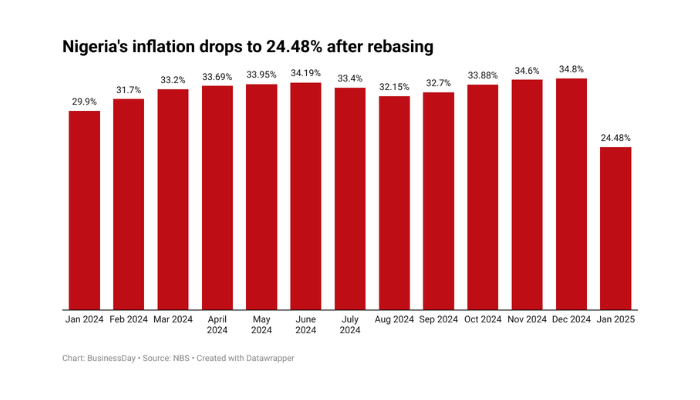
Nigeria’s sky-high inflation is projected to drop by 1.68 per cent to 33.12 per cent in the first three months of 2025 “supported by the basket reconstitution and a stable naira”, bringing succour for households and businesses who have been squeezed by rising prices which averaged 32 per cent in 2024.
Recent data by NBS already shows that inflation has drastically decreased to 24.48 per cent in January after the economy rejig, putting the country closer to President Bola Tinubu’s 15 per cent target.
PMI to average 53 on improved business activities
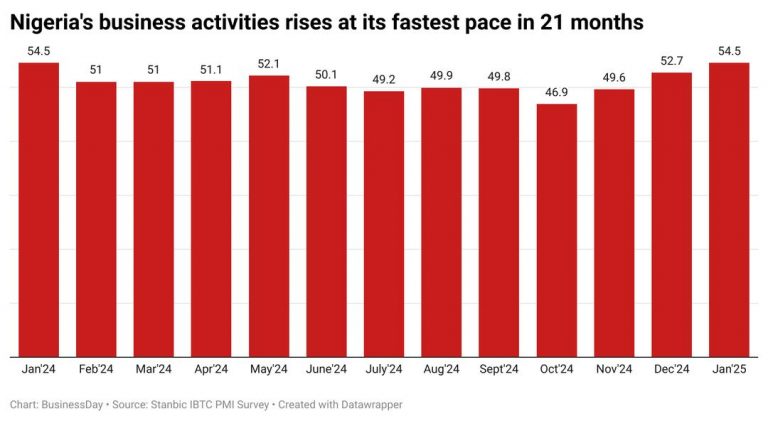
The report also stated that the purchasing manager’s index (PMI) will rise from 52.7 to 53 in Q1 as “lower inflation and stable interest rates improve business activities”.
Business confidence is gradually returning to Africa’s most populous nation as reflected in increased output for the second straight month in January, and at the fastest pace in 21 months, according to data from Stanbic IBTC PMI survey.
The survey disclosed that the headline purchasing manager’s index (PMI) rose to 54.5 in January from 52.7 in December, above the 50.0 no-change mark, signalling a solid improvement in the health of the private sector.
Market capitalisation to rise 4.29%
Nigeria’s market size is also projected to increase by 4.29 per cent to 65.45 per cent, supported by “a stable interest rate environment to bolster stock market performance”.
This is as the monetary policy rate is expected to remain unchanged in the reviewed period at 27.5 per cent as “lower inflation and positive real GDP growth will reinforce the MPC’s decision to maintain a status quo”.
Read also: Why Nigeria’s economy slows every first quart.er
Oil production to rise as crude oil price hits $75 per barrel
Africa’s biggest oil producer may be riding on a bumper crude oil production as it’s projected to see an increase in its producing capacity which is expected to rise from 1.43 million barrels per day (mbpd) to 1.48 mbpd.
This growth will be possible on “sustained efforts by the government to tackle oil theft and pipeline vandalism”.
President Trump’s tariffs could cause potential disruptions in crude supply from Canada and Mexico, the two largest oil suppliers to the US, raising crude oil price to $75 from $73.94 per barrel, a boost for Nigeria which got some 80 per cent of its revenue from the sale of crude oil.
External reserves to hit $42.2 billion on higher oil production
Nigeria’s gross foreign reserves are expected to increase from $40.8 billion it stood last year to $42.2 billion in Q1 as “higher oil production will boost export earnings” but a report by BusinessDay shows the net reserves have been tanking due to loan repayment and intervention by the CBN, sliding by $1.38billion since this year, reaching $39.49 billion as at February 5.
GDP growth to hit 3.8%
Nigeria’s gross domestic product (GDP) is projected to grow from 3.46 per cent in the third quarter of 2024 to 3.8 per cent in the three months to December, highlighting the gains from the festivities, especially that of the Detty December.
Rewane noted in the presentation that the economy may experience a sluggish start in the first quarter of this year due to “reduced post-festive spending and the typical lull in agricultural activities” which would see the GDP decline to 3.6 per cent in Q.1
Foreign inflows into Nigerian securities
At the last three auctions of Nigeria’s treasury bills, demand exceeded N1 trillion with the most recent auction seeing the highest demand in nine years (N3.22 trillion).
Many International banks are bullish on Nigeria securities.
For instance, J.P. Morgan in its recent report titled ‘Emerging Market Frontier Local Markets Compass’ stated that the reforms in Nigerihaveas made its securities more attractive.
“We stay long Nigeria T-bills, as reform momentum has started to bear fruit,” the report stated.
Similarly, CitiBank told BusinessDay that it is getting a lot of enquiries and country visits by foreign investors looking to invest in or increase their portfolio of Nigerian government securities.
“They have been impressed by the tough reforms (Subsidy removal, increase in non-oil revenues, uptick in oil production, growth in foreign reserves, inflation targeting, FX market reforms etc.) undertaken by this administration and the CBN which have led to stabilizing the economy.
“We are already seeing their investments in Nigerian securities grow and expect this to continue in the near term m,” an analyst at CitiBank told BusinessDay.