Soaring seeds cost prices Nigerian farmers out of bumper harvest
Josephine Okojie
The high cost of inputs and lack of technical know-how is hindering Nigerian farmers’ access to improved quality seed varieties that can boost productivity and tolerate climate change impacts.
Farmers have identified poor seeds as the major challenge facing their cultivation of crops and reducing their yield per hectare, BusinessDay’s farm survey shows.
This is because they cannot adequately access a secured and timely supply of quality seeds despite the country boasting of 314 registered seed companies.
Abubakar Aliyu, a sugarcane farmer in Gwandu local government area of Kebbi state, complained that farmers do not easily have access to quality seeds owing to high cost and the inability to find them in nearby markets.
“Quality seeds are expensive and we do not easily find them in open markets,” he noted, explaining that most of the seeds in the Nigerian markets labelled as high-yielding varieties are of low quality.
“I am from Kebbi and my farmland is there but I travel to the Institute of Agricultural Research in Zaria to get quality seeds for maize each time I am planting,” he noted, saying several farmers cannot afford such costs and would rather plant seeds from their last harvest.
Ayopo Somefun, a bitter kola farmer in Ogun State, explained that the country is supposed to be sufficient in food production, however, farmers’ failure to access quality seeds makes it difficult to boost supply.
“Most of the seeds in the markets are of low quality,” Somefun said, adding that you cannot even find any seeds or seedlings for certain crops in the country.
“I had to travel to Burkina Faso to get improved seedlings for my bitter kola farm. Research institute mandated for bitter kola in Nigeria does not have the seedlings,” he noted.
He added that the extra cost of travelling to the West African country made it very expensive to get quality seedlings.
“I could afford to travel and get quality seedlings but how many farmers can?” he asked. “Most of the seeds in the market today are imported because we do not produce enough varieties. The research institutes mandated to produce improved varieties of seeds are not doing anything,” he added.
Nigerian farmers have for long relied on open-pollinated seeds that they can re-plant as they didn’t have to buy seeds from companies yearly.
Experts say the act has constantly discouraged lots of seed companies from investing in the sector. Also, it has entrenched a culture where farmers are unwilling to pay for quality seeds.
Abiodun Olorundenro, managing partner of Prasinos Farms, said that the issue of seeds in the country is that farmers are not informed about its handling despite it being the most important component of any farming business.
He noted that apart from the ones given by the government, most smallholder farmers do not know where to get quality seeds from and the ones that do, are not informed on how to store them properly.
“If you fail to store quality seeds at the right temperature it becomes a bad seed because when you plant it the output will be poor,” he explained.
“Most smallholder farmers are not informed on seed handling and storage,” he added.
Plant Variety Protection (PVP) law failing to change narrative
For decades, the lack of a seed law in Nigeria limited the country from harnessing oppoartunities embedded in its seed sector, thus leaving farmers with low-quality and adulterated seeds and seedlings that portend danger to crop production and food security.
The PVP law which gives breeders intellectual property over a new plant variety with exclusive rights to commercialise seeds and propagate material is yet to incentivise national and multinational investments into the seed industry.
According to the National Agricultural Seed Council (NASC), Nigeria’s total seed production for major crops, including maize and rice decreased by 28.55 percent in 2022 to 96,169.07 metric tons (MT) from 143,598.25MT in 2022.
David Ojo, a retired professor of plant science and crop production at the Federal University of Agriculture, Abeokuta said lots of seed companies had closed shop and the few available lacked the technical-know how.
Ojo’s statement confirms a 2019 BusinessDay investigation which finds that the number of seed companies operating at that time was 40 out of the 314 stated on the NASC website, indicating an 87 percent drop.
According to him, most seed companies operating in Nigeria do not have breeders that can produce high quality seeds.
He added that most of the imported seeds in the market that are supposed to be high-yielding usually fail because of poor handling in the supply chain.
He urged NASC to ensure adequate monitoring of seed companies on the quality of their seeds and constant sensitisation of farmers on seed handling and storage.
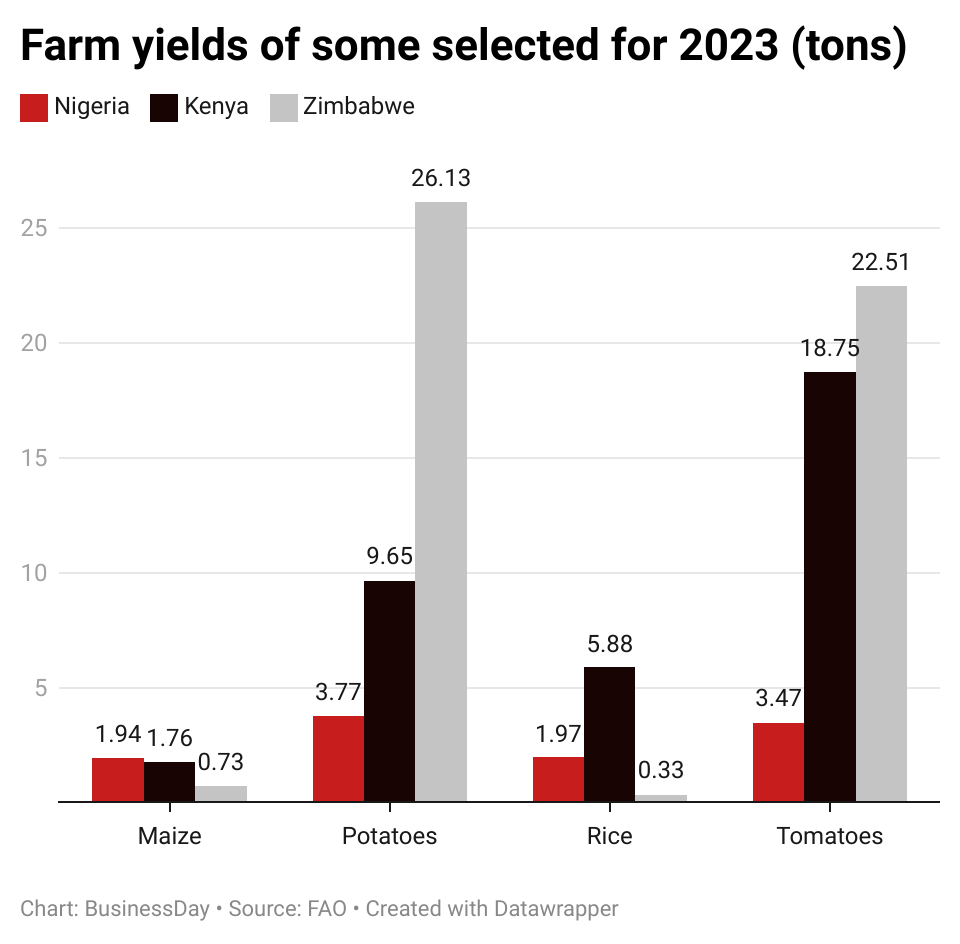
Zimbabwe pointing the way
Zimbabwe has the highest rate of seed adoption in Africa, according to a 2019 Access to Seed Index report.
In the South African country eight in every 10 farmers go to seed companies to purchase their seeds, the report said, a ratio that is higher than that of South Africa – the continent’s most industrialised economy.
The report attributed it to Zimbabwe’s vibrant seed industry that is mainly driven by the private sector and this allows for competition.