Nigeria is gradually warming up to Genetically Modified Organisms (GMOs) to enhance agricultural productivity and food security but public concerns over health and environmental risks are holding back full adoption.
Celestine U. Aguoru, a professor of plant science and technology, president of the Nigerian Biosafety and Biotechnology Consortium (NBBC) and current dean of the College of Biological Sciences at JOSTUM, emphasised that GMOs are safe for consumption during an interview session.
Aguoru however added that just like other hybrids, continuous research and development on GMOs should be encouraged. “All the noise about GMOs are rather political than scientific and they stem from non-experts in the field,“ he said.


To debunk conspiracy theories and doubts about GMOs, he shared a picture of himself enjoying a meal of beans cake (akara) and corn-starch (agidi) made from genetically modified BT Cowpea and Tela maize.
He stated that individuals without knowledge of biology, genetics, or the science behind GMOs should refrain from spreading fear and misinformation, as it only worsens the food crisis we are attempting to address through science.
Global Acceptance of GM foods
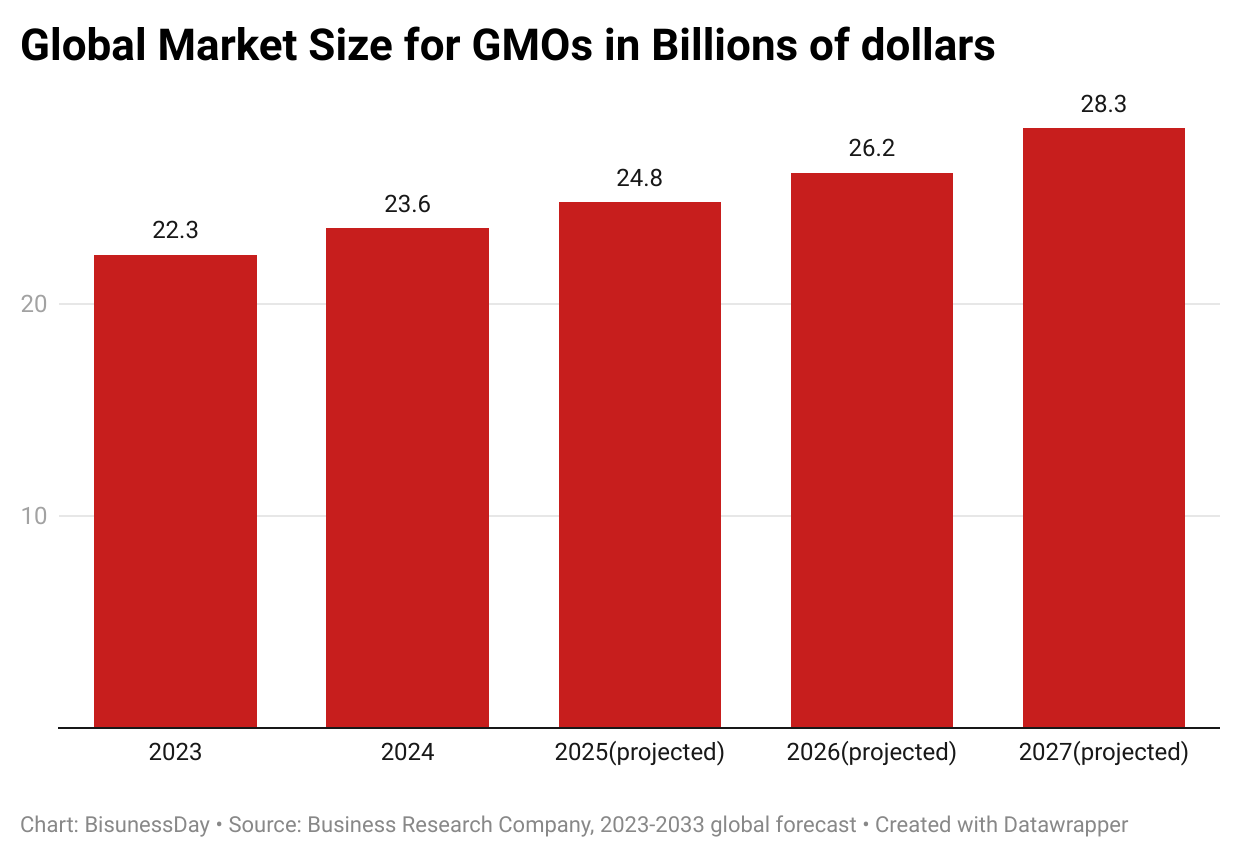
Global markets for GMOs are projected to reach $29.1 billion by 2028, up from $22.3 billion in 2023, reflecting a growth rate of 6.1 percent according to forecasts by Business Research Company in partnership with the Association of Internet Research Specialists.

According to reports, the global use of genetically modified GMOs varies widely across regions. In the United States, crops like soy, corn, and cotton are predominantly genetically modified.
Similarly, South American nations like Brazil and Argentina have widely adopted GMOs technology, particularly for soybeans and maize.
European nations, however, maintain stricter regulations, allowing limited cultivation of GMOs crops, though they still import large amounts of GMOs animal feed.
China and India are major producers of GMOs cotton in Asia, while other nations remain cautious. In Africa, interest is gradually increasing, with South Africa leading in GM crop production.
In 2023, the global land area used for genetically modified crops grew by 1.9% compared to the previous year, reaching a record 206.3 million hectares.
A total of 27 countries cultivated 11 distinct modified crops, with soybeans taking the lead at 100.9 million hectares, the first time this crop exceeded 100 million hectares. Maize followed with 69.3 million hectares, while cotton covered 24.1 million hectares.
In this speech at the 2024 World Food Prize, FAO Director-General QU Dongyu discussed how genetic science can help address global challenges like food security, climate change, and biodiversity protection
Major concerns raised about GMOs
Around two-thirds of genetically modified seeds are produced by just four multinational companies, raising concerns in Nigeria about food sovereignty as local farmers may become dependent on these companies for seeds.
According to the World Health Organization (WHO) reports on GMOs, farmers around the world also raised concerns about seed autonomy adding that GMOs have the potential to gain wider acceptance globally and allowing a few seed companies to control the market is risky for the entire population globally.
Furthermore, farmers fear the intrusion of GMO traits into species which could propel severe competition among food crops.
Other reports suggest that licenses to produce GM seeds should be issued to all regions of the world in equity and fairness so that no one claims autonomy in the market space as this will threaten food safety if left in the hands of few.
GMO market in Africa to hit $871 million in 2025
GMOs are seen as a viable option for farmers seeking climate resilience and higher yields. Experts project that the GMO market could expand from $615.4 million in 2018 to an estimated $871 million by 2025.
A report by the International Trade of GMO-related agricultural products also indicates that over the past 20 years, GMOs have reduced pesticide use by 37%, increased crop yields by 22%, and raised farmer profits by 68%, with greater benefits in developing countries and for insect-resistant crops.
Aguoru emphasized that in the face of climate change and economic challenges, GMO seeds offer cost-effective solutions for farmers, providing higher yields, increased productivity, and resistance to pests and climate impacts.
He noted that GMOs can withstand droughts and dry spells, while also boosting foreign exchange reserves through a strong international market for exports and high inflow of foreign investors.
In conclusion, food security not only addresses hunger but also empowers individuals, improves quality of life, and fosters economic stability and growth of any nation.