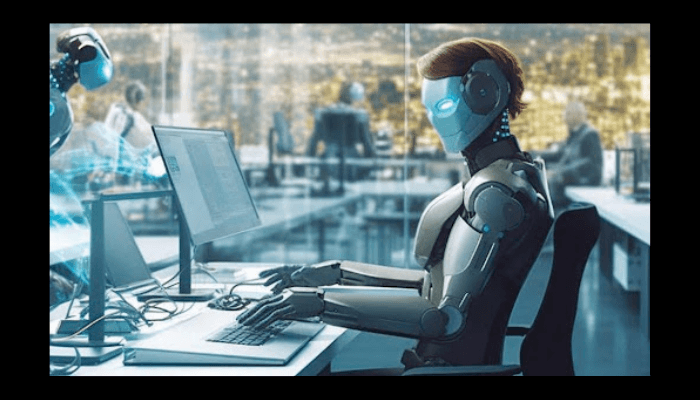
The future of work is rapidly changing, and AI is playing a significant role in shaping it.
At the forefront of this transformation stands artificial intelligence (AI), a powerful force that is reshaping industries, redefining job roles, and reimagining the very nature of work itself.
As AI continues to evolve at an exponential pace, it is imperative to explore the key trends and insights that will shape the future of work.
One of the most significant impacts of AI is its ability to automate routine tasks, freeing up human workers to focus on more complex and creative endeavours.

While concerns about job displacement are valid, historical patterns suggest that technological advancements often lead to the creation of new roles and industries.
Rather than viewing AI as a replacement for human workers, it is increasingly being embraced as a powerful collaborative tool.
AI-powered systems can augment human capabilities, providing valuable insights, automating tedious tasks, and enhancing deci- sion-making processes. For example,
AI-driven analytics can help financial analysts identify trends and anomalies in vast datasets, enabling them to make more informed investment decisions. Similarly,
AI-powered design tools can assist architects and engineers in generating innovative designs, accelerating the creative process.

Positive impacts of AI on work:
Increased productivity: AI can automate repetitive and mundane tasks, freeing up human workers to focus on more creative and high-value tasks.
Improved accuracy: AI can reduce errors and improve accuracy in tasks such as data entry, bookkeeping, and medical diagnosis.
enhanced decision-making: AI can analyze vast amounts of data, providing insights and recommendations that can inform business decisions.
New job creation: While AI may automate some jobs, it will also create new ones, such as AI developer, data scientist, and AI ethicist.
Negative impacts of AI on work:
Job displacement: AI may automate jobs, potentially displacing workers, especially in sectors where tasks are repetitive or can be easily automated.
Skills gap: As AI changes the nature of work, workers may need to acquire new skills to remain employable.
Bias and inequality: AI systems can perpetuate biases and inequalities if they are trained on biased data or designed with a particular worldview.
Dependence on technology: Over-reliance on AI may lead to a loss of human skills and abilities.
Future of work trends:
GIG economy: The rise of the gig economy, where workers engage in short-term, flexible work arrangements, may continue to grow.
Remote work: With the help of AI-powered tools, remote work may become even more prevalent, changing the way we collaborate and communicate.
Lifelong learning: As AI continues to evolve, workers may need to continually update their skills to remain relevant.
Human-AI collaboration: The future of work may involve humans and AI systems working together, with AI augmenting human capabilities rather than replacing them.
Jobs that are less likely to be automated:
Creative professionals: jobs that require creativity, originality, and imagination, such as artists, writers, and designers.
Social workers: jobs that require empathy, emotional intelligence, and human connection, such as social workers, counselors, and therapists.
Skilled tradespeople: jobs that require hands-on skills, problem-solving, and adaptability, such as electricians, plumbers, and carpenters.
Healthcare professionals: jobs that require human interaction, empathy, and complex decision-making, such as doctors, nurses, and health-care administrators.
Jobs that are more likely to be automated:
Data entry clerks: Jobs that involve repetitive data entry, bookkeeping, and record-keeping.
Customer service rep: the future of work is inextricably linked to the advancement of AI. By understanding the trends, challenges, and opportunities
that lie ahead, we can prepare ourselves for a future where humans and machines work together to create a more prosperous and equitable world representatives: jobs that involve routine customer inquiries, complaints, and feedback.
Bookkeeping and accounting: jobs that involve financial record-keeping, invoicing, and tax preparation.
Manufacturing and assembly line workers: jobs that involve repetitive tasks, such as assembly, inspection, and packaging.
Preparing for the future of work:
Upskill and reskill: Invest in education and training that develops skills that are complementary to AI.
Emphasize human skills: Focus on developing skills that are unique to humans, such as creativity, empathy, and criti- cal thinking.
Encourage lifelong learning: Foster a culture of continuous learning and professional development.
Rethink education: Reform education systems to prepare students for an AI-driven future.
In conclusion, the future of work is inextricably linked to the advancement of AI. By understanding the trends, challenges, and opportunities that lie ahead, we can prepare ourselves for a future where humans and machines work together to create a more prosperous and equitable world
By understanding the potential impacts of AI on work, we can begin to prepare for a future where humans and machines collaborate to create new opportunities and drive economic growth.
Olufemi Oluoje, a seasoned software developer boasts more than 7 years of expertise in the software development field. With a rich background collaborating with diverse organisations both in Nigeria and internationally.
He currently serves as a tech coach at Unlock Academy in the United States. In this role, he has successfully mentored and assisted approximately 3,200 students in enhancing their skills for a successful career in software development.
Additionally, he has contributed to the creation of AI-powered applications aimed at enhancing the productivity, profitability, and cost efficiency of small and medium-sized enterprises (SMEs).
Email: aolufemi.oluoje@gmail. com