Naira stability will halt the federation allocation windfall that has been enjoyed by federal and state governments in the last nine years, threatening their revenues and projections.
The federal government and its component units have, since the liberalisation of the foreign exchange market, saw a rise in their monthly disbursed allocation due to exchange rate differentials.
But the reduced volatility of the naira means the largesse seen from FX is gone and may pile pressure on the governments’ fiscal health.
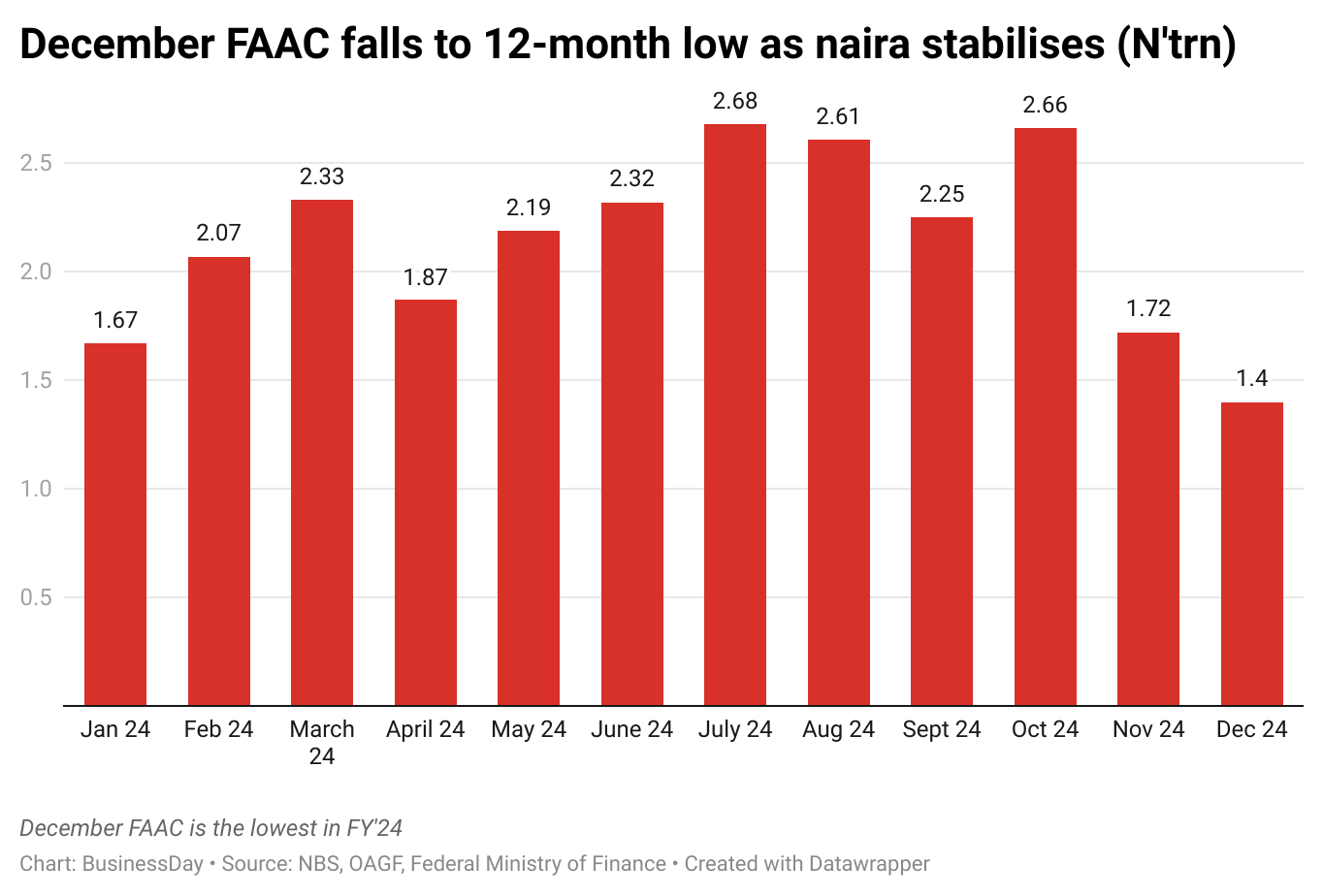
The Federation Account Allocation Committee (FAAC) revealed that the monthly allocation disbursed to the three tiers of government fell to N1.42 trillion in December 2024, compared with N1.7 trillion distributed in the previous month.

Analysts at FBNQuest Capital Research said the decline was primarily driven by a marked reduction in revenue derived from exchange rate difference.
The difference amounted to N403 billion compared with N671 billion received in November, as the naira was relatively stable in the period under review.
“The recent stability of the naira exchange rate due to the introduction of EFEMS and the CBN’s sustained efforts to improve market liquidity implies less revenue boost from exchange rate gains,” FBNQuest Capital Research analysts said in a research note on Tuesday.
The unification of the FX market by the Central Bank of Nigeria (CBN) since last June has led to a large depreciation of the naira, which has also increased revenue for Africa’s biggest economy.
Since the policy took effect, the shared amount to the three tiers of government has increased, hitting N2.68 trillion in July 2024, 2024, the highest in the whole year.

The surge coincided with the period when the country’s exchange rate was about N1.608.73 to a U.S dollar, highlighting the gains seen from the devaluation of the naira.
Read also: Nigeria’s debt stock surges to N142trn on weak naira
Tobi Ehinmosan, a macroeconomic and fixed-income analyst at Lagos-based FBNQuest Capital, said naira appreciation and low demand as a result of slowdown of business activities in December 2024 affected FAAC allocation.
“The federal government has gained from the naira devaluation because most revenues are dollar-denominated, including revenue from crude oil,” he said.
However, with the naira stabilising for the most part of December against the greenback, the Nigerian government must look elsewhere to generate revenue.
The FAAC report showed that the federal government received a lower amount of N451 billion compared with N582 billion received in the preceding month.
Also, the 13 percent derivation allocation for oil-producing states recorded a marked decrease of 41 percent m/m to N113 billion.
Better currency year
Analysts and economists are betting on a better year for the local currency as the naira’s volatility is gradually being subdued by the transparency and efficiency in the market, occasioned by the Electronic Foreign Exchange Matching System (EFEMS) launched in December last year.
The local currency appreciated by N125 to a dollar one month after the EFEMS was adopted, according to a BusinessDay’s report, with analysts saying the gains might be an indication that its rebound journey might just have begun.
Proposed tax reforms to the rescue?
The Nigerian government will, by the end of the first quarter (Q1), kick-start its long-awaited tax reforms, a policy geared towards doubling the country’s revenue as a share of gross domestic product (GDP) in the next three years.
Though the reforms have been heavily criticised by some sections of the country, it’s expected to take effect in July this year after legislative actions must have been completed.
The country must improve its tax base to improve its revenue shortfall, lower deficit and borrowings in a country whose debt servicing is about 162 percent, analysts have said.
“The proposed Tax Reform Bill, if passed into law by the National Assembly, could provide significant support to the government’s revenue base,” FBNQuest Capital said.