The Nigerian naira is undervalued against the US Dollar by a staggering 40.68 percent, according to a report by the Financial Derivatives Company (FDC).
This conclusion stems from a detailed analysis using purchasing power parity (PPP) as a basis for comparison.
To fully appreciate this claim, let us delve into the insights provided by Michael Todaro and Stephen Smith, two renowned development economists. In their work, they define PPP as “the number of units of a foreign country’s currency required to purchase the quantity of goods and services in the local developing country market as $1 would buy in the United States (in locations with an average cost of living).”
The relevance of PPP lies in its ability to provide a more accurate representation of living standards across countries. Unlike Gross National Income (GNI) per capita, which often exaggerates disparities between nations, PPP accounts for differences in domestic prices and relative purchasing power.

The gap between GNI and PPP
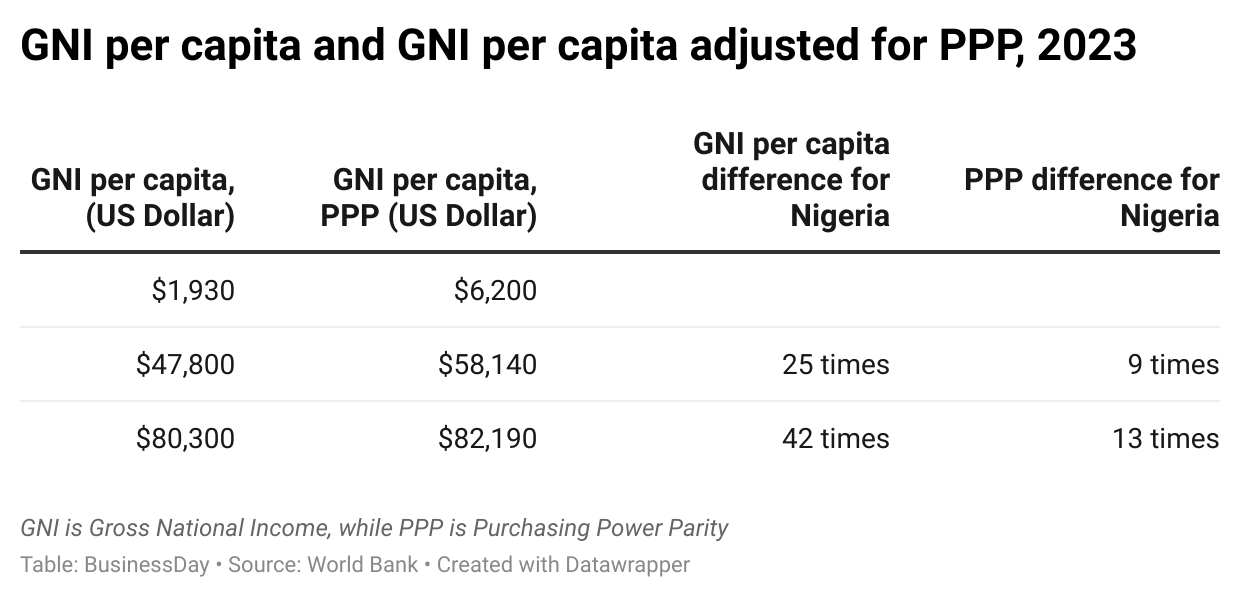
Consider the current GNI per capita figures: an average citizen in the United States earns $80,300, while a Nigerian citizen earns a mere $1,930. At face value, this represents a colossal inequality. However, when adjusted for PPP, the figures shift significantly to $82,190 for the US and $6,200 for Nigeria.
This recalibration offers a more balanced perspective. Using official exchange rates, an average American’s income is 41.61 times that of a Nigerian. By contrast, the PPP-adjusted ratio is a much lower 13.26 times. While the gap remains vast, PPP reduces the disparity by 68%, presenting a more realistic measure of relative living standards.
A similar pattern emerges when comparing income levels in the UK and Nigeria. Official exchange rates suggest a UK worker earns 24.77 times more than their Nigerian counterpart. Yet, PPP adjustments reduce this ratio to 9.38 times—still significant, but far less dramatic.
Practical examples: The Naira’s purchasing power
Let us illustrate this concept with a simple example. Imagine an indomie noodle costs $0.5 in the US but N350 in Nigeria. Based on this, the PPP exchange rate would be N350/$0.5—which translates to N700/$1. This means that N700 in Nigeria has the same purchasing power as $1 in the US. However, if the actual exchange rate is N1,500/$, the Naira is evidently undervalued relative to its PPP value.

According to FDC data, the official exchange rate at the time of analysis was N1534.19/$, while the PPP rate was calculated at N910.10/$ on average. This difference of N624.09 underscores the undervaluation of the Naira, reinforcing the need for alternative methods to assess currency strength.
Why PPP matters more than GNI
Todaro and Smith emphasise that GNI per capita calculated using PPP offers a clearer picture of comparative living standards than GNI per capita calculatd using official foreign-exchange rates to convert national currency values into US dollars.
The latter, when measured at official exchange rates, tends to exaggerate differences in income levels. For instance, official exchange rates suggest that an average American’s income is 42 times that of a Nigerian. Yet, PPP-adjusted figures indicate that real US incomes are closer to 13 times those in Nigeria. While this still highlights inequality, it provides a more grounded assessment of economic realities.
The broader implications
PPP adjustments are not just theoretical constructs; they have real-world implications. By measuring exchange rates through PPP, we gain a better understanding of relative currency values and living standards. In the case of Nigeria, reliance on official exchange rates significantly distorts perceptions of income inequality and economic strength.
As the FDC report reveals, services and goods often cost less in Nigeria than in the US. This disparity underscores the importance of using PPP to reflect the true value of the Naira. Policymakers and economists must leverage such insights to inform strategies that strengthen Nigeria’s currency and enhance its global competitiveness.
In conclusion, while the undervaluation of the Naira may seem like a technical detail, it has profound implications for understanding Nigeria’s economic position. By embracing PPP as a more accurate metric, we can move beyond exaggerated disparities and focus on actionable solutions to improve living standards and economic outcomes.