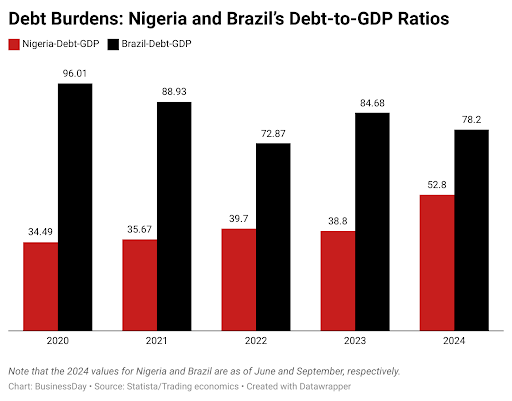
“Is Nigeria walking the same precarious path as Brazil, where debt and dwindling investor confidence wreaked havoc on its economy?” Nigeria’s 2025 budget is setting records at ₦47.9 trillion, but it raises big concerns about the country’s economic future. While this budget represents a 74.18 percent increase from the previous year, over a third of it—₦15.81 trillion—will go towards paying off debts, debt servicing so to say.
This means there’s less money available for essential investments in health, education, and infrastructure, which are crucial for improving the lives of ordinary Nigerians.

Nigeria’s Debt Spiral: The Numbers Behind the Crisis

Comparing this to Brazil’s recent experiences, Nigeria seems to be on a similar path. Brazil faced a severe financial crisis when its currency, the real, lost over 20 percent of its value in a single year, due to growing investor fears over budget deficits and unclear economic policies.

To stop the collapse, Brazil’s central bank intervened aggressively, selling over $3 billion in its financial markets within days. Although this temporarily stabilized the currency, it failed to address the structural issues at the heart of the crisis.
Brazil then attempted to balance cutting spending by $11.5 billion while simultaneously stimulating the economy, according to Bloomberg. This caused investor confusion and political unrest, adversely affecting people’s living standards, especially those dependent on social programs.
Parallels with Brazil’s Economic Crisis
The naira has lost more than 70 percent of its value against the dollar, as reported by BusinessDay in November 2024, making imported goods significantly more expensive and driving up inflation. The government’s heavy borrowing is pushing Nigeria’s debt-to-GDP ratio above 40 percent.
Although this is lower than Brazil’s ratio during its crisis, the rapid accumulation of debt and the high costs of servicing it makes the situation precarious. The government’s dependence on oil revenues, coupled with declining foreign reserves, hampers its ability to respond effectively to these challenges.
Lessons from Brazil’s Missteps