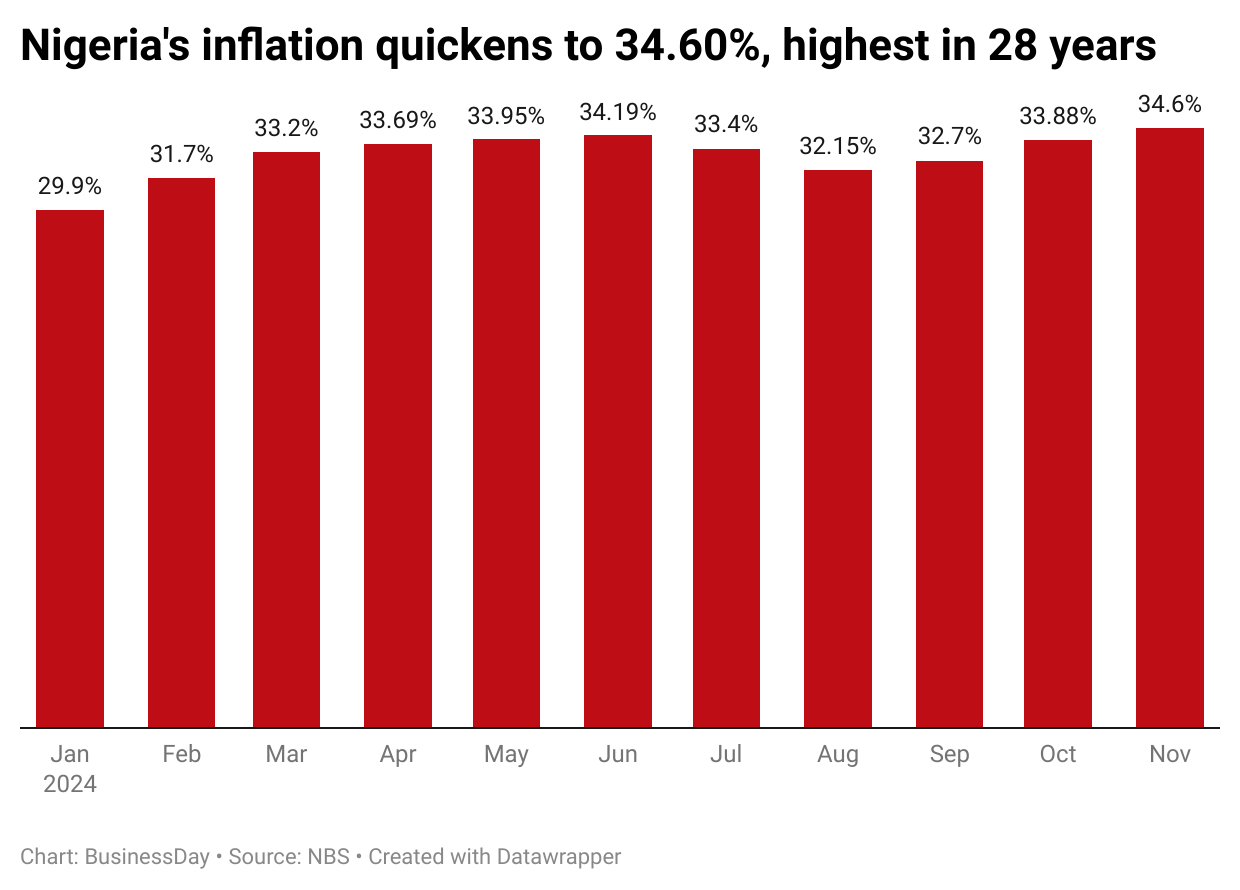
Consumer prices in Nigeria rose at a faster pace in the month of November compared to last year, hitting a fresh 28-year high as food and transport costs surged.
Annual inflation printed at 34.60 percent, the National Bureau of Statistics reported on Monday, marking the third consecutive increase after annual inflation slowed in August.
The annual rate was 0.72 percentage points higher than October.
Nigeria has been locked in a protracted battle to tame inflation this year with the CBN hiking interest rates by 850 basis points this year.

However, monthly inflation, which is a more accurate measure of current inflation, accelerated by 2.638 percent from 2.64 percent in October.
The surge in November inflation rate is the third consecutive rise after annual inflation was reversed in August.
According to the Economist Intelligence Unit (EIU), inflation is expected to reach a peak of 35 percent in December 2024 and remain high in 2025, averaging 27.7 percent.
Nigerian government officials are however more optimistic and believe inflation should average 15.75 percent next year, according to projections in the Medium Term Expenditure Framework.
A disinflationary trend is anticipated in the longer term, driven by forex stability, trade policy, and base effects, the Financial Derivatives Company (FDC) said in its December report. However, the pace may be slower due to a loose fiscal- monetary policy mix.

It mentioned that the Monetary Policy Committee (MPC) will meet next in January, and the consensus opinion is that the CBN will continue its tightening process, as this aligns with the trend, given that inflation is expected to maintain its upward trajectory.
Similarly another source told BusinessDay that the CBN will be motivated by data to begin its easing cycle. “Generally, inflation is expected to begin to slow starting next year. Base effect should also pave the way for a possible cut.”
Olayemi Cardoso, the apex bank governor, said that he expects to “see greater results in the first quarter of 2025” from the measures the MPC has taken to fight the “war” against inflation at the recent MPC meeting.
Adding that the MPC is optimistic that the deregulation of the petroleum industry will eliminate shortages and help stabilize fuel prices, while steps to improve security in Nigeria’s food-producing northeastern region will help ease food-cost pressures.
The report by FDC stated that food insecurity in Nigeria has reached alarming levels, exacerbated by insecurity, rising logistics and transportation costs, and seasonality. These factors have disrupted the food supply chain leading to widespread hunger and rising prices of food commodities.
Food inflation which constitutes more than 50 percent of headline inflation rose to 39.93 percent.
Meanwhile, core inflation on a month-on-month basis, was 1.83 percent in November 2024. It stood at 2.14 percent in October 2024, down by 0.30 percent points.