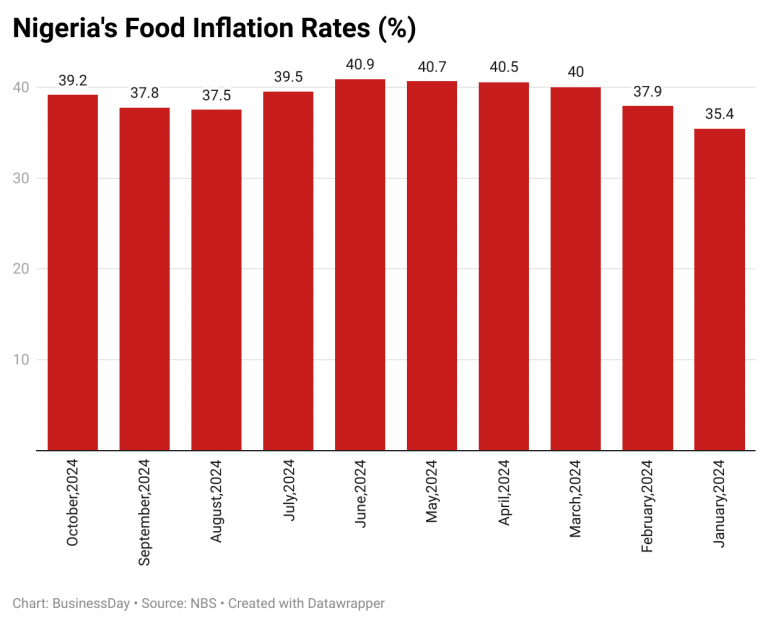
Rising food prices may linger for longer in Africa’s most populous nation with farmers decrying the impact of climate change on production.
The warning issued by Abuja farmers about the looming threat of famine due to climate change highlights the growing challenges faced by the agricultural sector in Nigeria.
This concern was raised by Ibrahim Kabir, Chairman of the Board of Trustees of the National Agricultural Foundation of Nigeria, during the 16th edition of the National Agricultural Show in Nasarawa State.
He cautioned that by 2025, the country could face a severe food crisis as a result of changing weather patterns.

In an inteview with Frederick Ukula, an expert on climate change and Agro-production/processing Manager at Ecobasic Seed Nigeria Ltd, more emphasis was made on the situation, particularly the elongated dry spells experienced in 2024.
Traditionally, farmers in Nigeria would face a brief dry spell, known as the “August break,” which lasted between 10 to 15 days. However, in 2024, this dry spell extended to 30 days in Kaduna State and 45 days in parts of the south-western region of the country. This prolonged drought has had a significant impact on crop yields.
In addition to the dry spells, he also stated that unpredictable rainfall patterns have caused further disruptions to farming activities. The unpredictable weather has led to both floods and sandstorms, which have devastated crops in both northern and southern Nigeria.
The Nigerian Meteorological Agency’s (NiMet) weather predictions, while still valuable, were less effective this year in helping farmers adapt to the changing conditions.These climate-induced challenges emphasize the vulnerability of Nigerian farmers to the effects of climate change, which could lead to a serious food security crisis if not addressed urgently.

For instance, in parts of Plateau State (Specifically Langtang-South LGA) , farmers decried withering and wilting of crops almost close to harvest time due to climate change impact as seen
below.
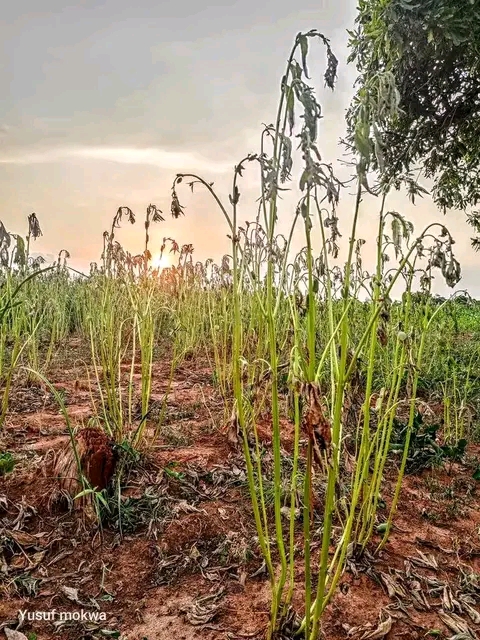
Source: Live photo by Abner, a young farmer in Plateau State.
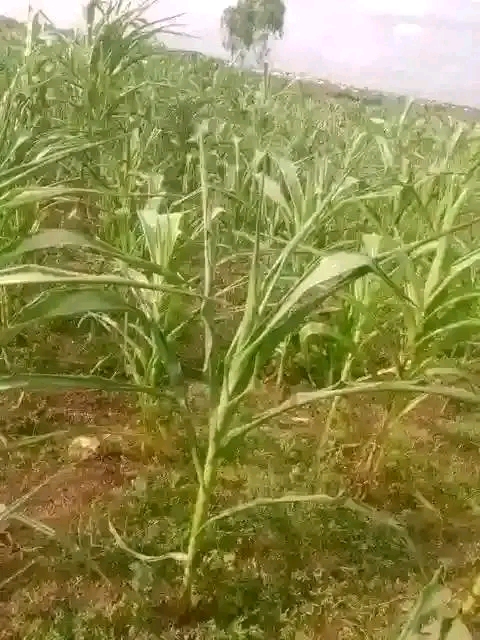
Source: Live photo by Abner, a young farmer in Plateau State.
Other sources of food crisis in Nigeria
Speaking with Apochi Joshua Apochi, an agricultural extension expert at Benue State University’s Center for Food Technology and Research, he highlighted several factors contributing to food insecurity in Benue State.
Besides climate change, he pointed to high production costs, limited access to finance for smallholder farmers, the farmer-herder crisis, inadequate land access, rural-urban migration, and the negative perception of farming among youth.
He also stressed that the growing population, as outlined in Thomas Malthus’ Population Theory, where population grows faster than food production in a geometric and arithmetic ratio respectively, was exacerbating the food crisis in Nigeria.
Frederick Ukula, a climate change expert, echoed these concerns, adding that weak agricultural insurance, resistance to new technologies, lack of proper monitoring of farming programs, low political will, and ongoing insecurity were also major contributors to the looming famine and worsening food situation in Nigeria.
During an agro-sensitization event in Benue State, agro-consultants Jennifer N. Achimba, Faith Atenyi, and Donald U. Aondoseer collectively agreed that Nigeria’s ongoing food crisis and looming famine are driven by a lack of effective agricultural policies, poor infrastructure, corruption, governance issues, insecurity, and rapid population growth.

Global Reports about food crisis in Nigeria
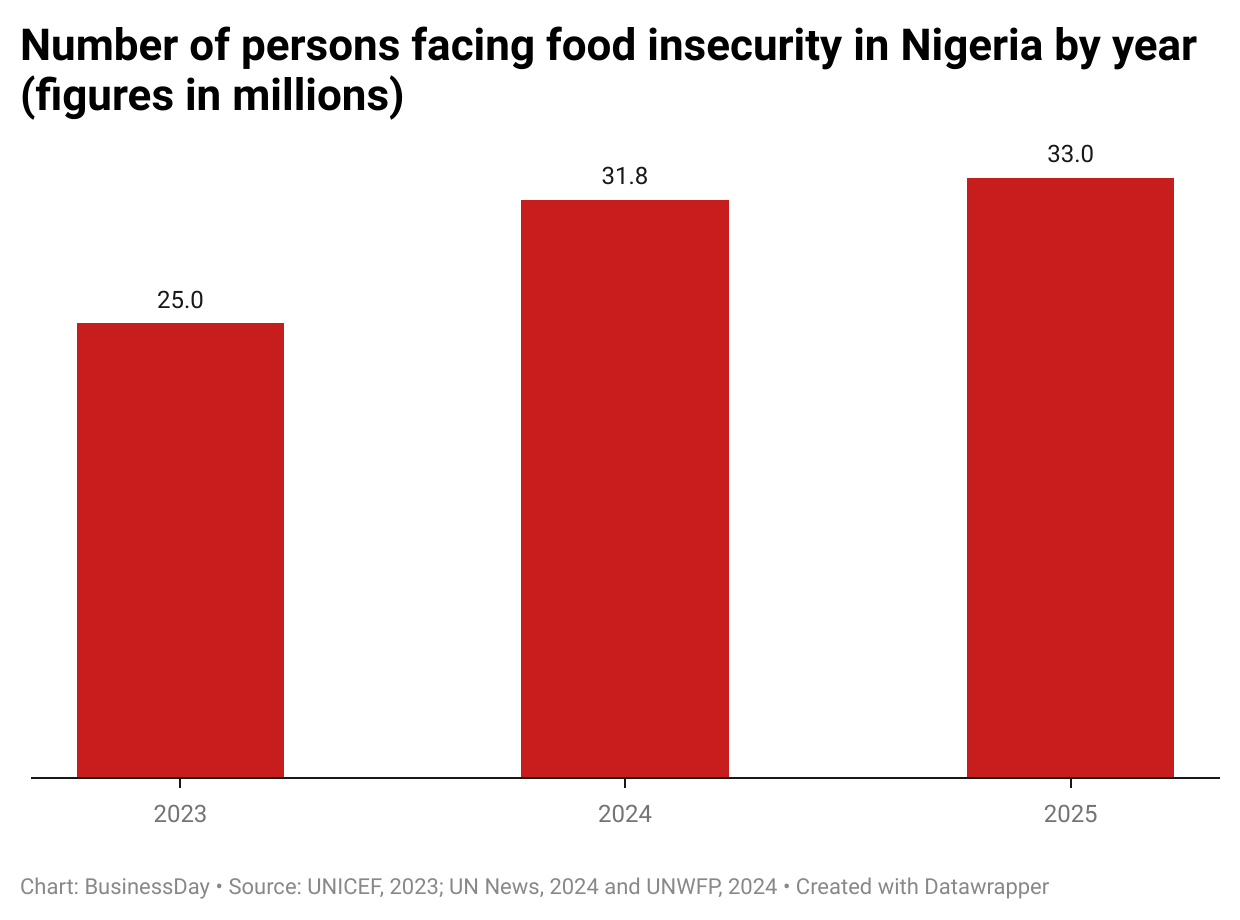
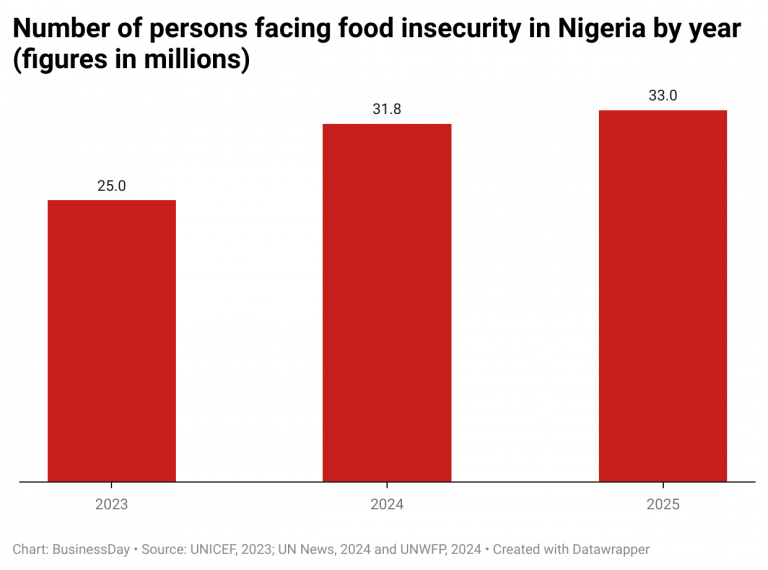
According to the Food and Agriculture Organization (FAO), wilting and stunted growth were observed in 40 to 60 percent of cereals and grains all over the country.By 2025, a staggering 33 million Nigerians could be facing severe hunger, according to the United Nations.
Nigeria is ranked 110th out of 127 countries, placing it as the 5th most hunger-stricken nation in West Africa with a Global Hunger Index score of 28.8. Below is Nigeria’s global hunger index trend for 2023 (actual) to 2025(projected).
What’s next for Nigeria in 2025?
To address Nigeria’s worsening food crisis and prevent famine, experts recommend investing in aggregator organizations like AFEX and Baban Gona. These organizations can directly connect with farmers and ensure that funds meant for purchasing agricultural produce are not diverted.
They also emphasize the need for extensive media campaigns to educate farmers about adopting high-resilience seeds, such as Genetically Modified Organics (GMOs), which can boost crop growth and yields. Fredrick Ukula, a climate change expert, pointed to genetically modified early-maturing cowpeas developed by the University of Agriculture, Benue State, as an example of technology that helps mitigate climate impacts.
Ukula also suggested focusing on a few agricultural projects that are easy to track and monitor, using their success stories as a tool for promoting advanced agricultural innovations through widespread campaigns. Other solutions according to experts include infrastructural development, conflict and peace resolution strategies, agricultural insurance, strong policy framework and youth engagements.
Conclusion
In summary, adequate food for all is a moral right. However, it takes the collective efforts of all and sundry to wage war against hunger. According to John F. Kennedy, 35th president of the United States “The war against hunger is truly mankind’s war of liberation.”