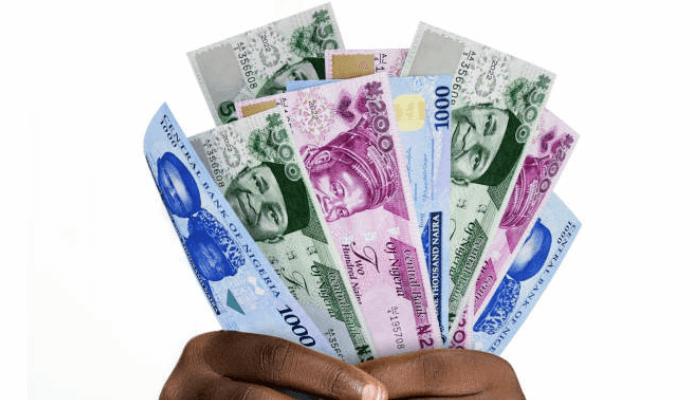
…Stands at N1,730 at parallel market
The naira, on Monday, appreciated against the dollar at the parallel market after the first foreign exchange (FX) trading day on the Electronic Foreign Exchange Matching System (EFEMS) via the Bloomberg BMatch System.
The local currency gained N20 as the dollar traded at the rate of N1,730 as against N1,750 on Friday at the parallel market, also known as black market.
The Central Bank of Nigeria (CBN), last Tuesday, issued a directive mandating all banks in the interbank foreign exchange market to transition to the Bloomberg BMatch system for FX trading.

The implementation, which went live yesterday, is designed to boost the operational efficiency and transparency of the nation’s FX market.
Read also: Foreign holdings drop $13bn on naira slump, corporate exits
At the official foreign exchange market, the naira depreciated by 1.69 percent as the dollar was quoted at N1,672.69 on Friday compared to N1,644.86 on Thursday at the Nigerian Autonomous Foreign Exchange Market (NAFEM).
Foreign exchange reserves reached a 34-month high in November, closing at $40.2 billion despite a slight dip towards the end of the month, according to a report by Afrinvest Securities Limited. This represents a 1.1 percent month-on-month growth, equivalent to an increase of $436.2 million.
In the NAFEM window, average daily turnover rose by 16 percent month-on-month to $365.2 million. Consequently, the Naira appreciated by 0.2 percent and 0.3 percent month-on-month against the U.S. dollar, trading at N1,672.69/$1.00 in the NAFEM window and N1,720.00/$1.00 in the parallel market.

Looking ahead to December, the Naira is expected to maintain its positive trajectory, supported by improved sentiment, bolstered reserves, and enhanced market liquidity. Afrinvest anticipates that the Naira will continue to trade within similar ranges, provided there are no unexpected disruptions.
EFEMS is an electronic platform introduced to tackle speculation and improve transparency in Nigeria’s FX market. It automatically matches buy and sell orders, promoting fairness and efficiency in FX trading. Financial experts have expressed optimism about EFEMS’ potential to address persistent challenges affecting the naira and Nigeria’s FX reserves.
Razia Khan, managing director and chief economist for Africa and the Middle East at Standard Chartered Bank, noted, “The introduction of EFEMS is eagerly awaited. It should allow for greater transparency and better functioning of the FX market, enabling the CBN to gauge the true extent of FX demand and formulate policies accordingly. Market participants expect that EFEMS adoption will lend itself to greater NGN stability.”
Read also: Naira maintains gain across markets
The CBN has set a minimum tradable amount of $100,000, with incremental clip sizes of $50,000. Omolara Duke, director of the CBN’s financial markets department, said this in a circular sent to banks last Tuesday.
Olufunmilola Adebowale, head of research, Parthian Partners, said this initiative is expected to streamline FX operations within banks by automating the matching of FX transactions. Banks engaged in currency trading will benefit from faster, more efficient processes, reducing the need for manual intervention and minimising operational errors.
She further said that banks will be able to improve their risk management strategies. With real-time access to exchange rate data, they will be better equipped to monitor market trends, manage their FX exposure, and optimise their portfolios.
“The banking sector will need to adapt to the new system. This could involve changes in how FX traders operate and adjustments to transaction processing workflows. Banks will also need to train their staff to effectively navigate and utilise the new electronic platform,” she said.
Aminu Gwadabe, president of the Association of Bureaux De Change of Nigeria (ABCON), said EFEMS is designed to achieve price discovery, enhance oversight, and reduce speculation. “The platform intends to integrate participants for transparency and visibility as well as enhancing data collection. It will ensure that participants trading and dealing on the platform are visible and transparent,” he said.
Gwadabe also highlighted the importance of integrating BDCs into the system in the second phase of implementation.
The EFEMS system allows authorised dealers, including commercial banks, to place buy and sell orders in real time. Transactions are automatically matched based on predetermined rules, ensuring swift execution and real-time visibility for market participants and regulators.
Read also: Naira steadies after CBN’s rate hike
Olayemi Cardoso, CBN governor, reaffirmed the bank’s commitment to fair and efficient markets. Speaking at a recent Harvard Club of Nigeria event in Lagos, he said, “Trust is the currency of central banking. If the public loses trust in the institution, the efficacy of its policies diminishes. Our decision to implement the Electronic Foreign Exchange Matching System is rooted in this understanding.”