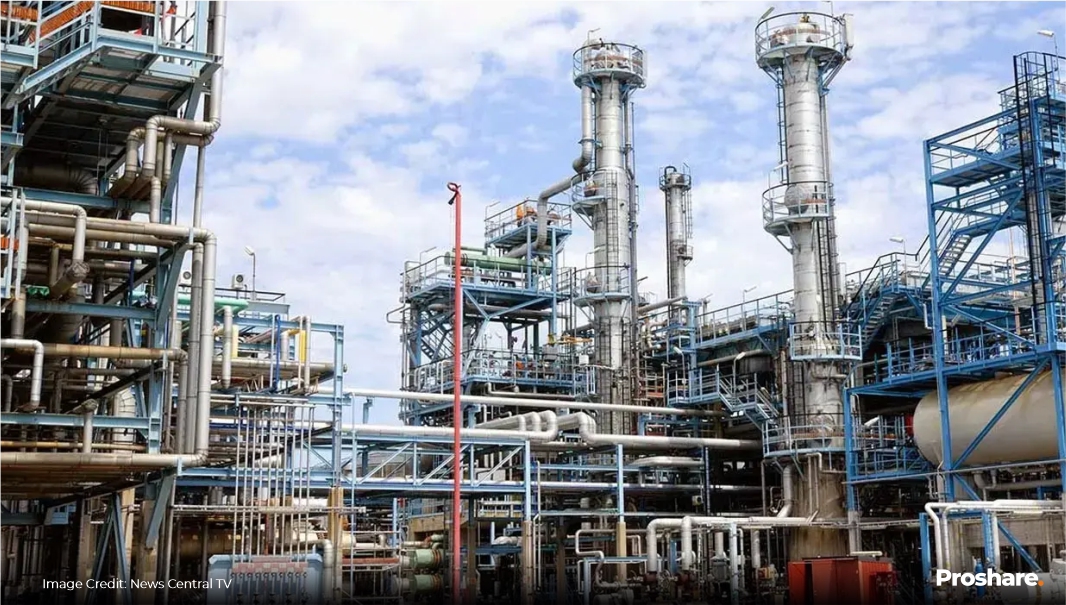
The much-anticipated resumption of the Port Harcourt Refinery’s Old Wing, celebrated as a milestone in Nigeria’s drive for energy self-sufficiency, has been overshadowed by controversy following reports that the facility is not refining crude oil as claimed but merely blending semi-finished or finished petroleum products.
The refinery, which resumed operations on Tuesday after 22 years of dormancy, was heralded as a key step in reducing Nigeria’s dependence on fuel imports.
However, social media platforms have cast doubt over the refinery’s true capacity, with claims that it is functioning as a blending plant rather than a crude oil processing facility.
What Is a Refinery?

The Port Harcourt refinery, managed by the Nigerian National Petroleum Company (NNPC), is an integrated complex comprising two facilities: the old refinery commissioned in 1965 and the newer one added in 1989.
Together, they process crude oil into refined products such as petrol, diesel, kerosene, and other by-products. This involves sophisticated chemical and physical processes like distillation, cracking, and reforming to transform raw crude into usable fuels.
How Do Blending Plants Operate?
Blending plants, on the other hand, do not process crude oil. Instead, they mix various refined components to produce end-use products like lubricants, gasoline with specific octane ratings, or even specialty fuels.
These plants rely on pre-refined materials and additives rather than raw crude oil.

The Propeller Club of Geneva stated that a blending plant mixes different petroleum products to achieve specific properties or specifications. “It’s about creating the final, refined product that meets regulatory or consumer standards.”
On the other hand, a refinery, according to EPC Land, an online learning platform for Piping Engineers, processes crude oil into various usable products like petrol, diesel, jet fuel, and other petrochemicals through complex chemical processes.
A report by Belgium-based Emerson Process Management said blending is the seventh unit in this seven-step overview of petrol refining.
The other six steps include: Crude and vacuum distillation, delayed coker fluidised-bed catalytic cracker, fluidised-bed catalytic cracker (FCC), alkylation, hydrotreating, hydrogen plant
“Petrol blending is a refinery operation that blends different component streams into various grades of gasoline,” the report said.
Read also: Negotiations still ongoing for Port Harcourt refinery petrol, PETROAN clarifies
Claims of Blending Operation
Viral posts and images circulating online allege that the Old Wing is using imported components, such as refined or partially refined products, which are blended to create market-ready fuel. This revelation, if confirmed, would contradict earlier government and Nigerian National Petroleum Company Limited (NNPCL) assurances that the facility was fully rehabilitated to refine crude oil domestically.
“The facility is not refining crude oil; it is simply blending imported products,” one post claimed, sparking outrage among citizens who had hoped the project would signal a turnaround in Nigeria’s refining capacity.
Official Response
The NNPC Limited has denied these claims, citing that the refinery is producing refined products and currently operates at 70 percent capacity.
A statement signed by Olufemi Soneye, chief corporate communications officer of the NNPC, said the state-owned oil company responded to a report claiming that the refinery, instead of processing crude oil, bought “cracked C5 petroleum resins” and blended them with other products, including Naphtha, to sell to the Nigerian public as though the refinery had processed them.
“We are, however, aware of unfounded claims by certain individuals suggesting that the refinery is not producing products. For clarity, the Old Port Harcourt Refinery is currently operating at 70 percent of its installed capacity, with plans to ramp up to 90 percent,” Soneye said.
Soneye stated that the Old Port Harcourt Refinery is currently operating at 70 percent of its installed capacity, with plans to ramp up to 90 percent, adding that claims by “certain individuals suggesting that the refinery is not producing products” are untrue.
According to NNPC, the refinery has commenced production of daily outputs of straight-run petrol (naphtha), which is blended into 1.4 million litres of petrol.
The national oil company said the refinery has also started producing 900,000 litres of kerosene per day and 1.5 million litres per day of diesel.
The NNPC said 2.1 million litres daily volume of low-pour fuel oil (LPFO) would also be produced at the refinery, noting that additional volumes of liquefied petroleum gas (LPG) will be refined at the plant.
“Blending is a standard practice in refineries globally, as no single unit can produce gasoline that fully complies with any country’s standards without such processes.”
Additionally, the NNPC said it has made substantial progress on the new Port Harcourt refinery, “which will begin operations soon without prior announcements.”
Other views
Billy-Gillis Harry, national president of the Petroleum Retail Owners Association of Nigeria (PETROAN), in a statement seen by BusinessDay, narrated how he had a first-hand visit to the refinery and witnessed the crude distillation and refining at the facility.
“PETROAN was there from the beginning to the end. The refinery is on stream and has started its 60,000 barrels per day production. Petrol is already being produced there.”
He said there’s nothing wrong with blending when it is in partnership with refineries across the world to achieve efficiency.
“It happens elsewhere. I was there and have the empirical evidence of what happened from the beginning to the end,” Harry said.