In the 1960s, Nigeria’s economic future was bright. Endowed with rich natural resources, arable land, and a young, growing population, the country seemed poised to lead Africa’s economic ascent.
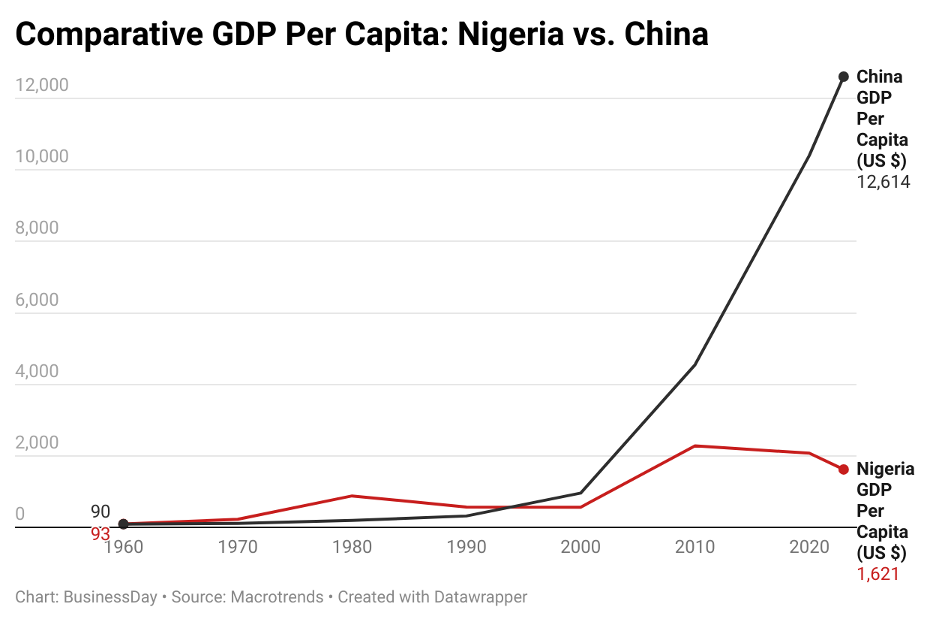
For years, Nigeria’s GDP per capita exceeded that of China, spurring hopes that it would emerge as a regional powerhouse. Oil discoveries only amplified this optimism, with the economy initially benefitting from high revenues and rapid growth.
Yet Nigeria’s economic story would take a different turn. Today, China has soared to become the world’s second-largest economy, with a GDP per capita of $12,614, according to Macrotrends and World Bank data in 2023.
Nigeria, despite its early lead, now trails significantly, with a GDP per capita of just $1,621. What caused these economies, once similarly poised, to diverge so dramatically?

Parallel Beginnings, Divergent Paths
In the early years, the trajectories of both nations were remarkably similar, with Nigeria’s resource wealth and China’s vast workforce offering distinct yet promising economic foundations.
However, where China moved to industrialize, Nigeria became reliant on oil, diverting focus from agriculture and manufacturing. China’s reforms in the 1970s and 1980s—opening to foreign investment, embracing exports, and developing Special Economic Zones—lifted millions out of poverty and set the stage for long-term economic growth.
Nigeria, in contrast, remained tethered to oil. As prices fluctuated, so too did the economy, which became increasingly vulnerable. Efforts to diversify were sporadic and hampered by inadequate infrastructure and unreliable power.
Data from Macrotrends reveals that while China’s GDP grew almost 10 percent per year through the 1980s and 1990s, Nigeria’s economy lagged, with oil revenue propping up a limited industrial base and discouraging wider economic development.

The Oil Trap and Industrial Decline
The curse of dependency became evident as oil revenue eclipsed other sectors, overshadowing manufacturing and agriculture, which had been traditional economic pillars.
A report from the Lagos State Employment Trust Fund (LSETF), titled Going Down the Memory Lane: Learning from the History of Manufacturing in Nigeria, sheds light on how oil overshadowed Nigeria’s manufacturing sector.
Throughout the 1990s and 2000s, Nigeria’s manufacturing output declined significantly. The report reveals that most manufacturing firms were not export-oriented and lacked the efficiency needed to compete globally.
Consequently, many competitive companies relocated their factories abroad, leaving Nigeria’s manufacturing sector to dwindle.
Even industries like beverages, textiles, cement, and tobacco, which once kept the sector afloat, struggled, often operating at half capacity. Between 2000 and 2008, Nigeria’s manufacturing sector experienced one of its worst declines, with 820 companies either shutting down or suspending production.
The textile industry, once a major employer with nearly 700,000 workers and a turnover of $8.95 billion, witnessed a catastrophic collapse. By 2004, what was once a thriving sector had dwindled to just ten stable factories.
The report underscores a missed opportunity in Nigeria’s history: an overdependence on oil revenue not only hindered the manufacturing sector but left the economy vulnerable to global oil price fluctuations.