. His protectionism seen hampering trade
.Migration, remittances may suffer
Donald Trump’s comeback as the 47th president of the United States is poised to usher in an era of volatility and further pressure Nigeria’s already shrinking oil revenue.

The 78-year-old recaptured the White House on Wednesday after his 2020 defeat, but his victory could lead to some market distortions that would impact oil prices.
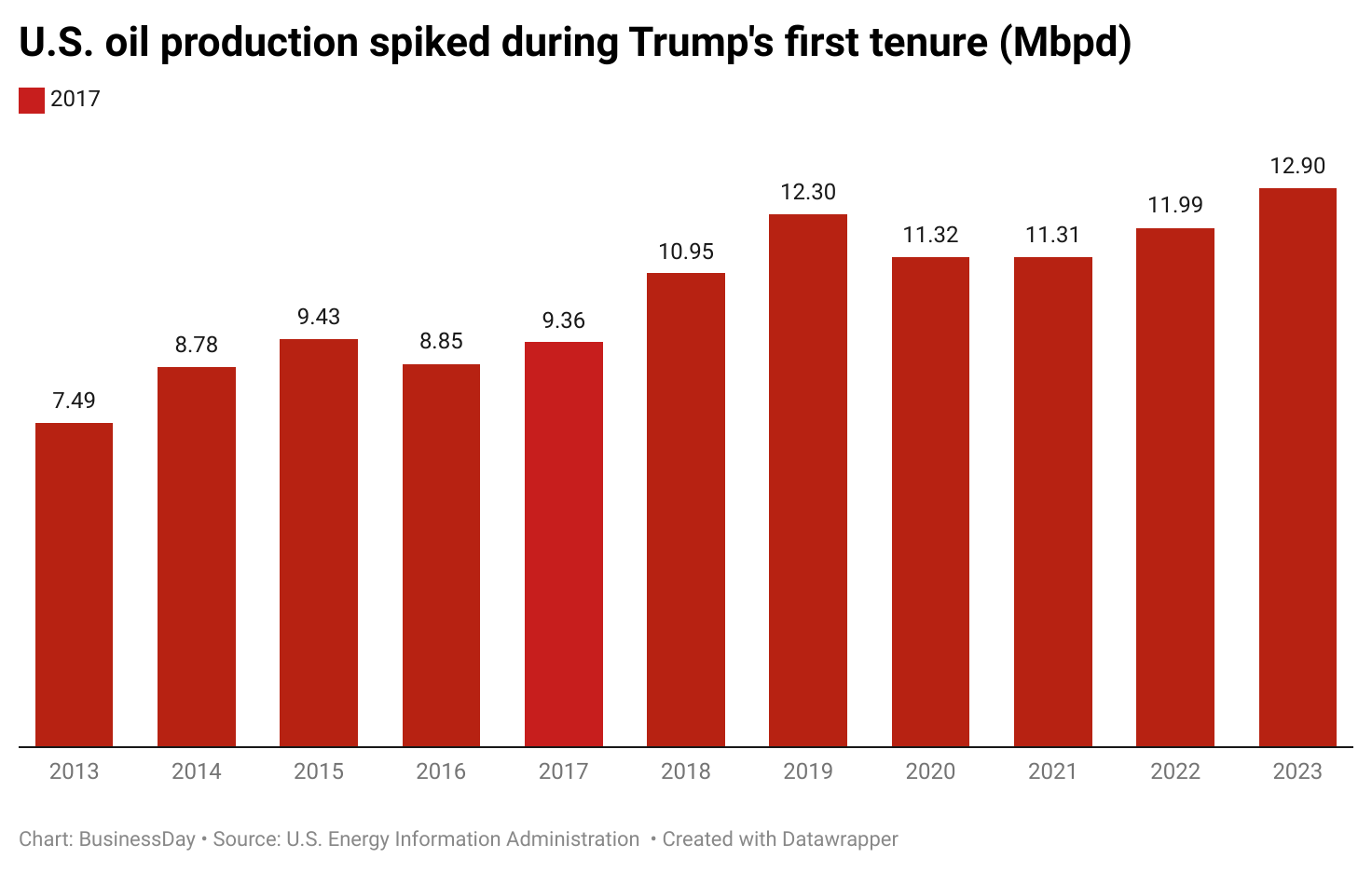
Trump’s plan to increase oil production in the U.S. would potentially lower global oil prices and impact Nigeria’s oil revenue.
In Trump’s first term, the United States’ government leased more land for drilling in the Arctic National Wildlife Refuge, the National Petroleum Reserve-Alaska and in the Utah wilderness.
Trump himself asked agencies to loosen regulations to speed up permits for pipeline construction.
As Nigeria, Africa’s biggest oil producer, relies heavily on oil exports for revenue, lower prices could reduce foreign reserves, putting pressure on the naira and contributing to inflation as import costs rise.

“Trump’s victory may pressure oil prices as he is seen pushing for a further increase in domestic oil and gas production, leading to increased supply in the long term,” said Lukman Otunuga, senior market analyst at London-based FXTM.
Given Trump’s antecedent when he assumed office in January 2017, oil production increased and Brent crude oil prices trended downwards in the first six months.
According to Samuel Sule, the CEO of Renaissance Capital Africa, the Trump-led administration would be supportive of oil industry expansion and less focused on climate mitigation.
“As such, a potential increase in oil supply resulting from policy changes could lead to lower prices, which has an impact on oil producers such as Nigeria,” he said.
Nigeria is not producing enough to shake off the whims of global oil prices.
Africa’s most populous nation currently produces 1.32 million barrels per (mbpd) day, which falls short of the projected budgetary 1.7 million bpd estimated for the year 2024. This is severely hampering the country’s revenue levels.
“The Trump presidency would see America impose some of the harshest protectionist measures. This would hamper the ability of Africans to trade with the USA,” said Samson Simon, the chief economist of ARKK Economics and Data Limited.
“It will also lead to drastic reduction of Africans leaving for America and an America that is less meddlesome in African affairs,” he added.
With slowing migrants, Nigeria stands to lose steam of its already booming diaspora remittances and some of the concessions Africans hitherto benefited from America like African Growth and Opportunity Act (AGOA).
Naira depreciation, rising inflation may persist
Analysts say Nigeria’s naira may continue to plummet, with inflation soaring, should Trump roll out some policies that may lead to trade restrictions.
“Less diaspora remittances and limited ability to trade would mean weaker currency hence more inflation,” Simon, cited earlier, said.
The naira has fallen by at least 51 percent year-to-date and was adjudged in October as the third worst performing currency globally by the World Bank.
This is just as Nigeria is equally contending with rising inflation, which has climbed to 32.7 percent in September, with food prices higher still.
Adedotun Adesile, a U.S.-based financial analyst, said Trump’s ‘America First’ mantra could lead to a stronger U.S. dollar.
“A stronger dollar often weakens the naira, making imports more expensive for Nigeria, which can drive up inflation as the cost of goods and services rise,” the Deloitte Becker CPA readiness scholar said.
Kingsley Moghalu, former Central Bank of Nigeria (CBN) deputy governor, said Trump’s victory will not benefit Nigeria but will matter to the Middle East, Ukraine, Europe more broadly, and China.