.Lagos, FCT, Rivers account for 50%
.States’ IGR rose 32 percent in five years
Pay As You Earn (PAYE) pushed the internally generated revenues (IGR) of 36 states and the Federal Capital Territory (FCT) to a five-year high in 2023, demonstrating that subnational governments can boost economic activities in their domains to earn more income.
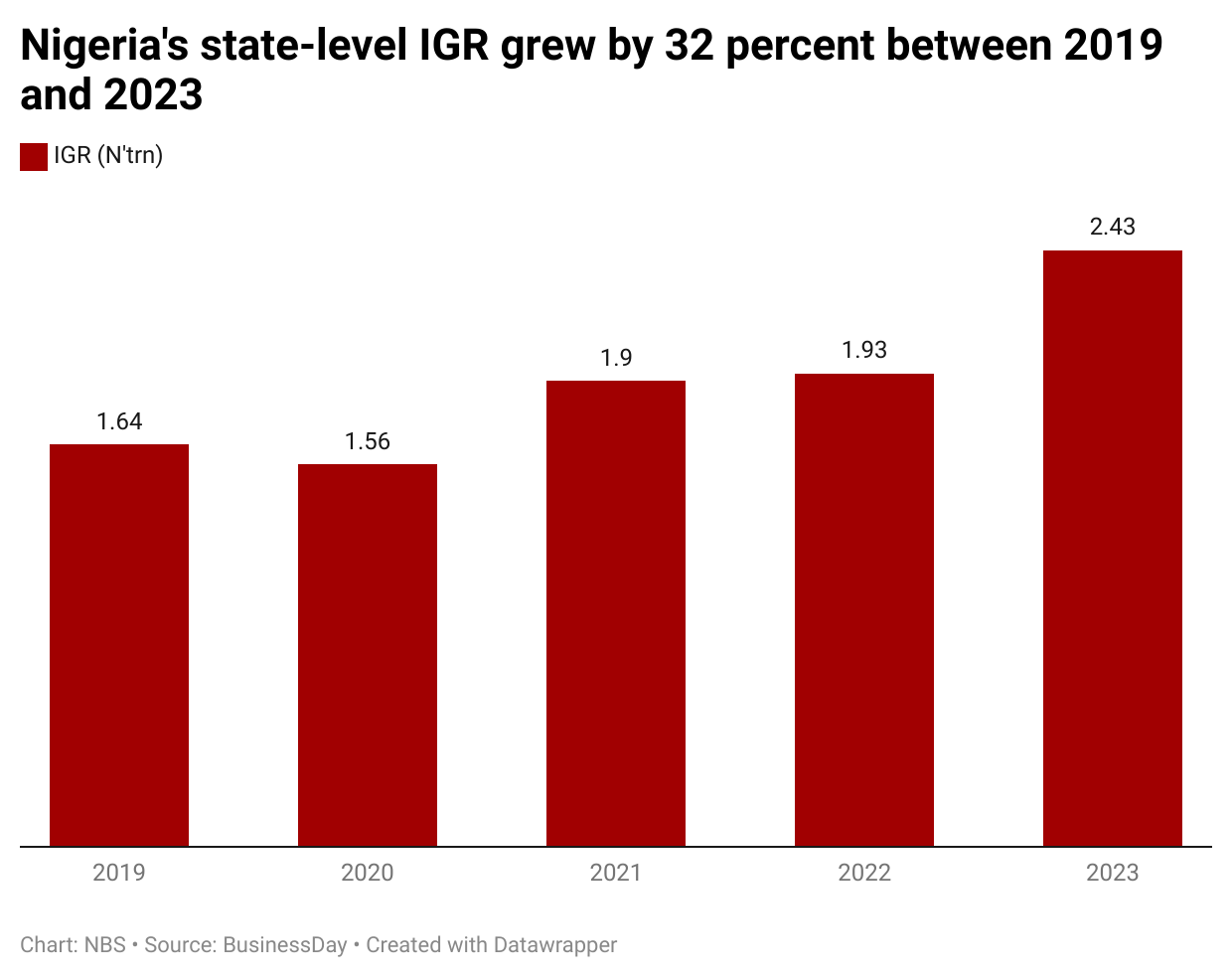
States grew their IGRs by 32 percent, from N1.64 trillion in 2019 to N2.43 trillion in 2023, according to BusinessDay analysis of the National Bureau of Statistics (NBS)’s IGR reports between 2019 and 2023.

The 2023 states’ IGRs represent 41 percent of the federal government’s N5.99 trillion revenue generated in 2023.
According to the NBS, the ratio of total taxes to total IGR stood at 80 percent nationally in 2023.

PAYE, the IGR driver
PAYE was the most tax revenue recorded during the period (N1.24 trillion), representing 63.83 percent of the total taxes collected, while capital gains tax was the least with N5.91 billion.

PAYE is the repayment or withholding scheme that incrementally makes deductions as paychecks are received, said Investopedia, an investment dictionary.

Lagos, FCT, Rivers lead the chart
Lagos retained its top position as the state with the highest IGR in the period under review, followed by the FCT and Rivers. The three states earned 50 percent of the total IGRs over the period.
Four states from the oil-rich South-South region made the top 10, three from the South-West, and one from the North-Central and North-West each. No state from the South-East and the North-East is in the top 10.
All of the southeastern states (Anambra, Enugu, Abia, Ebonyi and Imo) generated N142.94 billion. This is six times less than the amount generated by Lagos.
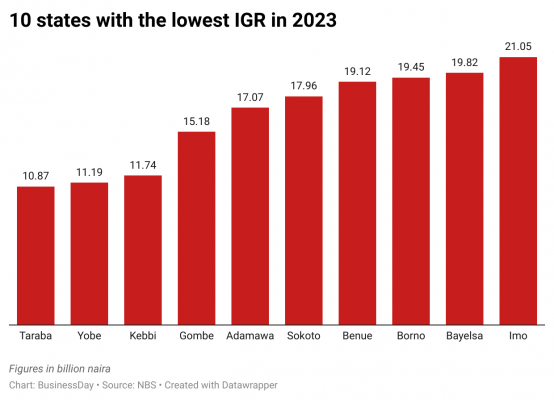
According to the data released by the statistics agency, Taraba generated the lowest IGR in 2023, followed by Yobe and Kebbi.
Meanwhile, revenues from Ministries, Departments and Agencies (MDAs) contributed N478.01 billion to the pool, representing 20 percent to the total IGR.
Experts’ view
Lagos has always topped the chart of IGRs due to its demographic size, infrastructure and growth. The state has over 20 million residents, millions of businesses, seaports, airports and a refinery. These facilitate economic activities and boost the state’s capacity to collect tax.
Rivers is an oil-rich state and collects royalties and other levels of tax from oil companies.
On the other hand, the FCT is Nigeria’s capital with business-enabling infrastructures, experts say.
Tajudeen Ibrahim, director of research, Chapel Hill Denham, said that states should consider incentive-driven taxes for small business owners to improve revenues generated from taxes.
“States can consider some incentive-driven taxes. For instance, people should be encouraged to open for business through initial tax holidays. But once they are granted a tax holiday at first, they will begin to pay tax at the pioneer stage. So, it is just creating an incentive for them,” he said.
Ibrahim said that infrastructural investment in Lagos gives it a competitive advantage in attracting investors who pay tax.
“There are a lot of investments in Lagos and those investments are paying taxes. Lagos can attract more investments, not only because it was previously the country’s capital, but more importantly, because of the level of infrastructure in the states.
“Other states should also invest in infrastructure to attract both local and foreign investments,” he further said.
Afamuefuna Chukwurah, research analyst at Capital Bancorp Plc, said that states should consider improving taxes like “fees for licenses, permits, and public utilities land use charges and market levies” to improve revenue generation.
“States can increase revenue by attracting investments through improved infrastructure, diversifying economies by developing local industries such as tourism and technology,” Chukwurah noted.

Insight
Experts believe that the sit-at-home order in the South-East and high rate of violence may have affected the region’s capacity to collect tax.
In the period under review, states received N6.57 trillion from the Federation Account Allocation Committee (FAAC), more than double their IGRs.
This goes to show that without the monthly disbursement from the FAAC, many states would remain unviable and will struggle to survive.
All of the 10 states with the lowest IGR got at least six times their IGR as FAAC allocation.
For instance, Taraba State got N123.1 billion as FAAC allocation, which was 10 times the N10.9 billion it generated as IGR.
Bayelsa, one of the states with the poorest IGR, received N268.3 billion in FAAC as a result of the 13 percent derivation fund given to oil-producing states.
Speaking on how FX devaluation has affected the total revenue generated by states, Ibrahim said that states need to finance projects with the naira, rather than the dollar.
“FX devaluation has affected states’ IGR negatively because when you convert to US dollars, you now have fewer US dollars than last year. So, it limits their ability to spend on dollar-denominated projects. This is also why states should look at financing infrastructure projects using Naira, instead of dollars,” he said.
While the government’s revenues are swelling, a chunk of the earnings are gulped through debt servicing, leaving the government with a pittance to meet up with its fiscal responsibilities.
According to BudgIT, debt servicing accounted for 43.9 percent of the budget at N8.56 trillion — the largest single expense. This is even as the FG has continued to depend on borrowings to finance its budget.