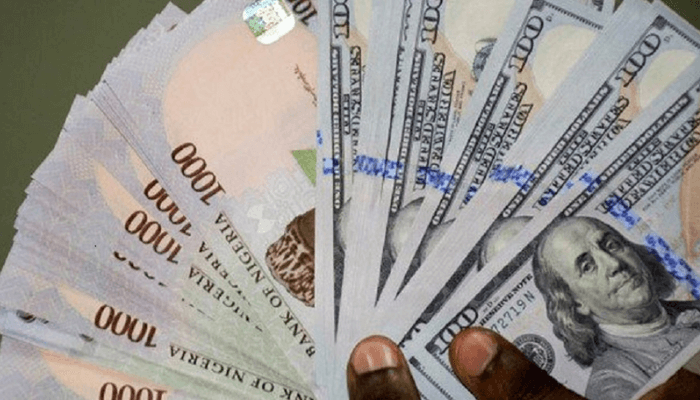
The naira, on Tuesday, recovered from its losses against the dollar, gaining N40.20, following improved liquidity at the official foreign exchange (FX) market.
Data from the FMDQ Securities Exchange Limited showed that the naira appreciated by 2.5 percent as the dollar was quoted at N1, 630.45 on Tuesday compared to N1, 670.65 seen on Monday at the Nigerian Autonomous Foreign Exchange Market (NAFEM).
The FX market turnover increased significantly by 198.86 percent to $242.59 million, from $81.17 million recorded on Monday at the NAFEM.
The FX turnover market turnover refers to the total volume of currency traded over a certain period, usually measured in terms of both buying and selling activities. It does not directly represent the amount of dollars or any specific currency in the market.
According to the FMDQ market summary, the intraday trading closed at N1, 690/$, lower than N1,677/$ closed on Monday, while the intraday low printed at N1,601/$ on Tuesday as against N1,585.67/$ on Monday.
The local currency depreciated on the parallel market, losing N25 against the dollar as the market closed at N1,745/$ per dollar on Tuesday from N1,720/$ on October 18, 2024, data from street traders and online data collating platforms indicated.
Muhammad Sani Abdullahi, deputy governor of the Central Bank of Nigeria (CBN) for Economic Policy, had expressed optimism for Nigeria’s foreign exchange (FX) growth, emphasising the role of the oil sector and diaspora remittances in enhancing FX supply.
According to him, Nigeria’s external reserves have grown to $40.2 billion. This represents a 21 percent or $7.18 billion increase compared to $33.02 billion recorded at the beginning of the year, data from the CBN showed.
Speaking at the banks’ and foreign investors’ forum during the recent International Monetary Fund (IMF)/World Bank annual meetings in Washington D.C., the United States, Abdullahi outlined the CBN’s renewed focus on FX sources to address the rising demand for dollars domestically.
“We now have the oil sector back and back positively,” Abdullahi said. “Over the next few months and years, we will see an improvement in production. We will see that the oil sector contributes much more to the FX growth.”
He noted that along with boosting oil output, the Central Bank of Nigeria (CBN) is also capitalising on remittances from Nigerians abroad, which have shown substantial growth.
“As of last year, the highest we’ve had in a month was $350 million. Now we’re doing $600 million a month for diaspora remittances, and we’re on target in the short to medium term for one billion dollars a month,” he explained. This increase, according to Abdullahi, is anticipated to “significantly clear the domestic market demand for dollars.”
In addition to these efforts, the CBN is implementing strategies to address liquidity risks and to ensure the smooth functioning of the FX market. By leveraging remittances and improving oil sector contributions, the bank aims to stabilise Nigeria’s foreign exchange landscape amid ongoing economic pressures.
Read also: Naira now third worst performing currency in the world
Wale Edun, Nigeria’s minister of Finance and coordinating minister of the Economy, on Wednesday, disclosed that the country’s gross reserves are building organically due to the government’s decision not to defend the naira as was done in the past.
Nine-month low at parallel market
Meanwhile, the naira fell to a nine-month low of N1,745 per dollar at the unofficial market on Tuesday.
Olaoluwa Boboye, economist at CardinalStone, attributed the parallel market’s high rate to speculations.
“The major driver of the depreciation is the speculation around the market. People are buying ahead of an expected rate hike,” he said.
Boboye said that another reason is that the market is not receiving enough supply by the CBN despite FX reserves reaching $40.2 billion.
BusinessDay’s analysis shows that the naira fell by 19.17 percent at the parallel market, from N1,460/$ per dollar in late January 2024 to N1,740/$ on October 29 2024.
“The CBN’s firm policy trajectory is fuelling speculative activity, as high-net-worth individuals hedge against inflation by buying the dollar, leading to a naira depreciation,” Afamuefuna Chukwurah, research analyst, Capital Bancorp Plc, said.
“This is the end of October. We’re moving into November, approaching December. You would find that around this time, there may be some sort of flight to safety because of the potential volatility that is likely to occur towards the end of the year,” Segun Sopitan, principal partner Woodridge and Scott Consulting, said.