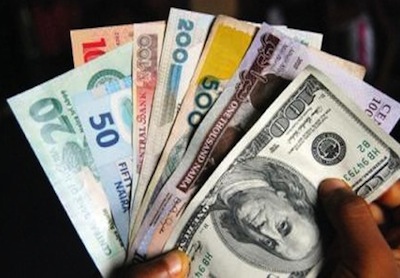
Gains by the Naira have kept Central Bank Governor, Godwin Emefiele from having to raise interest rates four days before elections.
The naira, which reached a record low of 206.32 per dollar on Feb. 12, has since advanced 3.7 percent after the CBN imposed restrictions to protect the currency. FGN bonds have risen 2 percent in dollar terms since the end of February, the most after Russia and the Dominican Republic among 31 emerging markets, Bloomberg indexes show.
Following the drop in oil prices, ratings agency S&P downgraded its credit rating for Nigeria by one level to B+. The IMF also cut its growth forecast for the country to 4.8 percent.
“The naira seems to have stabilized momentarily, and the transition to the new currency system has been relatively smooth,” John Ashbourne, Africa economist at Capital Economics in London, said in an e-mailed response to questions. “The Central Bank of Nigeria certainly avoided a disaster.”
The currency’s rebound gave the Monetary Policy Committee room to keep the benchmark lending rate at 13 percent on Tuesday. The drop in oil prices slashed foreign exchange reserves needed to defend the currency, prompting Emefiele to raise the policy rate for the first time in three years in November by 1 percentage point and devalue the naira.
The Central Bank introduced a new trading system on Feb. 13, under which banks can only buy dollars in the interbank market when they have matching orders from customers who need foreign exchange for imports. Five days later the regulator abandoned weekly foreign-exchange auctions, effectively devaluing the naira for the second time in three months, helping to stabilize the currency.

READ ALSO: LASUTH proves capacity in cardiothoracic surgery as 22 year old is saved
The naira was unchanged at 199.05 per dollar at 7:57 a.m. on Tuesday in Lagos, the commercial capital, taking its decline this year to 7.8 percent.
“They’re hanging on until after the elections” before letting the naira weaken further, Blackwood of EM Quest Capital, which advises Denmark’s Sydbank A/S on $3.5 billion of fixed-income investments in developing countries.
“Then there’ll be less pressure on the currency and less need for trading restrictions.”
“Our view currently is that they hike to 15 percent within the next few months,” Ashbourne said. “Inflation should pick up further as naira weakness passes through into the broader economy, and it is likely that the currency will take another hit if the election results in a political crisis.”
A weaker currency will translate to imported inflation for Nigeria, as the country is heavily import dependent. Inflation rose to an annual rate 8.4 percent last month according to the NBS. The CBN will be seen raising rates later in the year to curb a further rise in inflation.