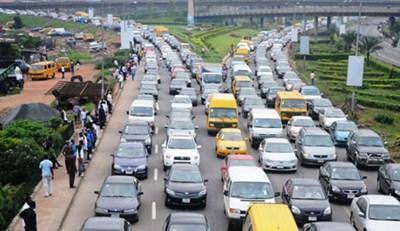
Lagos’ growing notoriety as a difficult place in which to live and conduct business is seen having a wider impact on its longer-term attraction for global businesses. Harder living conditions, most notably from highly congested traffic situation, and dearth in infrastructure is dulling the shine of one of the fastest growing regions in Africa. Data released last week from consulting firm Price Waterhouse Coopers (PwC) that analyzed cities in terms of their relative strengths showed Nairobi and Johannesburg as the region’s top destinations in terms of financial services while Lagos followed behind.
Lagos’ underperformance in PwC’s indices is not unrelated to its dearth in infrastructure, as well as lingering difficulty in its business environment. The expectation from watchers would likely have been that as a city vying to become the top finance center in the region, investment in basic infrastructure would be ramped up, in preparation for the influx of more businesses and its attendant population. Seemingly, Lagos’ infrastructure, especially its roads is being over- whelmed by the over 20 million people residing in the city.
The pace of infrastructure spending mean-while, has not kept up, hence the widening gap. According to the report, Nairobi and Johannesburg are ahead of Lagos in the area of infrastructure development. In terms of ease of doing business, Lagos did not fare better, as Nairobi recorded 12 points out of a possible 20 in the PwC index, Jo- hannesburg scored 19 points, while Lagos scored 8. Lagos’, and indeed Nigeria’s un- friendliness in hosting businesses is highlighted by the decision of international businesses to choose other locations as bases for their operations, at Lagos’ expense. Nairobi, being perceived to be a much better place for businesses now hosts global businesses such as Bank of China, Blackberry Ltd, Cisco systems, Diageo, Mastercard, Pfizer, Qualcomm, Rockefeller foundation, and Sony. Johannesburg, on the other hand serves as the Africa base for international financial institutions such Goldman Sachs Group Inc., JPMorgan Chase & Co., Deutche Bank, and Barclays. Johannesburg also hosts companies such as BMW, Levi Strauss, Singapore Airlines, and Volkswagen.
The Foreign direct investment index based on the report also showed Nairobi becoming an investors’ favourite, scoring the maximum 20 points, while both Johannesburg and Lagos were tied at 18 points. Lagos however ranked as the top spot in culture, as the centre of music, as well as an essential venue for movies (Nollywood). However when gauging opportunities in the surveyed African cities, Lagos outperformed peers in the middle class growth category as it scored 18 points, while Nairobi and Johannesburg scored 13 points and 6 points respectively. Analysts say Lagos will be- come more attractive to investors if money is spent in infrastructure development given the immense opportunities in its rising population and burgeoning middle class. “Infrastructure investment needs to expand”, said the PWC report.

READ ALSO: #ENDSARS: We’re still quantifying our losses – BRT operators
“Africa’s cities cannot maintain their current levels of growth with- out enhancing their infrastructure,” it said further. Some constraints for Lagos, according to PWC include its clogged city centres and constraints on river crossings citing that the inability to access central business districts over rivers is often a major cause of the congestion. “Although Lagos has three bridges to the mainland, a journey to the airport that only takes 20 minutes on a Sunday morning can easily take three hours or more on a weekday evening, especially in the rainy season, the report said. The report sees rail infrastructure as the answer to the notorious conundrum of road building. The World Bank has estimated that while sub-Saharan Africa needs infrastructure investment of nearly $100 billion annually, it currently gets less than half of that.
Lagos has accessed World Bank loans to part finance its light rail project estimated to cost N160 billion ($800 million) to complete in order to meet the transportation needs of its 21 million people. The blue line light rail project however remains uncompleted seven years after construction began. The PWC infrastructure index ranked Johannesburg with 16 points, while Lagos scored 15 points and Nairobi 4 points. Lagos quest to become the financial hub of sub Sahara Africa will take a longer time to materialize as a new report places Nairobi and Johannesburg ahead of the bulging megacity.