In democracies old and new, there is nothing as ordinary and humdrum as a national election. It is a ritual that foreigners will look upon with bemusement and nonchalance. Increasingly, however, national elections, especially in developing and emerging democracies such as ours, have tended to take on a palpable international dimension, with the media, international institutions and civil society organisations and the business community taking a keen interest. Global stakeholders are interested in ensuring that things are seen to be done in a fair, free and transparent manner in accordance with accepted international norms and standards. The gaggle of election observers from the UN, the EU, Commonwealth and an assortment of international
NGOs are often on hand to scrutinise processes and outcomes and to ensure that everything that takes place is above board. This is as it should be.
The upcoming Nigerian elections, however, have taken on a strong international dimension that outstrips what we would consider the bounds of normality. I believe that this undue interest is not merely on account of the fact that Nigeria has recently acquired the status of being Africa’s largest economy by GDP. International investors are inevitably interested in who is better placed to safeguard their interests and whose policies hold a better promise of growing the economy and enhancing long-term development prospects. Again, nothing wrong with that.
My own worry is with regard to the undue interest – even desperation – that seems to inform the attitudes of certain international interests towards the Nigerian elections and the two gladiators in the presidential race. The influential London Economist newspaper opined that although Buhari is a man “with blood in his hands”, he deserves to rule Nigeria, not Goodluck Jonathan, whom they labelled “a complete failure”.
A few weeks ago a Senegalese colleague in Brussels asked me what I thought of the upcoming elections and the prospects for the two frontrunners. I explained to him that I thought their chances were 50:50, with a slight marginal edge in favour of the incumbent, this being Africa. My friend shook his head. He told me he has heard from various “international circles” that the outright and sure winner is Muhammadu Buhari. So sure and so confident was he with regard to the final outcome. This colleague has probably never visited Nigeria in his life, but he felt nothing amiss in laying claim to being an authority on our upcoming elections. As a citizen and regular visitor to my own country and a public intellectual to boot, I thought I had some claim to being something of an authority with regard to the contemporary politics and economics of my own country. Nein, insisted my friend.
I have been deeply troubled by this attitude. A columnist in the Daily Trust was recently writing that if the elections took place fair and square there’s no how Buhari and the APC will not win. Such attitudes are patently dangerous. When President Goodluck Jonathan was asked what he would do if he lost, he quietly replied that he would pack and go back to his ancestral village of Otuoke. When the opposition leader Buhari was asked the same question, he retorted that he could not contemplate losing. I heard echoes of blood, dogs and baboons in that ominous response. The APC has insisted they cannot lose and plans are already in place to set up a parallel government. As far as they are concerned, the only way they could lose is if the elections are rigged.
In fairness to him, Buhari has done more than the president in currying the favour of the international development set. During President Obama’s second inauguration in January 2013, the General was invited while President Jonathan was snubbed by the Americans. Obama was sending an unmistakable signal that he accorded greater respect to the opposition leader than he did the President and Commander-in-Chief of Africa’s most populous democracy. Buhari, we are told, has employed the services of a top-notch American public relations consultant to fumigate his political persona and to present him as the squeaky clean statesman who will set Nigeria to rights. It has also been alleged that Buhari has promised the international community that he would revoke the anti-gay legislation that has recently been passed by the National Assembly; over a practise that the African conscience judges to be repugnant to the laws of nature and the laws of God. To all intents and purposes, the international propaganda is working.
With the mounting tension exacerbated by all the name-calling and virulent personal attacks by either side, international onlookers are getting increasingly alarmed. The UN Special Representative for West Africa, Mohamed Ibn Chambas, has been on frequent visits to Abuja since January to engage with our politicians and to build confidence in favour of free, transparent and peaceful elections. Only last week, UN Under Secretary-General for Political Affairs, Jeffrey Feltman, visited our federal capital to convey a strong message from Secretary-General Ban Ki-Moon that Nigeria must demonstrate commitment to holding elections that meet the standards and norms accepted by the international community. While the UN grudgingly accepted the explanations for the postponement of the elections from February 14 to March 28, they have been insistent that we have a duty not only to ensure free and fair elections but also to uphold the common peace.
Some of us in our own small corner have been talking to European leaders about the good intentions of President Goodluck Jonathan and his government to abide by all democratic norms during the coming elections. We have joined thousands of the Nigerian Diaspora community in campaigning for peace during the coming elections.
A recent trend that I find most unsettling is the constant reference to the ICC by the opposition APC. Over a silly remark that the First Lady Patience Jonathan made a few weeks ago, the opposition wrote a letter to the Chief Prosecutor of the ICC in The Hague alleging “Crimes against Humanity”. During the same period the opposition press reported with glee the decision of a court in Abidjan to sentence former Ivorian First Lady Simone Ehivet Gbagbo to 20 years in prison for various political crimes. The same APC has again written to the ICC over last week’s demonstration by the Oodu’a People’s Congress (OPC) against INEC Chairman Attahiru Jega. They alleged that the OPC were demonstrating aggressively on behalf of the ruling PDP, presaging the armed confrontation that is to come.
The parallel being drawn between the Gbagbos and the Jonathans is a historical fallacy. I lived in Côte d’Ivoire for several years during the turbulent period leading to that country’s civil war. The truth of that tragedy will one day be told. As Chinua Achebe used to say, until the lion learns to tell his own side of the story, his story will always be told by the hunter. There were many hunters and vultures in Côte d’Ivoire: the French and their hatchet man Blaise Campaore, who created the forces nouvelles and armed them with the most sophisticated weapons to fight a democratically elected government. Gbagbo and his wife began their careers as young university lecturers who throughout their lives fought against one-man rule during the long years of Houphouet Boigny’s benign dictatorship. They were frequently in and out of prison for their convictions. Gbagbo’s real crimes as president was because he wanted to put an end to “France-Afrique”, the pernicious invisible imperialism that ensures that France exerts total political, economic and geostrategic control over its (former) African colonies.
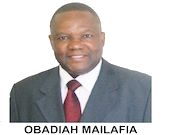
Obadiah Mailafia