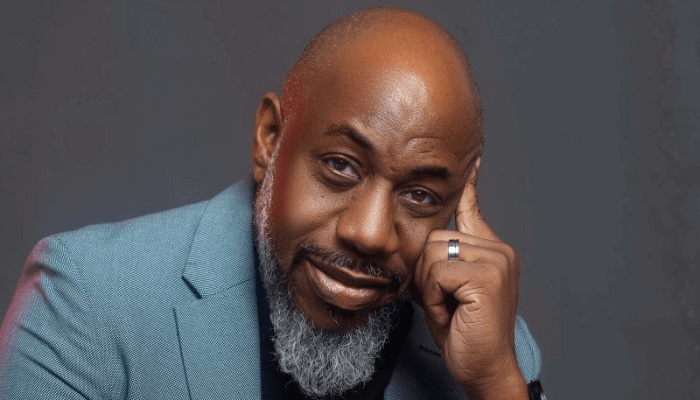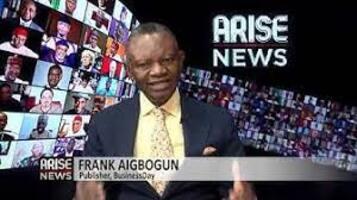
Frank Aigbogun, Publisher and Chief Executive Officer of BusinessDay Media Ltd., Nigeria’s foremost and most authoritative business newspaper, shared insight in this 30-minute thought-provoking and very engaging interview on the Arise Television Sunday Newsday programme about the more than 100 days of government under President Bola Ahmed Tinubu.
Aigbogun also gave us a teaser of what to expect in the much talked-about BusinessDay CEO Forum scheduled to take place at the iconic Eko Hotel and Suites, Lagos, on Thursday, July 13.
Find the excerpt below:
What do you think of Tinubunomics? Which started with the removal of fuel subsidy which people said was courageous, the harmonisation of the Forex exchange regime, the tax reforms, and now the setting up of a committee to give ideas about fiscal policy, tax administration, and addressing the tax revenue ratio to GDP. Your broad thought on all of these

I think after eight years of a Centrist government, a government that tended to pretend that it was capable of providing scholarships for everything we needed, you needed a new direction, which President Bola Tinubu is beginning to establish or create. First, let us talk about the removal of fuel subsidy and the unification of exchange rates. Those were two subsidies that had essentially brought the Nigerian economy to its knees. I mean, if you look at the data, the numbers are staggering: a country that cannot provide health for its people, a country that cannot build basic infrastructure for its people, a country that cannot ensure good education for its people.
We have one of the largest, if not the highest out of schoolchildren in the world. Spending N400 billion on subsidising petrol every month is a recipe for disaster, and I am not surprised that when the president announced that the subsidy on petrol was gone and then prices were adjusted days later, there was not as much as a whipper of protest. As they say, it was something whose time had come.
You go to the subsidy on the exchange rate, because that is what I call it, and look at what is happening, which is quite interesting. The official rate has gone past, and sometimes we imagine what we call the black market rate at N700 and something. But if you look at the initial fear, it was that “if you adjust the official rate, the black market rate will fly away through the window,” but essentially, it is only just creeping.
I was with a very senior manufacturing CEO on Friday, and I was asking about sales, inventory size, and all that, and he said to me, Frank, “We have all been pricing at 700 plus for years, so our prices are going nowhere, because nothing has changed in terms of how we get foreign exchange. Now, I know there is talk about inflation and all of that, but that is not surprising. The truth is that the biggest part, or core, of inflation in Nigeria, has essentially come about through the printing of money by the Central Bank of Nigeria, or Ways and Means.
Then you look at other things the president has done—the relief by way of tax for some months—and I am not surprised by that because this is a transition as one government has come and gone, and many of the things you see today being announced were actually on fire during the last administration. So they are being announced today, and the president is suddenly seeing some of them say, No, let’s take a pulse here.

The law says you must give this number of months before a policy like this can come into force. Then you look at the Taiwo Oyedele committee. One grand norm of taxation is that it has to be fair. So when you look at taxation in Nigeria, the people who bear the burden carry essentially all of the burden. When any new taxation comes, it goes to them because they are the ones that know all their addresses, bank accounts, and all the businesses that they do. The bulk of Nigerians don’t pay tax.
Look at the tax registers of tax authorities in Nigeria, and you will be shocked at how many of us are not in those registers. So what you call Tinubunomics, as some of us are calling it already, is essentially freeing the economy from the hold of government and giving back to the private sector, which constitutes, by some accounts, 87 percent of GDP in Nigeria.
Read also: Nigeria’s future depends on efficient use of gas resources — BusinessDay CEO
What should we expect from the BusinessDay CEO Forum?
Now we have two special guests of honour, both of whom are governors: Governor Umar Namadi of Jigawa State and Governor Godwin Obaseki of Edo State. Both governors would be sharing with guests at the forum what they intend to do to depopulate Lagos. How do we get cities outside of Lagos to attract populations the way Lagos does? How do you create industrial and economic hubs out of Lagos while building a good work-life balance for people?
Adesina would be speaking on a very interesting topic, “The Day the Lion Roared: Making Nigeria a Global Industrial and Economic Giant.” And then, of course, we would have Ralph Mupita, who is the global president of MTN Group; he would be speaking on navigating technological disruption. We have Osagie Okunbor, who is the Managing Director of SPDC, which is Shell Petroleum Development Company, and he is the Chairman of Shell Company in Nigeria. We are interested in finding out from a knowledgeable person like Mr.Okunbor, in an era where there is so much concern about fossil fuels, what Nigeria can still do with its oil and gas resources.
We have significant oil and gas resources. For example, the proven gas reserve of Nigeria is as much as 2/3 of that of Russia. Russia earns about a billion dollars selling gas to Europe every day; we should be doing 60 percent of that. 60 percent of that is $600 million a day. If we were selling $600 million a day in gas, Nigeria would not be where it is today. There is a lot we want to know. I and BusinessDay still believe that Nigeria’s future depends on how we utilise our gas resources. We need revenue from gas to fund our fiscal requirements. We need FX from gas to supply our foreign exchange market. So oil and gas are still very crucial in all of this.
Now, we have panels. One panel starting in the morning will deal with the impact of government policy and regulation on businesses—big, small, and medium businesses. How do you ensure smart regulation? Regulation that helps us build a bigger cake, rather than regulation that helps us share around the cake.
We will also have a panel on navigating technological disruption. We want to be early adopters’ of technology so that we can benefit from and thrive in the fourth industrial revolution.
We also have a panel on mobilising capital for growth. The biggest challenge that Nigeria has today—which is ironic—is getting enough capital to fund development and growth. I say it is an irony because there are trillions of dollars packed aside around the world looking for good places to be invested. Unfortunately, over the years, Nigeria has been seen as a place not serious, not even desiring, not even deserving of attracting capital, which we badly need in Nigeria.
Do you think that President Tinubu can provide that leadership? And what are the priorities that you will ask him to focus on? because the sustainability of the growth of businesses is important. One of the things he said about the executive orders is that the whole idea is to provide an enabling environment. So what will be the priorities without preempting the outcome of the CEO forum?
You see, after he announced that the subsidy is gone, BusinessDay reckons that the next Federal Accounts Allocation Committee (FAAC) will have a pool of funds that is essentially doubling with the work that Soludo’s committee is doing on behalf of the National Economic Council (NEC). So we are moving from N760 billion to N1.4 billion in one month in terms of the size of the pool of funds available to the three tiers of government. The key thing here is discipline. How do you spend this money to make an impact? How do you spend this money to create inclusiveness in the economy? That’s one. So it is not enough to put the money in the pool there; that is constitutional; there is a need to provide leadership. What should we all do to ensure that this money and the impact of it get to our people across the country.
Secondly, we are in the process of a convergence of exchange rates. The biggest challenge today is that of supply. It has always been a challenge, but in the past we focused on things around demand or demand management. For the first time, we are addressing supply, taking away bottlenecks in the way of supply, but I know it is not enough to just say that you have unified the exchange rate. There are a plethora of policies that need to complement the exchange rate convergence that must be done. Better economic management, like I said earlier, would ensure that this whole jump available in FAAC does not become a source of fueling the inflation that is already in a disturbing situation. It has to be well spent, and the transition mechanism has to be right to ensure that the positive impact is huge and that we limit the negative impact.
There is, of course, the point that how do you—in fact, a global CEO of one of the two leading consulting firms in the world said in Lagos that if he were president of Nigeria, there is something he would do every week. He will ask his people to give him the list of the global companies that are not in Nigeria, and every day, I will call one CEO who is not in Nigeria and say to him, “Mr. A, B, and C, why are you not in Nigeria? What can we do to ensure that you come to Nigeria?”
What do you think of the CBN coming out with another policy directive that the IOCs can sell dollars to whoever wants to buy them? Would that address the problem of supply? We hear about this in all these CEO forums—how about actions and follow-ups?—because most of these forums are just talking shops.
It doesn’t end there. Gatherings like our CEO forum seek to promote three things: knowledge sharing, top-level networking, and there are people who have attended these forums and have, in such engagements, tied up investments in Nigeria. Those that are in Nigeria have found suppliers and logistic partners; those who are not in business have found equity partners who are willing to fund their business or fund their ideas.
So this is not just about talking, and the mistake we often make is to imagine or equate those CEOs who come to speak with policymakers. CEOs don’t make policy; they ship it. When the president said, “Subsidy is gone,” at the inauguration, he was speaking from a hymn book. Where did you think that hymn book came from? It is the clamour and advocacy of CEOs over the years. It is providing inspiration for leaders and for the policies of today and tomorrow.
So networking, knowledge sharing, and top-level leadership development are important because we are bringing together those who have already made it there and those who are aspiring to be leaders just to sit at the feet of the senior CEOs and learn how they excel and how they build big global businesses.
How do we participate in the event taking place on Thursday, July 13 at the Eko Hotel and Suites?
You have to register with open registration. Two months ago, people started registering. There are also invitations that have gone out to certain people to come, but we are also still accepting registration for those who have not registered as of today. We need to know how many seats to provide because the Eko Hotel is not a limitless space. We are taking as much as we can, as we expect as many as 300 CEOs from across Nigeria and West Africa to be joining us on Thursday, July 13.
Who are the Key government officials expected to be there?
We expect two governors to be there. These two governors are members of the National Economic Council: the Governor of Jigawa and Godwin Obaseki of Edo State. But we also expect one or two advisers to the president to be in the room. But we also expect heads of MDAs, government parastatals, and regulators in the room as well.
For us, the key people we want to address today are regulators. How do you ensure that regulation is taking away the bottlenecks for businesses to thrive rather than fitting bottlenecks in the way of businesses?
Based on a recent World Bank report endorsing the reforms of President Tinubu and saying, according to one of their senior economists, that the current spike in prices will go down in due time, knowing the Nigerian situation, can we expect the price of things to go down?
When you impose a tax and you take out that tax, that impact will be felt immediately. There is absolutely no doubt that, regarding telecom and excise duties, you are going to see it. It is true that when that happens, especially when you make changes the way we have been forced to make changes in Nigeria, If we had been adjusting petrol prices the way other countries do—in South Africa, for instance, petrol prices are adjusted every month.
Only four days ago, South Africa announced the price of petrol for the next one month. When you do that, the changes are usually at the frontier, but when you allow us to get to where we are now, you expect huge bumps. But I have absolutely no doubt that we are doing the right thing.
We are now following economic orthodoxy that has been proven over centuries, that is, if you change demand, then price will change. You must complement the changes with a plethora of other things that people may not even talk about. My thinking about palliative is that the government needs to focus more on long-term, impactful things.