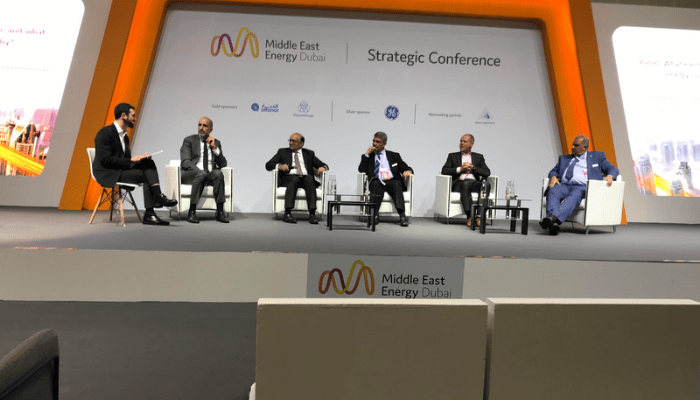
At the three-day Middle East Energy Conference which held in Dubai from March 7-9, half a day’s programme was devoted to discussing investment opportunities in Nigeria arising from the country’s $10billion Energy Transition Plan, the first of its kind on the continent and investors were expressed keen interests in exploring opportunities in Africa’s biggest economy.
A panel session on investment opportunities in Nigeria drew wide interest on the second day of the conference with intense inquiries into the government’s energy transition plans. Nigeria considers gas, which it has an abundance of as its transition fuel, opening up investment opportunities in areas such as gas infrastructure, Compressed Natural Gas and Liquified Natural Gas. Nigeria’s plan to further commercialise flared gas also stirred keen interest.
The Nigeria Energy Transition Plan (ETP) seeks to reach net-zero emissions in terms of the nation’s energy consumption by 2060, by cutting emissions across five key sectors; Power, Cooking, Oil and Gas, Transport and Industry.
With gas reserves of over 206 TCF, Nigeria has chosen to leverage the resources to develop its power and industrial sectors and government officials on the delegation, according to feedback from investors, were impressed in their marketing of the plan.

Sule Ahmed Abdullaziz, the managing director of the Transmission Company of Nigeria, the highest Nigerian government official on the delegation, spent the bulk of this time highlighting the challenges that have conspired to force the nation’s creaking grid to collapse several times this year.
The key challenges, he said, were financing, sabotage of the power transmission lines and sub-national governments’ penchant to impose arbitrary right of way charges before cables and poles can be laid in their regions.
Nonetheless, he encouraged over a hundred delegates gathered at a makeshift conference hall of the World Trade Conference including rich Arab sheikhs, EPC contractors, project developers among others that Nigeria was a fertile ground for investment leveraging its vast gas resources.
“It is said we are an oil rich country, but in comparison to gas, we have just a drop of oil,” he said.
The TCN boss said the country was leaning towards China to finance some energy projects and invited other investors to leverage Nigeria’s plan to transit to cleaner energies using gas. He also said the renewable energy sector holds massive potential and is fast developing.

Sowunmi Olabode, a senior legislative aide to the Nigerian Senate President in remarks at the panel session said while Nigeria contributes less than one percent of the global CO2 emissions, it is not unaware that he world is accelerating transition from fossil fuel dominated to cleaner energies, the country seeks to translate its huge gas reserves into energy for its people.
Addressing investor concerns, Olabode said there was indeed some disconnect between policy making and private sector operation and there is no sufficient forum for effective, constructive engagement. He said governments have realised that consistent regular and effective communication between private and public sector policy makers helps to improve the investment climate.
The event organisers, Informa Markets brought together buyers and sellers from across different countries to explore the latest advancements in energy products and solutions. It provides opportunities to network with international energy suppliers, discover products and solutions that are changing the energy landscape, and build long-lasting business relationships. By the second day of the event, they said deals worth over $750million were already reaching advanced stages but it was unclear if any would be coming to Nigeria.
However, some investors who offered comments during the panel sessions and others who shared their concerns with BusinessDay said Nigeria has to eliminate foreign currency risks to retain interests.
Dolapo Kukoyi, Managing Partner at Details Commercial Solicitors and leads the firm’s Energy, Infrastructure practice, who was on a panel on investments into Africa said while Nigeria allows for repatriation of dollars, the rules must be objective and well communicated to investors and the Central Bank needs to innovate ways that will make the process easier to attract much needed investments.
Malador Sowe, CEO of Sierra Leona-based Disruptive Energy Solutions, in an interview with BusinessDay said governments who talk about incentives, should consider incentives along easing currency challenges for investors to find the continent attractive.
Along with currency risks, some investors were also concerned about regulatory overreach and the challenge with continuity of policies after a new government takes office.