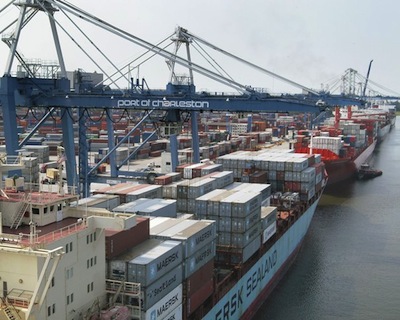
The economy may have lost a whopping N45 billion to the nine-day strike by Customs licensed agents operating at the nation’s busiest sea port, Apapa.
The figure is based on the daily estimate of N5 billion in revenues from the port, following the temporary closure of activities until Tuesday, when the strike was called off.
The standstill made the customs unable to examine containers or process clearing documents. As at yesterday, ports operators were battling with a backlog of 6,000 containers stranded since last week.
Analysts said yesterday, that given the backlog, the chaotic situation may roll over into the new year.

“Ships awaiting berthing at Apapa increased to 81 in October, from 70 in September. We expect further increase at year-end, due to inventory stock up,” said Bismarck Rewane, chief executive, Financial Derivatives Company, in the current,monthly Economic News and Views, at the Lagos Business School.
Industry watchers are foreseeing grinding congestion at the affected port terminals.
“The port is now open, and people are free to come in and transact their business,” said Nasir Anas Mohammed, LPC port manager. Mohammed said the Nigeria Police Force (NPF) and other security operatives have been put on alert, to provide adequate security for anyone with business to transact at the port.
READ ALSO: Vote us out, if we underperform, Senate President tells Nigerians
Apapa port which handles over 50 percent of the totality of Nigeria-bound containers, did not clear any shipments in the nine days that the strike lasted. Typically, an average of 750 containers exit the Apapa port daily. Consequently, not less than 6,000 containers supposed to exit Apapa port in the last nine days, have remained uncleared.

“No single container has exited Apapa port for the nine days that the strike action lasted. The port has started experiencing congestion and there may be congestion on the high seas because Apapa bound vessels may find it difficult to berth because the berthing slots are occupied by vessels stranded by the strike,” confirmed Tony Anakebe, managing director of GoldLink Investment Limited, a clearing and forwarding company.
Anakebe said the congestion caused by the strike was made worse by the overflow of goods, caused by heightened Christmas season imports.
He said one of the causes of the strike was the failure of officers of the Nigeria Customs Service (NCS) to adhere to the Federal Government’s directive to keep the port operative round-the-clock. “The 24-hour port operation has not been effective, and it has not impacted on cargo clearance at the port.
“This is because Customs officers who are supposed to commence clearance at 8:00 am, are compelled to start at 12:00 pm and close at 4: pm due to man-hour losses caused by unyielding traffic gridlock in Apapa.”
A Lagos-based importer, Emma Nwabunwanne, lamented that the importers of the uncleared cargoes at the port would bear huge losses, resulting from storage and demurrage charges. These losses, he added, would be passed on to the end users, by way of increased prices of imported goods.
He further called for onward transfer of incoming cargoes to bonded terminals, to decongest the Apapa port. “We also want the shipping companies and terminal operators to grant waivers to the importers, to reduce the demurrage and storage charges burden, which have continued to pile-up in the last nine days of the strike.”
AMAKA ANAGOR