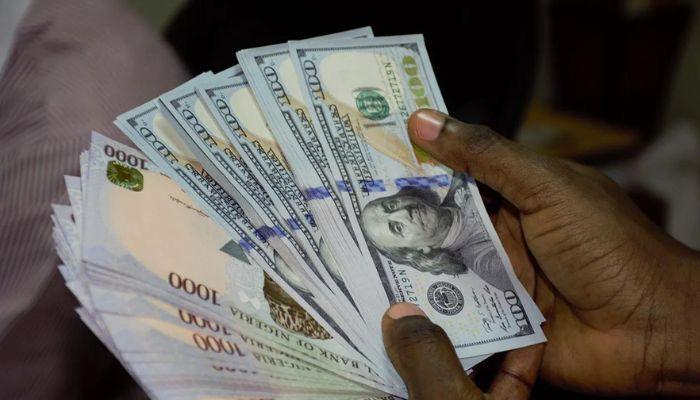
The Federal Government’s exchange rate benchmark of N435.57 per dollar is unrealistic and may lead to a loss of revenue, analysts say.
The National Assembly has approved N435.57/$ as the 2023 budget assumption. This represents 5.84 percent lower (currency value) than N410.15 per dollar for the 2022 revised forecast as of July 2023.
It falls below the 2021 benchmark by 12.07 percent from N383.0/$ actual in 2021.
One dollar is currently being sold at the rate of N461 at the Investors and Exporters (I&E) forex window, Nigeria’s official foreign exchange market.

The Central Bank’s official exchange rate, which it sells at the I&E window, stood at N450.03 per dollar as of Wednesday January 4, 2023.
“Exchange rate assumption is unrealistic. The exchange rate gap is extremely wide. It should be adjusted far beyond the I&E window,” said Muda Yusuf, chief executive officer of The Centre for the Promotion of Private Enterprise (CPPE).
He said with this exchange rate benchmark, the government is losing revenue.
“it should be adjusted to a minimum of N600. They should adjust it so that they can earn more revenue,” he said.
Tope Fasua, CEO, Global Analytics Consulting Limited, said, the FG’s 2023 budget exchange rate benchmark does not look realistic.

“My contention has always been that we should have a more comprehensive method of planning this budget because all they do is just make an assumption for crude oil and that is it,” he said
He said the benchmark price they are using is outdated and also conservative. “The general idea is that all they do is budget from crude oil, what about the solid mineral sector and other sectors where the Federal Government has a stake, which is in fact every sector,” he said.
“There are bigger fish to fry for Nigeria in 2023. The budget is not particularly a big issue; hopefully, the new government that is coming will still have to do a review of the budget,” Fasua said.
Responding to the development, Taiwo Oyedele, head of tax and corporate advisory services at PwC said, “while the approved exchange rate may appear unrealistic, the government has a mechanism to account for exchange differences arising from variances between actual and budgeted exchange.”
He said the US dollar strengthened against most foreign currencies in 2022 due to interest rate hikes by the Federal Reserve Bank to rein in inflation.
This in addition to domestic economic challenges led to the significant depreciation of the Naira, especially in the parallel market.
Unfortunately, he said this trend is expected to continue in 2023 albeit to a lesser extent. In any case, the strength and stability of the Naira will depend more on the government’s ability to tackle oil theft and ramp up production especially if the price remains high.
On his part, Ayodele Akinwunmi, relationship manager, corporate banking at FSDH Merchant Bank Limited, said, the exchange rate the CBN quoted on its website as of January 3, 2023, is N449.51.
“If the FGN adopts N435.57/$ as a benchmark for the 2023 budget, I think it is good for the purpose of planning,” he said.
Zainab Ahmed, minister of finance, budget and national planning, said some of the parameters underlying the 2023 projections deviate from the projections in the National Development Plan (NDP) 2021-2025. They have been updated based on a combination of current realities and a modified medium-term outlook.
For instance, she said the real GDP growth is projected at 3.75 percent in 2023 compared to 4.39 percent in the NDP. Growth is expected to moderate to 3.30 percent in 2024 before picking up to 3.46 percent in 2025.
The inflation rate is projected to average 17.16 percent in 2023, and 14.93 percent projected in the NDP for 2022.