Education is the fourth pillar of the Sustainable Development Goals (SDGs) of the United Nations which specifically demands that nations should have their people acquire the skills and knowledge to sustainable development by the year 2030. Specifically, the SDG 4 aims “to ensure inclusive and equitable quality education and promote lifelong learning opportunities for all.”
However, with economic challenges and political upheavals in many countries today, it is certain that many developing countries will not achieve the goals in the fourth pillar of the SDG.
A country whose people are not educated, disciplined and organized cannot develop. If Nigeria has an aspiration to be a developed nation, why are public universities closed? What do we stand to gain when students and their teachers are attacked by terrorists mostly in the northern part of the country?
Any closure of schools and an attack on students and their teachers in any part of the country is an attack on national development. Attack on education and students started more than three decades ago. You may believe it. Or, you may say that I am wrong. That was when the standard of education started falling below an acceptable threshold, but policy decision makers did not pay much attention to it.

As far as I can remember, ASUU first went on strike in 1986 to protest the introduction of the infamous Structural Adjustment Programme of the General Ibrahim Babangida’s government
What are the problems of the education sector in Nigeria? Inadequate funding of public schools, teachers’ unpaid salaries and incessant strikes by lecturers, particularly at the tertiary level, decay of technological infrastructure (schools, research and development institutions), over 15 million out – of – school children, and because there is no job satisfaction, most teachers engage in parallel businesses that have occupied their time from their main job.
It must be stated that employment of some teachers without relevant teaching skills and qualifications is another way we have wrecked education in the country. We have many youths of school age who cannot complete their education either because they can no longer afford school fees or they are fed up with the education system that cannot guarantee them any form of security.
Accordingly, these youths end up on the streets selling cheap goods made in industrialized countries. Today, we learnt that almost 600 students graduate from our tertiary institutions yearly without work while the nation claims 33 percent unemployment rate in the year 2022.
There is an African proverb which says that “It is only a mad man that go to sleep when his roof is on fire. Scholars who understood this proverb explained that it is only a foolish person that will assume a dying situation to be a comfortable condition. Many Nigerians are now uncomfortable with the incessant strike demonstrated by the Academic Staff Union of Universities (ASUU) because for the past 6 months the Union has been on strike.
One must admit that incessant ASUU strike does not project the country in a good light. As far as I can remember, ASUU first went on strike in 1986 to protest the introduction of the infamous Structural Adjustment Programme of the General Ibrahim Babangida’s government. Within the same period, the Union members opposed the killing of students at Ahmadu Bello University, Zaria, by the mobile police. Since then, it has been one ASUU strike or the other.

Who is to blame for the current ASUU strike? Some will say it is the Federal Government, while some will say it is ASUU. I have seen some Nigerians who have expressed their displeasure saying that both the ASUU and the government are to blame for this current strike. We have read in newspapers that the ASUU wants the Federal Government to abide by the terms contained in the agreement reached between both parties – FG and ASUU – since 2009. Also, the FG is yet to come out clear on ASUU’s preference for the University Transparency and Accountability System (UTAS) against the Integrated Payroll and Personal Information System (IPPIS) which the Union considered troublesome.
REad also: Road to anarchy: ASUU, Labour and solidarity protest
Several meetings have been held between ASUU and the FG. All we could see is accusations and counter – accusations by both parties. The negotiations have dragged for so long that some public affairs analysts expressed their views that Mr. President should have stepped out of the shadow, order his cabinet members and the teachers who are on strike to return to the negotiating table with a clear deadline to resolve all issues. But what did we hear?
Mr President ordered ASUU members to call off the strike because “enough is enough.” But “enough is not enough when it is not enough,” many public intellectuals argued. The ASUU President, while appreciating the efforts made by some stakeholders on the strike replied Mr President that: “It is not over until it is over.”
Explaining his idiomatic expression, the ASUU President said that the Union has no plan to suspend its ongoing strike but to end it permanently. When will the ASUU strike end permanently? To end the strike permanently can only happen when all demands have been met, according to the ASUU President. Some of the lecturers believe ASUU strike can end in 2 days only.
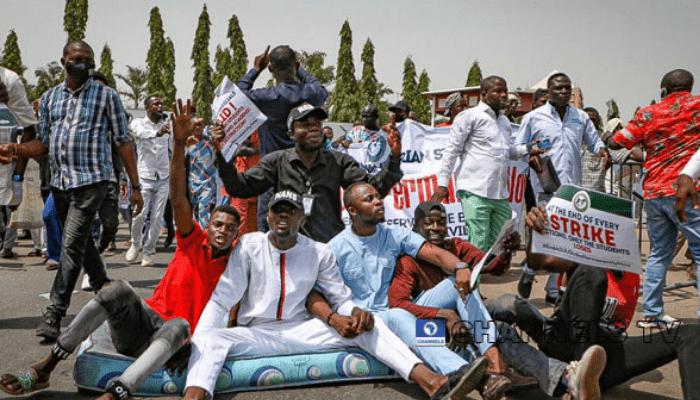
Mr President has directed the Minister of Education, Adamu Adamu, to resolve the 6-month strike within 2 weeks. The Nigerian Labor Congress has equally threatened to join ASUU on a solidarity strike which the FG in its wisdom claimed is illegal.
At the time of writing this article, the NLC has refused to back down on its planned 2 – day nationwide protest scheduled for July 26 and 27. It was rumored that no fewer than 40 unions will participate in the rally called by the NLC in solidarity with striking ASUU which has shut down public universities since February 14, 2022.
It is important to remind policy decision makers that in today’s knowledge – based economy, educated people represent the most critical natural resource of a nation. The power of any nation is determined among other factors by the huge number of educated citizens it can muster at any given time.
Of what value will it be to the nation when the university system completely collapses? All associations and unions in the public universities and colleges of education are either on strike or planning to embark on strike. Even the Aviation Sector workers have planned to join the ASUU strike unless parties to the conflict go back to the negotiating table to resolve their differences. (To be continued)