Lagos State of Nigeria is known for many things, but it does not like to be known for its traffic jams, road congestion and large numerous potholes along some major roads and streets. Indeed, the state has consistently been repairing several roads and in some cases the construction of new roads and expansion of old ones have been the order of the day.
This is in addition to the rehabilitation of some Federal roads such as the Apapa-Oworonshoki expressway pioneered by Dangote Group of Companies with about 12inch thick concrete-based road construction in recent times. Typical examples at the state level include the VGC fly-over and expansion of some portion of the Lekki-Epe road as well as the international airport road.
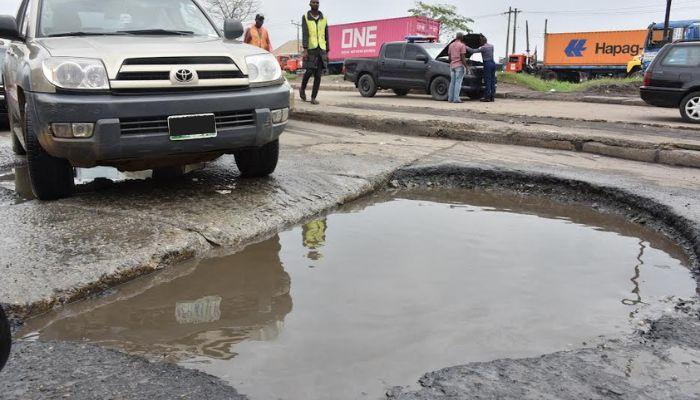
Some TV comedians frequently joke with the state of the roads: “There is a pothole so big on Lekki-Epe road on the approach to ‘Blenco’ store from Epe near the Sango-Tedo U-turn at Ogidan. It has its own ‘pure water depot’ in it. Furthermore, around Farapark Estate very close to the NNPC petrol/diesel filling station in front of the U-turn from Epe is also, another very difficult-to-navigate large pothole. Motorists spend close to over one hour at these potholes.
“When it comes to potholes, some years seem to be worse than others. The last rainy season of 2021 was exceptionally low, but the ongoing rainy season, which is really at the early stage, seems to suggest that not much is being done to alleviate the problems of potholes in the metropolis.

At least, our agency charged with the responsibility of monitoring weather conditions should be able to inform us on the number of inches of rain so far this year and thus, set the pace for road maintenance activities the moment the yearly ‘august break’ kicks in. It is known that potholes are caused by numerous factors which range from poor quality road construction at the onset, over-loaded trucks (lack of weighing bridges), accidents, rainfall, wilful breaking and laying of water-pipes, telephone cables, etc. without recourse to keeping the surfaces in the original or even better state prior to the project.
The thing of poor quality is synonymous with the spate of collapsed buildings across the country at the cost of lives. On a scale of 0-100, poor quality road construction and wilful damage to roads seem to take over 60 percent of the share of causes of bad roads. However, the recent sudden jump in diesel costs since January this year (due to the Russian-Ukraine war and exchange rate fluctuations, etc.) may lead to excessive over- loading of trucks which in turn could impact adversely on the roads and the emergence of more potholes. It is understood that the local government has a role to play in fixing the potholes within their areas of jurisdiction and so it is of every citizen to do what needs to be done to survive this rainy season.
On record is the supervision by the Eti-osa LGA chairman of the filling of the large pothole around Ogidan recently, which lifted up the spirit of motorists. However, the heavy downpour since then had practically returned the road to its poor state. In particular, there is the need for every citizen to be responsible by reversing the age-long old habit of dumping refuse and auto-components and consumables in the city drainage systems; and converting service lanes of most roads such as the Lekki-Epe expressway to trading lanes with make-shift shops constructed deeply into the shoulders of the roads.
In Lagos alone, about 20,000 potholes were filled last year. In my view, that’s an astounding accomplishment, but more needs to be done this year. As a matter of fact, we should have road inspectors on the roads or at least ask the road cleaners also gather information on the state of the roads as they perform their daily tasks. Their role should include monitoring and reporting back to the head-quarters of any damaged or emerging pot holes for immediate repairs.
If you take a closer look at any congestion on the road, a large pot hole within that vicinity cannot be ruled out.

Potholes are to some extent a measure of federal, state, and local government competence—and they are quite costly. To mitigate the cost, we have noticed some innovative and interesting interventions by the government through the models of ‘adopting’ roads and also some form of outsourcing to capable companies and institutions. This approach is commendable more so now that the purse of the state is increasingly shrinking.
Generally, poorly constructed roads/streets cost the average motorist an estimated N250,000 per year in repair work and new tires. There appears to be a steady and dramatic increase in potholes from around 30,000-50,000 in the 1990s to the devastatingly high 100,000-300,000 range in recent years throughout the country.
It is evident that bad weather and the factors enumerated above cause the potholes and therefore, it becomes difficult to use only inches of rainfall as a measure of severity of the rainy season across the southern and northern parts of the country.
There is the need to develop an estimate of the number of potholes versus the inches of rainfall each rainy season and other factors, to aid planning for repairs and interventions. More importantly, the need to act responsibly by other stakeholders of the road/street network cannot be over-emphasized.
Research shows that Nigerian cities would need to resurface at least 1,000 km of roads per year just to stay at par with road deterioration. Any amount below that would contribute to a gap or backlog of roads/streets needing repair. In this context, the real reason for the steady and substantial increase in the number of potholes could be due to the increasing gap in road resurfacing. Let us continue to manage our transportation infrastructure responsibly.
Ojadi is a faculty at LBS and an affiliate to CKCRLE, LBS