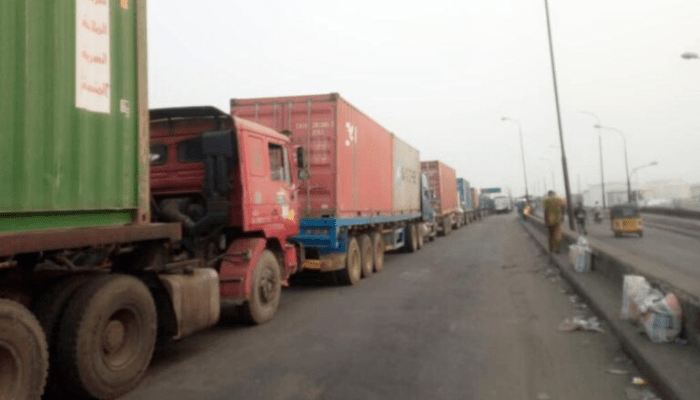
Following the disorderliness in the movement of trucks and other articulated vehicles on port roads resulting in road congestion, stakeholders have called on the Trucks Transit Parks (TTP) Ltd, providers of an electronic call-up system for truck movement into the port, to fine-tune the operations of the traffic management system.
Presenting a paper on day two of a 2-day workshop tagged: ‘Sustainable Synergy with Customs, Shipping Companies, Terminal Operators, Freight Forwarders and Others,’ organised by the 100% Compliance Team of the National Association of Government Approved Freight Forwarders (NAGAFF), Mohammed Sani, general secretary of the Association of Maritime Truck Owners of Nigeria (AMATO), said that though the electronic call-up system for truck movement into the port is working, the service provider needs to improve on it in order to achieve operational efficiency.
According to him, there are multiple checkpoints of human interference along the port corridors that are slowing down the movement of trucks released from pre-gate from getting into the port.
He said TTP has been inefficiently using daily truck manifest to release trucks indiscriminately from pre-gate terminals to flood the port corridors, thereby resulting in gridlock.

Sani said that trucks are also not released from the pre-gate according to the demand of terminal operators.
“Presently, trucks are being released from pre-gate using time belt without waiting for terminal operators to request the number of trucks they could handle at any given time. This contributes to queue along the access roads to the port,” Sani said.
Read also: NAGAFF secures release of vehicles trapped at Clarion terminal
Sani however said that the worst of Eto is still far better than the days of the manual call-up system even as he called on the Nigerian Ports Authority (NPA) and other stakeholders to synergise in order to eliminate checkpoints and extortion as well as other operational bottlenecks hindering Eto so as to improve operational efficiency.
On his part, Remi Ogungbemi, chairman of AMATO, urged TTP to take urgent steps toward ensuring the removal of the long queues on the port access roads.

Reacting, Irabo Akumona, head of operations at TTP, said the Traffic Manager of the NPA determines the number of empty container trucks, export, and flatbed trucks that each terminal can handle on a daily basis.
He said the TTP only works with the information provided by the Traffic Manager.
To him, the TTP has challenges in the area of daily truck requests, which deals with terminal operators because some terminals do not work when it rains while others complain of insufficient equipment and network failure.
Earlier in his opening remark, Barth Okeke, secretary of the team, who represented Tanko Ibrahim, the national chairman, said it was a shock that service providers, government agencies, and others were absent from the 2-day event.
According to him, government agencies, shipping companies, and terminal operators should have been the ones to undertake the initiative of organising workshops that would provide a platform for stakeholders to come together and discuss crucial operational issues and challenges in order to boost efficiency at the port.