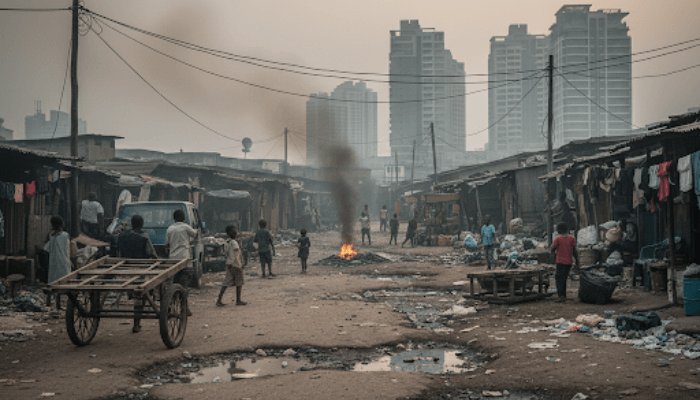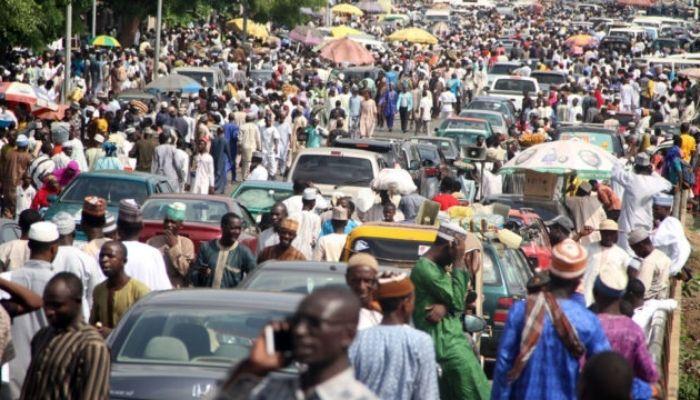
Life and living in contemporary Nigeria have never been tougher than in previous years. Many more Nigerians are leaving the middle-class niche, sliding steeply into the poverty canyon with every passing day.
Sadly, the state functionaries seem to be indifferent to this unfortunate reality, insofar as it bears no immediate effect on their excessive debauchery and political gains.
Misery, defined as extreme joblessness and low economy-wide production at the same time, has been the lot of Nigerians for a long while now. However, President Buhari’s government has come to ensure that things get worse and this has been so since he assumed office in 2015!
Indeed, Nigerians have become much more miserable in 2022 than they were in 2021 and 2020.

For instance, Hanke’s Annual Misery Index Report in 2020 showed that out of 156 countries observed, Nigeria’s position in the misery index calibration had been downwardly revised from occupying the 15th most miserable country to being the 11th most miserable country in the world.
Within the African region, the Report also shows that Nigeria ranks 4th in the league of the most miserable countries in the region in 2021, only behind Sudan, Zimbabwe and Angola.
This reality has placed Nigeria among the most besieged countries by poverty, hunger, disease invasion, extremism and endemic corruption. Certainly, this does not augur well for Nigerians
his reality has placed Nigeria among the most besieged countries by poverty, hunger, disease invasion, extremism and endemic corruption. Certainly, this does not augur well for Nigerians.
With the index of consumer prices, which measures the yearly inflation rate ticking at 15.92 percent (year-on-year) in March 2022 and the unemployment rate standing at 33.3 percent, according to the National Bureau of Statistics (NBS), Nigeria’s current misery index score tops at 49.22, a value significantly higher than 41.12 index points observed at the start of President Buhari’s tenure in 2015.
Between the start of the present administration’s government and now, the country has slipped into recession twice, and this partly explains the reason for a rough macroeconomic exposure and the subsequent undesirable outcomes as are currently observed.

According to the International Monetary Fund (IMF), Nigeria’s 2022 economic growth has been predicted to slow to 3.8 percent from the 2021 4.5 percent. This slow growth projection can be blamed on the impact of the novel Covid-19 pandemic and the current Russia-Ukraine fox-trot as global supply chains struggle to resume normal flow of activities and consumption goods as well as rising energy prices. The IMF has further projected that regional inflation rates in 2022 and 2023 will remain at their elevated levels of 12.2 percent and 9.6 percent, respectively.
Currently, there seems to be no signal of a corrective plan to ameliorate this fast worsening and dismal situation. Instead, the general elections which are set to hold in 2023 appear to be the dearest fancy that tickles the imagination of the nation’s public office-holders. In view of their myopia, they fail to understand that inbound regimes will always be haunted by the consequences of the preceding administration’s ineptitude and poor governance.
However, it is instructive to appreciate that the country’s current misery situation is avoidable. Stacked with abundance in human and non-human resources, Nigeria’s pre-oil discovery years can be experienced again. However, for this to happen, there must be a concerted and intentional effort between and among: the government, private sector players and the diaspora.
The government must commit to re-stabilising the macroeconomic variables if efforts by the private sector are to be meaningful. The government must stick to its core duties of optimising the social and economic welfare of the state by promoting stabilisation, structural adjustment and fair wealth distribution policies.
Ensuring stable prices by prioritising inflation targeting policies over other money supply policies, maximising reserve policies by the CBN, and promoting foreign exchange stability by prevailing on deposit money banks and other licensed FX transfer operators to allow for the availability and accessibility of the greenback to all who need it for their various activities. These indeed are some of the ways in which the government can roll-back unfavourable trends in the economy.
Furthermore, the government must openly support and defend transformative change through technology and social media embrace, optimise revenue generation and collection without further tightening the economy.
Moreover, the productive base of the economy must be diversified through massive industrialisation, especially in extractive minerals and household consumption goods industries.
There is also the need for the government to hand over state-owned enterprises that constitute a fiscal drain on the economy to more efficient private hands. If and when these are allowed to happen, then, the stage would have been set for effective private sector participation in the economy.
The private sector is not primarily a welfare-oriented entity. Rather, it is a resource maximising body whose activities are capable of transferring wealth only to the most productive players along the value chain. Wealth maximisation should accompany productivity, and so, venture capitalists should help to encourage entrepreneurship in small, medium and large-scale enterprises.
Hence, the private sector should take advantage of the government’s stabilising and welfare policies to drive more investments and expand the opportunities for wealth creation through productive labour engagement and value offering.
The media is also needed to serve as the conscience of the public office holders by demanding better governance and accountability from each government representative at all levels.
A synergic association between the public and private concerns in the country will serve as a formidable template upon which foreign interests may truly impart positively to the economy.
Meanwhile, Nigerians in the diaspora have for long repatriated capital to fund the social welfare of their families and friends back home. However, the overall welfare effect of this capital flow is not sufficient to solve the misery equation of the country.
If diasporas transfer a significant amount of their transfer budget back home to augment domestic private savings to fund investment in financial and other durable assets, then, the country will enjoy multiplier returns in output and income.
Furthermore, Nigerians in the diaspora should also avail themselves in instances where their wealth of experience and knowledge may be required when issues concerning nation building arise.
In all, pulling Nigeria out of its current misery profile requires not just an isolated effort by the government, but a coordinated commitment by all Nigerians in their various spheres of life. In the long run, giving the country a fresh head start might be difficult. However, it is achievable. Therefore,
governments at various levels should put their respective hands on the plough. This is with a view to ensuring that Nigeria’s misery index is substantially reversed along positive lines.
Indeed, such is a well-resourced Nigeria that, the country has no business with poverty and the attendant misery.