|
Getting your Trinity Audio player ready...
|
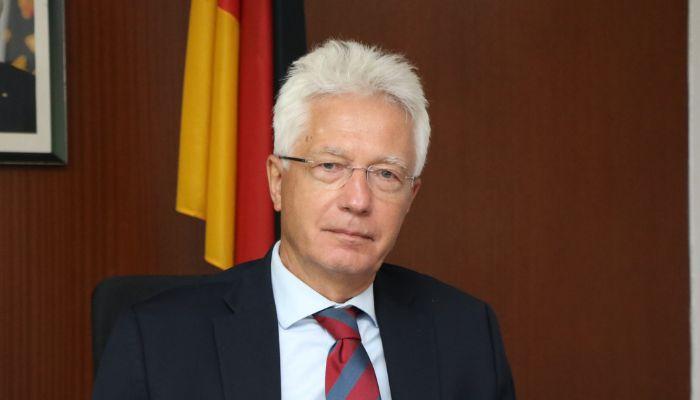
Nigeria is Germany’s second largest trade partner in Sub-Saharan Africa, but the value of trade in 2021 was ten times lower than what Germany did with South Africa, its largest trade partner. BERND VON MÜNCHOW-POHL, head of Mission, Consulate General of the Federal Republic of Germany in Lagos, in this interview with CALEB OJEWALE, speaks about knotty issues in trade between the two countries, German companies bringing their expertise to establish in Nigeria and general opportunities to deepen trade. Dr Munchow-Pohl speaks extensively on the unique opportunity Nigeria has to step up as a Gas supplier to Europe but an opportunity limited due to a number of factors that must be urgently addressed. He also gives insights into the forthcoming (2023) elections. Excerpts:
What has the experience been for you in 9 months of serving here in Nigeria? And what were your earliest impressions being in Nigeria?
I read about Lagos (before coming here) and my experiences made me feel very quickly that this is the business hub of Nigeria. All the companies of any relevance to this country are either here, or if for whatever political reason need to have headquarters in Abuja, they still have a presence here because it is where the business is.
Before Nigeria, I only had one previous African posting (in Niger), which even though was a neighbouring country, it was different in many ways. The contrast to Lagos was quite stark. Here it is very easy to get to talk to people, they are very approachable, or will approach you if they need to.

There is this coincidence, perhaps, that Nigeria’s current and immediate past president (Goodluck Jonathan and Muhammadu Buhari) had their earliest foreign head of state visits with the German Chancellor, Angela Merkel, do you think it has any reflection on the bilateral relationship between Germany and Nigeria, or is it really just coincidence?
That’s interesting, and of course, we are very honoured by this. In general, Germany and Nigeria go back a long way. We opened our mission (in Lagos) right after (Nigeria’s) independence, so we always had a very strong presence here. And as you know, we, like other countries, moved the embassy to Abuja, but we stayed here with the consulate.
I always like to add that the consulate is actually bigger than the embassy (laughs). We have been here through the ups and downs. Nigeria is the most populous country in Africa and is at this point still the biggest economy in Africa (by GDP), although I read the other day that South Africa and Egypt are closing in.
Nigeria is our second-largest trading partner in Sub-Saharan Africa, but (as at 2021), trade with South Africa which is number one, is tenfold to that of Nigeria.
Speaking of business, apart from crude oil & cocoa that we already know of, from your own knowledge and experience, are there other areas of opportunities that you think exist for Nigerians to do business with Germany?
If you look at the structure of our bilateral trade, the export from Nigeria remains dominated by fossil fuels and agricultural products, which are mostly unfinished products such as cocoa.

I know that there are efforts to improve the value chain in Nigeria and also have (more) finished goods as export commodities to the world and I personally believe that has a lot of potential. Of course, it depends on who else is in that market and Nigeria’s particular value addition as an export country. The way to go is to do this all by yourself (i.e. value addition) and export it with a higher margin.
However, the domestic market still has a big demand as there is still a lot of food being imported. Therefore if you are producing in Nigeria, the first opportunity to look at will be locally. But beyond that, I think some of that would also stand a good chance for export and I think that’s in very broad terms, the future for us.
On the other side of that question, are there things Nigeria currently gets elsewhere that you think Germany perhaps can offer us a better deal?
You used the word ‘better deal’ and I think that’s exactly the clincher because if you reduce better deal to price, then of course, a lot of things that we produce, export and that we’re known for, we cannot compete with producers, like say China.
We don’t even try to do that because that’s not really our part of the market. If you look at what Germany exports to Nigeria, you will find machinery, tools, vehicles, chemical products, and some electronics, but with an emphasis on the first two; machinery and vehicles.
In Machinery, we do not compete with Chinese machine producers because German machinery is better. Also, one of our advantages is that we provide quality after-sales services. Take for instance, someone in the food industry; you have some packaging equipment imported from Germany that puts all your juice into cartons every day. You cannot afford to let that line of production go idle otherwise you would lose so much money (it has to be efficient and reliable). This is what German companies in that market are known for, also what their customers expect, and why our machinery is a little more expensive.
Over time, some (German) companies have actually set up here and they produce equipment in Nigeria, not just importing to sell. An example is Krones in Ikeja, which produces equipment for packaging lines. Another one is Big Dutchman, which produces agricultural equipment.
I understand both of them are making good business, production has been expanding and they are very content with the way their Nigerian business is going.
We are waking up in Europe to realise we can no longer depend on Russia, and then the question is how soon will you (Nigeria) be able to bring all that gas to the market?
What do you think are the major impediments to expanding some of these existing opportunities?
Nigeria is our second-largest trading partner in Sub-Saharan Africa, but (as of 2021), trade with South Africa which is number one, is tenfold that of Nigeria. The volume of trade that goes on in both directions – imports and exports- between Germany and South Africa, is 10 times what was done with Nigeria.
Trade is basically around a billion euro in each direction, between Nigeria and Germany, and for a country the size of Nigeria that is not much at all. I was kind of astonished and had expected it to be higher although some previous years were higher.
I don’t know how much this is all tied to COVID, but the current trade balance is about two billion euros, whereas in 2014, it was over five billion euros. But then, oil exports from Nigeria have also dropped. However, I would like to say there is still a lot of potential for more (trade).
In the other direction of Germany to Nigeria, because we have a broader-based portfolio, we see that whenever the economy is doing well in Nigeria, then we usually also find customers for our products. But generally, it is hard to predict the process of things in Nigeria, because we struggle with the same constraints and problems as anybody who does business in this country.
First and foremost the Nigerians themselves. Then cumbersome bureaucratic procedures, customs and then the scarcity of forex, security issues, and poor infrastructure especially transport. Of course, the unreliability of power and its high cost. Our own diesel bill went through the roof and we had to beg the headquarters for extra money because it just doubled.
As you know, probably the same for any business in this country, most businesses have to produce power because it is unavoidable and they are dependent on that, and it all goes into the price of the products. It is tough and we are dealing with the same issues as anyone else.
But do you know specific areas where you think these opportunities lie?
I’m sure you must be aware of the renewed interest in all of Europe, and especially in Germany for alternative sources of gas and Nigeria has the potential for that. Because of the war in Ukraine and our dependence on Russia in that area, we need to diversify really quickly. This is predominantly dependence on Russian oil and gas but this is something that doesn’t happen if we look at it from a 10-15 years perspective.
Forget all these pipeline projects, what we would be interested in would be LNG, but this is also very slow-moving. There is the energy terminal in Bonny Island, which has six trains, train number seven has been delayed, and I just recently read construction has not really taken off.
These are big projects. So I don’t know if that’s realistic and I’m sure you hear about these other abandoned projects, where nothing has happened in the past 17 years, like other LNG liquidification trains and terminal gas plans going back to the President Obasanjo years. But in order to ramp up the country’s export potential, these projects all have to be revisited.
I believe that there’s a lot of potential in Nigeria to tap into the current opportunity but it takes more push from the authorities to really bring these things back to life
Any large absence especially from the younger people (who are majority in Nigeria) is not good for the legitimacy of any incoming government
This was going to be the final question but since you’ve brought it up, how can this work out on the more practical side of getting the gas to Europe?
It can be done through specialized LNG ships, which are basically the special tanker ships built for LNG. When you liquidify LNG, cool it down, make it liquid, and then compress it, that way it can be transported through ships. Of course, you need a special terminal to get it onto these ships and the receiving side, Germany in this case also needs a terminal to unload it and then take it to their storage facility and basically turn it back into gas. It is liquified for the purpose of transporting only.
The US has been doing this for a long time, and I think the Bonny terminal, started operating in 1999 or so, with the first line train and now six with a capacity of about 22 million tons of liquified gas every year. By building another line (Train 7) and when that is done, bring output up to 30 million tons.
The plan is good, but we are talking about probably three years if construction starts now, before gas can flow from the train seven. There are also other projects, one has been in the news, in Bayelsa. When it was conceived at the time in early 2000 it was supposed to be able to produce another 10 million tonnes per annum bringing the capacity up to 40 million. Basically, the LNG is all for export because the gas that is used here in Nigeria is sent through pipelines to Lagos and other states.
But if you want to get into this market and get a piece of that pie, as unfortunately, we are waking up in Europe to realise we can no longer depend on Russia, then the question is how soon will you (Nigeria) be able to bring all that gas to the market? For pipeline projects, these are 10-20 years down the road if they ever come to bear which we don’t know quite honestly. There is one on the coastline, it goes all the way around from West Africa to Morocco but this is like a $25 billion project and they’ve just awarded the feasibility study for it.
And then the other one you probably know about is this plan to pipe gas to that steel plant in Ajaokuta but I don’t know if the line exists to Ajaokuta. As you know Ajaokuta has never produced any steel, and I know that it has not been extended yet, since the idea was to bring it to Kaduna and Kano and from there through Niger up to Algeria.
That is a very interesting future. Considering the money you need for building that and the security issues involved. I know some of the security issues in that region. I’m not saying this cannot eventually happen, but this is not something that is going to be realized anytime soon.
Read also: Germany finally breaks from Russian oil in boon to Nigeria
If I get you correctly, if Nigeria is able to put in more investment or infrastructure as it were to be able to do more LNG, then it stands a chance of meeting some of Germany’s needs?
We would be very interested as a customer. It doesn’t matter whom we are dealing with, because, now we don’t have to be dependent on one source. We have just had to learn the hard way and it’s not just in Germany that goes for other European countries. I understand Nigeria is already exporting gas to Spain in Europe, but I read somewhere that whatever Nigeria is able to produce and export in the form of LNG is already taken up by existing contracts. Right now, the country is not in a position to acquire new customers. In order to do that they would need to produce more.
The major activity dominating discourse in Nigeria from now till next year is the election; what are your own thoughts on this election and the direction you hope the electorate go?
This is a very tricky question (laughs). I will answer it in a way I can answer it. First and foremost what we wish for a partner country that has a democratic constitution is that the country ensures all the rules required for the democratic process to work are intact. That they conduct free and fair elections. Our wish for Nigeria is that there will as soon as possible be an impact on the security situation, I think that’s a big worry on everybody’s mind. I would wish for Nigeria that they could achieve broader voter participation because compared to other countries it is pretty low.
In order to really have a mandate from the people of Nigeria it is important that there is more participation (during the election). Any large absence especially from the younger people (who are majority in Nigeria) is not good for the legitimacy of any incoming government. That’s one thing that we hope for; that more people come around and register and then go to vote.
There’s this saying in Nigeria where someone can be referred to as a German machine, meaning the person is very energetic and reliable and this was derived from this perception that German technology is reliable and durable. The question here is; as Germany has built that reputation how do you think Nigeria can achieve a similar reputation?
It is very hard to transplant certain cultural norms and social values or say you have to do it this way because we’ve done it this way and been successful. It might not really work the same way because we operate in different environments. I know certain attributes are often connotated to us, and while some of that is true, in general it is also a generational question.
I am obviously old and represent a generation and I was brought up in a certain way. If someone sends me an email and asks for something I usually answer at least the following day and if I don’t have the information required I’ll say “if you can let me look at this, I’ll get back to you later” so they know I’ve received it and can wait for response. I having things done in an organized way, always result-focused and I expect the same of my staff.
For Nigeria, I believe if we can work on the economy, and business, for instance, if you are in business with someone I think output, reliability, and transparency are very important. You want them to be someone whose yes is yes and no is no. But then, if you look into the Nigerian economy, there are areas where they have done very well. You have an established style of leadership and moral culture. Look at finance for example. What I notice is that mostly in the fintech sector most of the companies have Nigerian leadership but in the production/manufacturing sector, the leadership is predominantly foreign. However, we see more Nigerian leaders in the technology sector of the economy.