|
Getting your Trinity Audio player ready...
|
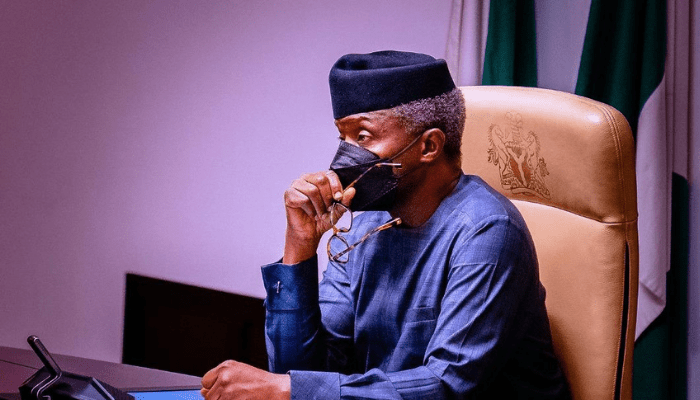
Nigeria needs to urgently speed up local production of products to survive, following disruptions in the global supply chain caused by the ongoing Russia-Ukraine war in Europe, Vice President Yemi Osinbajo said on Tuesday.
Osinbajo said this at the national conference on Non-oil export with the theme “Export for Survival: Optimising Nigeria’s Non-oil export potentials”, organised by the Nigerian Export Promotion Council (NEPC) in Abuja.
With the Ukrainian invasion and with what is going on in the supply chain, if we do not concentrate on local production, it will be extremely difficult to cope. The theme, “Export for Survival”, carries an urgency that perfectly frames the challenges we will increasingly face if we do not accelerate the diversification of the Nigerian economy,” the vice president said.
Osinbajo stated that Nigeria is yet to unlock the full potentials of the non-oil sector. The vice president, therefore, charged regulators in the Nigerian business environment to act as promoters and not as police, to ensure the survival of local businesses.

“We must seek to achieve a situation where regulators see themselves as facilitators of businesses. So our job as government is to assiduously enable businesses with regulatory policies, procedures and processes that are continuously optimized for greater efficiency and easing the flow of business across sectors,” he added.
Read also: 2023 and highlights of the Electoral Act 2022
He also charged stakeholders at the event to produce practical and far reaching recommendations that will further reinvigorate the non-oil sector and the economy at large.
Boss Mustapha, Secretary to the Government of the Federation (SGF), speaking, said the timing of the conference is apt as the world is recovering from the devastating impact of the pandemic which slowed economic growth, as well as the conflict in Europe which has resulted in high prices of commodities.
While noting that Nigeria has not maximized the benefits of the non-oil sector, Mustapha however noted that the contribution of the sector to the GDP has increased tremendously.

For instance, it can be said that the production of rice padding has grown from less than 4 million tonnes to about 5 million metric tonnes in the last three years. “These are clear indications that the policies of the government have boosted production and non-oil exports,” he said.
The SGF however pointed out that, while Nigeria strives to boost non-oil export, it must also improve quality and standard of commodities.