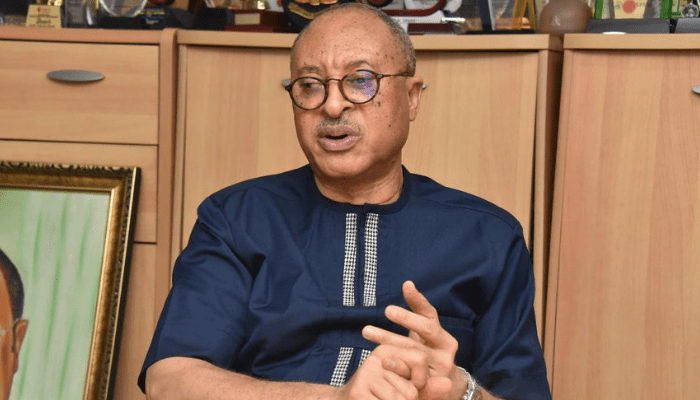
Patrick Okedinachi Utomi, a professor of political economy and management expert, is a Fellow of the Institute of Management Consultants of Nigeria and a former presidential candidate. He is the founder of Centre for Value in Leadership (CVL) and the African Democratic Congress (ADC). In this exclusive interview with ZEBULON AGOMUO, on the state of the nation, Utomi said that revamping the Nigerian ailing economy and turning around the total state of hopelessness in the country was not a rocket science. According to him, some countries that passed through the situation Nigeria is currently in, were able to get it right through the determination of a few individuals to make sacrifices. As the jostling for another round of electioneering is already on, Utomi urges Nigerians to look beyond the two prominent political parties which, according to him, have been responsible for the unfortunate state of the country. Excerpts:
Could you please scan the socio-economic and political situation of Nigeria at the moment? How would you describe the point at which the country is right now?
Nigeria is challenged; Nigeria is at the crossroads. Nigeria has exhausted Nigerians in terms of their faith in governance and government. Nigerians are on the verge of despair. In their homes, violence can meet them; they can be brought out at night and shot. In fact, in some parts of Nigeria, people don’t sleep in their homes because they think it is dangerous; in the night they run into the bush and in the morning they come back to their homes. What kind of life can that be? So, insecurity reigns.
In these times, Nigerians face galloping inflation; part of it is self-imposed; part of it is from circumstance. Galloping from- first of all, the fact that we have so mismanaged this economy that the two things that top our import bill are the two things we should be exporting-food and petrol. Paradox of paradox. And some people have been in power forever and it does not shock them that something like that can be the situation. Of course, there is the imported part of the inflation that comes from the supply chain crisis that came with Covid and the Russian-Ukrainian scenario, but it is partly because we did not do enough to build up our food security for our people when things were normal. So, we are completely vulnerable as a country. Nigerians are also suffering from a state where power supply has been so bad. The National grid collapses with a certain rapidity that you wonder if it is going to stay down permanently. One of the evenings a few days ago, I was coming home from work and there was public power in my house; I nearly had a heart attack. I am not joking, it is the first time I returned to my home in two or three months and there was power; of course, two hours later it was gone, but the shock of seeing it at all was something strange, in the middle of impossible price of diesel. An Indian friend of mine who came in said to me, if half of what is happening here happens in India, government would have fallen; there would be riots and all of that. So, that is part of state of the nation. Nothing seems to be working any more. And the government just looks at you, says nothing; does nothing.

In the midst of the seeming hopelessness, there is another round of politicking going on for positions. We have been here several times; we have been having motion without movement. How do we get it right this time?
There is a fundamental myth that work is in progress in Nigeria. It was cleverly built up by the current dominant political class. It is a myth that people who think are dangerous and that the people who don’t think they have to be thugs and that only thugs can hold things together; basically it is a stupid concept, but Nigerians have somehow been made to believe it that the more stupid you are the more likely you are to be a political leader. So, the country is run by stupid people; so, why wouldn’t the place be a mess like it is? When you talk, you hear people say, ‘Ah na grammar we go chop?’ ‘These na grammar people.’ It is an incredible myth, and how they succeeded in selling it to the people beats me; but they have succeeded.
In 2007, when as a result of frustration in the polity, some concerned professionals came together to engage the space. They said I should run for president. So, I became involved in that process. We travelled round Nigeria. In fact, none of the people who contested the presidency at that time covered Nigeria the way we did. We went from state to state, and covered the entire country. And the typical protocol, you arrive in a state; you call on the state governor. On one of those journeys, we got to Gombe, like I said; we called on the governor and the traditional ruler.
So, we called on the Emir. Normally, you’ll begin with your mission and the nice things about your plan for the country and the Emir smiles at you and says I wish you the best, and those kind of thing you know; civility kind of thing.
But in Gombe, after I said the usual thing about our plan for the country and the microphone passed to the Emir; he said, ‘I don’t misunderstand what I am about to day; I’m not in any way going to indicate that I don’t think you will win the election, but I want to beg a personal favour of you. If you don’t win this election, please don’t stop running for the president! The reason I am saying this is that Nigeria will not make progress until you or somebody like you becomes its president! That was shocking for me coming from an Emir. I was waiting for the usual general well-wishing kind of thing that aspirants get during consultations. So, I was almost still in that state of shock after we left the Emir’s palace; when we arrived the home of chairman of the Emirate Elders’ Council, the former managing director of then Afribank, Yerima Addullahi, I said to him, Alhaji, I am still in shock what I just heard from the Emir.

The Emir did not only say that, he went into details how professional politicians function in public office. They don’t have the seriousness of purpose; they know they don’t know; so, they hire technocrats who are supposed to be advisers. Technocrats will write the advice but the politicians don’t have the discipline to read what has been written. So, in the evening they look at the paper and just write ‘bring forward’ and put aside, and they move to the next event and merriment. Yerima said to me, yes, he knows what he is talking about. He’s a former Federal Permanent Secretary. I said, oh now I understand. So, for an Emir to say what he said publicly was shocking. While the inoculation that Nigerians have suffered, only idiots can run the country, has continued to dominate how we generally perceive the country; look at what has become of Nigeria because of that illusion.
Read also: Why FG initiated power sector recovery programme – NERC
Among the first things that we really need to do is to reinvent the mind of Nigerians that you don’t need to be a thug to run a country. You don’t need to be clueless to run a country; because that’s how people believe it that you have to be “big man” who has no idea of what to do for the country to be available to you to run; don’t worry if you are smart they will invite you to come and serve. Ibrahim Gambari who is now Chief of Staff to the President; we invited him to speak at CVL Annual Lecture many years ago and he was speaking very critically of how Nigeria was governed, and somebody in the audience said, but how can you be saying this; you used to be minister; what did you do when you were minister? Gambari said, look there’s a difference between being in office and being in power.
And that defines where Nigeria is. You have people who are in power; who have no idea what the country should be doing and where it should be going. Sometimes, they put some people in office who at that point are tired of their advice being ignored and they too join the culture of can I make some small money and disappear from this place? What we have is a minefield of displaced purpose – taking private purpose and replace public purpose. State capture is rife. Nigeria doesn’t function for Nigeria anymore; it is just an instrument used by a few who manage to capture power to advance their interest. Sometimes, they are so shortsighted interpreting what they even think their own interest is but they do themselves damage. So, when you are in this kind of situation; you really need a revolution. What kind of revolution? I think it is still possible to have revolution of ideas; revolution using the ballot box.
I think when I reflect on these matters, what happened to England in the late 19th Century when Laissez-faire Capitalism reigned. Charles Dickens and others had written ‘Tale of Two Cities’ and all of those things. A number of intellectuals were thinking how do we save this country; what do we do? And it was dangerous for them to actually meet publicly. So, they began to gather in pubs. In truth, they were not going to drink. They created an impression that they were bunch of drunkard. They will show up in a pub to have a meeting. They were considering their strategy. In the end, they settled for a strategy, that involved saturation of ideas; massive attack with ideas in society, and they wanted to reflect this properly.
The historic figure that they could remember that used the saturation attack system was a Roman General when Hannibal crossed the Alps; when no one expected him to succeed and his great army laid siege on Rome. Confronting them was dangerous because they were going to annihilate you. But this general decided that they were going to do mass gorilla attack, that this great army would not know what was coming on it from all kinds of place. This general was Quintus Fabius Maximus, and these intellectuals meeting at the back of beer parlour decided to name their movement after him; so they took his name, Fabius, and called themselves The Fabians.
The Fabian Society created the London School of Economics to use to circulate their ideas and essentially the Labour Party. And using their minds, they freed Britain from the clutches of Laissez-Faire Capitalism. So, in essence, a couple of us began to consider this. My old group, the Concerned Professionals, we decided then to create what we call, The New Fabians,’ – people like Femi Falana, Muiz Bamire, a number of us; and we have been meeting; through zoom, and all that. Part of it has become what some people like to call The Third Force; I don’t like the name myself, partly because I don’t think there’s a third thing – PDP, APC are one; they are the same. In fact, the new chairman of the APC was a PDP governor and many others like that. To save Nigeria, you’ve got to shot these guys out. You have got to really draw the blind on this phase of Nigeria’s history in the late 23 years.
The tough business of building new parties is really part of what we have been engaged in. Whatever is built must be based on ideas; big ideas, not big men.
We want problem-solving, not grand-standing. We stated that what we need is collegial leadership not some messiah coming to deliver people. You see all of them now rushing to declare their presidential aspiration, and all of that; which one of them have you heard say one thing about what he would do in the presidency? But we have serious problems that need to be solved urgently. How do we solve these problems? Unemployment rate is over 45 percent. I can’t think about a generation of Nigerian youths that have been so morally crushed by the burden of unemployment; government that talks down at them; the absence of opportunity to be anything; and you can’t offer them any way out, and you are talking about only that you want to be in power. Aren’t they such a lucky people? Because in most normal countries they would be burning these guys on the street. Maybe, we need to begin to burn a few guys on the street before sanity returns to this place. But this is where we are, unfortunately.
You talked about a Third Force even though you don’t like the name. But Nigerians have seen what the parties are doing and many people are not ready to accept new parties or hear about new faces coming into the space because they do not just see the difference between the old and new. How do we move on from here?
I don’t think that is the case. What I think is that it is a problem of the media. Media is lazy in Nigeria; I can say that with authority because I am a journalist myself. Sometimes, also the structure; the economies of the media prevents the media from being able to do what it should do. So, these stereotypes ‘oh, Nigerians are saying the devil we know are better than…’ who are the Nigerians? These are the creations of some lazy journalists and it becomes a myth. But that is true. What I hear every day on the street is we are tired of PAC, PDP; can we trust that anybody can liberate us from these people? That’s what I hear. So, I don’t believe in this wanting to stay with the devil business. When we then get there and ensure there’s a proper electoral process, because you and I know that there has been no election in Nigeria since 1979. I can prove it authoritatively without any question. Again, that’s part of the reasons people say, ‘oh, what can we do? They will do what they like? But we can overcome the mess in the system. Many times INEC is fully complicit. But people should be ready to fight with their lives now. But it is doable.
One of the major challenges we have in the governance of the nation is the inability of leaders to properly address the economy. Economy today is the greatest problem in Nigeria and many people say the next president should be someone that not only understands the economy but who can also frontally combat the crisis. As a renowned economist, can you speak to that?
A friend of mine said I don’t want to know the person who becomes the next president of Nigeria; they have done so much damage that it will take forever to revive the economy. It is true but, fundamentally I am an optimist; that depending on the strategy you adopt, you can overcome an adversity, and I want to give an example. My favourite are of interest used to be Black America, when I was in school. I was very interested in modernisation philosophies in Latin America. I was fascinated particularly by an Argentine scholar called Guillermo O’Donnell. He talked about the Concept of Bureaucratic Authoritarianism where technocrats and political a class create an excluding coalition that focuses on modernisation. But Latin America turned out to be a complete mess. If you look at Argentina versus United States, same level of development in 1929, but in the 1980s, Argentina was dropping to West Africa level GDP (gross domestic product), and the United States was virtually pre-eminent economy in the world. So, I began to lose interest in Latin America, then I switched to South East Asia, the miracle economy.
A lot of my work moved in that direction. What do you know, twenty-five, thirty years later, Latin America, specifically Brazil, comes back in a magnificent way. Back in those days in 1999, as a young graduate student, I actually confronted a famous Brazilian academic, Professor Fernando Henrique Cardoso; I said to him that I loved the elegance of dependency thesis; brilliant theory; but the problem I have is that it is elegant theorising with no redemptive value for the people of Brazil. Who would believe that fast forward, 20 years or so Professor Cardoso returned from exile in Chile back to Brazil. He became the Foreign minister of Brazil. At that time the Brazil economy was in tatters; inflation was so high; everything was outrageous and the lifespan of a Finance minister was like a couple of weeks.
They were just firing them. Cardoso as foreign minister was in New York for General Assembly, and as he was about to make a speech, he got a call from the president, saying, Professor Cardoso, would you like to be finance minister? Cardoso said ok Mr. President, I am about to make a very important speech; can we talk about this tomorrow? He said fine. He made his speech; returned to his hotel room and his phone rang, and it was his wife. She said, Fernando, how can you do such a thing? He said, do what? The wife said, you don’t know what you’ve done? It’s been announced you are the finance minister; how could you accept such a position? Who wants to be finance minister in this country? He explained his conversation with the president.
On his long flight between New York and Brazil, Professor Cardoso decided he was going to give it a shot. He made a very important decision- what matters is not Cardoso; what matters is Brazil. So, he decided to put together some of the Brazil’s bright young economists and asked them to go into a debate and fight each other as hard as they could and that when they are nearing conclusion they should invite him in; whatever they decided, it does not matter how it aligns or otherwise with what Cardoso had ever stood for, that he Cardoso would back it. Of course, the conclusion was everything Cardoso had stood for. His friend argued for selective linking from international capitalism. They said that the structural dependence was under developing their country. So, to make progress is to selectively delink from international capitalism.
So, these young guys argued for Brazil to go full blast into globalisation and profit from the benefit of globalisation. Cardoso completely swallowed his pride and accepted the position of these young economists. Inflation came to a halt and Brazil began to grow. Of course, it was not rocket science to realize that he was asked to run for president; and he became the president of Brazil. He did a pretty good job stabilising Brazil and showing it the way forward. The president that succeeded him did an equally fantastic job; a creative Labour Leader. Under his new laws and policies, poverty was disappearing from the window for tens of millions of people, a week literally. So, to cut my long story short; I am optimistic that it can be possible in Nigeria; because you look at countries like Brazil you know these things are doable.