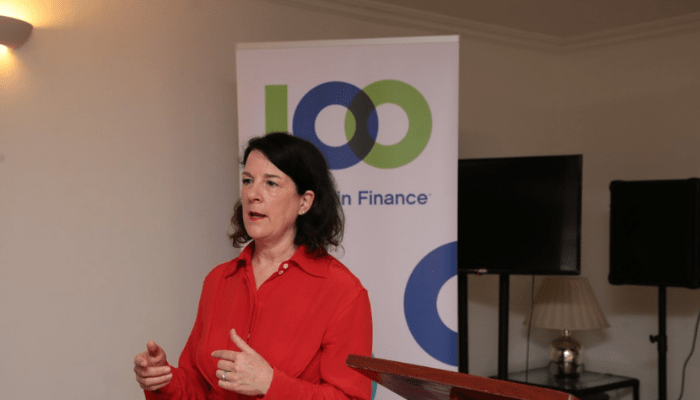
Amanda Pullinger is the chief executive officer of 100 Women in Finance, a global non-profit organisation. She was in Nigeria last week to launch the Nigerian chapter of 100 Women and to set up a Working Group. In this interview with AMAKA ANAGOR-EWUZIE, she shares the organisation’s plans in Nigeria. Excerpts:
May we know how the journey for the launch of 100 Women in Africa started?
The evolution of the launch was that we have a very generous donation from Zambia-born Dambisa Moyo who is an economist and a board member. We met in September 2020 in the UK, and she asked why the 100 Women is not in Africa. And I said that our model is that we wait for volunteers to put their hands up. She said I will like to encourage that to happen in Africa. If I make a donation, will you help to get working groups in South Africa, Nigeria, and Kenya going? It is something that we have never done before but obviously, we are non-profit but we need the money to enable the setup.
So, we basically started from scratch to reach out to a few people that we knew will be interested to join the working groups. What has been amazing since last year that we have been exploring particularly Nigeria is the number of women in high-level roles in the banks and other financial institutions, and also the number of women who are chairing boards for the financial institutions. I can tell you that the percentage of women in those roles in Nigeria is far higher than in the UK or US. Yet, the rest of the world does not know who they are, and they don’t know the story of what is going on in Nigeria.

I think that what the 100 Women can bring to the three locations that we are exploring is actually for the outside world knowing what is going on here and giving the women who are in the community here a global platform. There is a real positive and as a global organisation, we can literally get somebody who is in Nigeria to be interviewed by somebody in London and New York.
What is critical about it was to elevate the role of women who are experts in their field. So, it is good for those women themselves because they also inspire the next generation of young women, particularly black women. It is a very powerful message to pass across.
What specific plans do 100 Women in Finance have for Nigeria?
We just started and the first step was to bring together a group of women. We don’t have men in the committee but we will be happy to have men involved. The first step was for the working group to get to know each other. Interestingly, they all live in Lagos and they literally live around the corner but they have never met each other in person and before 100 Women, they did not know each other.
So, why does that matter? Being a woman in the finance industry is a lonely place and the most senior you get, it becomes lonelier. It is just lonely being in those senior roles. We want to help women find their people. So, if nothing else comes out from what we do in Nigeria is to help women in Lagos to connect here, and then find women in London, Hong Kong, or New York who they can identify with, and have real conversations, we have succeeded because out of all that you will get so many other things. I believe that in trying to keep women in this industry that one of the key issues is that they often feel alone.

We do education events where we connect with very important people and we focus on the next generation of young women. The first step is to connect women who are here. We also want to be able to put Nigeria on the map as the place that the rest of the world should be looking at. One of the issues for Nigeria and Africa is the fact that there is still that negative perception. The outside world sees all of the problems and none of the opportunities.
Again, I will like to demonstrate the fact that there are within our organisations men and women who are actually on ground here, fighting for the risk management issues. The big news about Nigeria is the opportunities that are here. Nigeria has the youngest population in the world and is going to be the largest country in the world. Nigeria has leapfrogged all technology.
Read also: Women in industry: Upskilling for a transitional energy industry
One of the missions of your organisation is the ‘mission 30 by 40’. Can you elaborate on that?
Our ‘Mission 30 by 40’ came out of our conversations. We turned 20 years old last year. So, we look forward to another 20 years and where we want to be in 20 years’ time. One of the things that have really not changed so much is the demographic of certain elements in the finance industry. The main one is the investment side as about 10 percent of the world fund managers are women and that number hasn’t changed for 30 years. We want to do something about that and inspire the next generation of young women to see that investing is cool and that you can make a difference in the world by investing in an environmentally sustainable organisation.
The second goal is that we want 2 percent of executive committee roles at firms to be women, and that is why Nigeria is very interesting. I think that if we look at the numbers here in those top jobs, Nigeria will probably be at 30 percent and the rest of the world is not. This does not mean that we do not need women in other top jobs or other operational roles. These are the top two roles in the industry and we really want to get that. Why 20 years? Because it is about the next generation and changing perception of what women can do together and I think we are going to try a number of different initiatives.
What are some of the challenges you have come across having gone round to network with women?
I think the challenges are very often within women themselves because we tend to be professional and everything has to be so before we take opportunities. We often put a priority on our at-home responsibilities rather than our own professional development. So, trying to persuade women that it is okay for things not to be perfect and it is okay to invest in oneself. So, getting that message across is really a critical thing. For me, CEO of a global non-profit, I am not unlike the CEO of any order institution. There are times I feel lonely and I face issues not terrible issues because we have amazing volunteers and staff. There are times that I have no one to talk to. One of the things I try to create is a peer network of my own among CEOs of other non-profit organisations that are in the finance space because you constantly thinking about where the revenue is coming from? How am I going to grow the organisation? My mantra throughout as women in the finance industry during the crisis, whether is the financial crisis of 2008/09 or the Covid in 2020/2021, was that we need three things community, connectivity, and continuity.
How does the organisation help women to beat funding challenges?
We are doing that in a very practical way through our global fund women conference week, which used to be a regional in-person set of small events where we connect female fund managers with institutional investors. But because of Covid, we have to go virtual and global.
Last September, we introduced 500 fund managers around the world across private equity, real estate, mutual funds, and hedge funds and there are women here who were at those conferences. We had conversations with those institutional investors saying that they can’t find the women. I am hoping in the future there will be a lot of female fund managers who are investing in women-owned and run businesses around the world.
Increasing the number of women who are fund managers is one thing, around 10 percent of the fund managers are women and they get allocated 1 percent of the capital, so if we can’t move that number up, we going to fell and we are not going to fell because this is a relationship business. We are going to persuade those female fund managers that they got to raise their heads up from the desk and come to networking events, get involved, be on our panels, and attend those conferences so that they will be visible to the institutional investors.
At what level do you think government can come in to support this initiative?
Every country has pension funds and in many cases, those institutional investors that we are working with have either state pension funds or sovereign wealth funds. Government can help through those institutions, and by insisting that women are given an opportunity.
Q: We also want to be able to put Nigeria on the map as the place that the rest of the world should be looking at