|
Getting your Trinity Audio player ready...
|
Following the recent pull-out by the Chinese Government from capital financing of rail projects in Nigeria, some concerns have been raised as regards alternative funding sources available to the Federal Government. This is more so, given the huge capital requirement of projects in this sector.
In the years before, the majority of rail projects had been financed by loans received from the Chinese Government.
According to the Debt Management Office (DMO), as of March 31, 2020, the total borrowing by Nigeria from China was USD3.121 billion (N1,126.68 billion at USD/N361) with the rail projects that took the bulk of spending listed to include the following: The Nigerian Railway Modernization Project (Idu-Kaduna section), Abuja Light Rail Project, and the Nigerian Railway Modernization Project (Lagos-Ibadan section). The total loans from China Exim as of December 21 2021 was stated to be N3.26 billion.
Q: Some have also alleged that the lack of confidence in the Nigerian government to put into judicious use the funds and a lack of accountability may have accounted for the Chinese retreat
There have been several postulations as to the basis for the pull-out by the Chinese. In some quarters, there have been suggestions that the decision taken by the Chinese government is not unconnected with “the switch by the China Belt and Road Initiative from investing in transport infrastructure development to smart investment such as digital infrastructure, 5G network, and telecommunications, that do not require heavy investment”.

Others say that the Chinese economy has been hard hit by the Coronavirus pandemic which has in turn negatively affected the financial stability of the country to support infrastructural projects in developing economies.
The dire debt position of the Nigerian economy, the strain on the revenue situation of the economy, and the uncertainties surrounding the ability of the government to pay back the loans may have also informed the backdown of the Chinese government.
Yet, some have also alleged that the lack of confidence in the Nigerian government to put into judicious use the funds and a lack of accountability may have accounted for the Chinese retreat.
Irrespective of the version from economic and political analysts, it is important to acknowledge that the world over, there has been a slanted shift in the mode of infrastructural funding for large projects in the railway sector.
It is gratifying to note that the government has now rightly looked towards private financing from Standard Chartered Bank (SCB) for the financing of outstanding projects however with no guarantee of their eventual structure of funding.

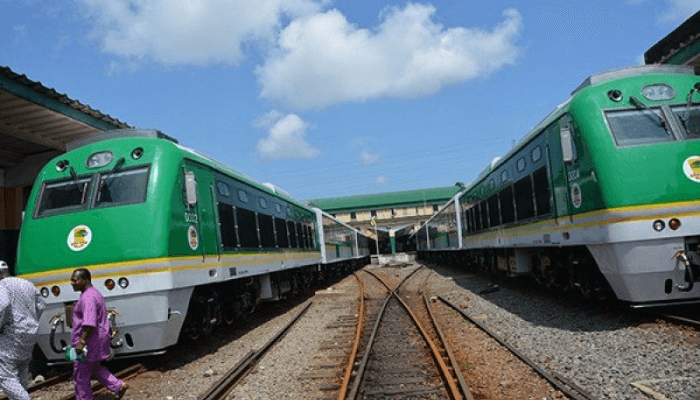
This differs markedly from the concessionary arrangement between the Chinese and Nigerian governments for railways projects that have been operational and have culminated in the successful completion of the Lagos Ibadan railway at a cost of $2.5 billion to the Nigerian government, financed by the China Exim Bank and undertaken by the China Civil Engineering Construction Corporation (CCECC).
According to Fitch Solutions Report, other projects previously undertaken by the CCECC were “the 187km Abuja – Kaduna line, which was completed in 2016 after five years, was awarded to CCECC at a cost of $876m. The 204km Kaduna – Kano project is handled by CCECC for $1.2bn.”
In all, the report stated that the “China Civil Engineering Construction Corporation has dominated the railway construction sector in Nigeria, supported by Chinese financing.”
Read also: Work progresses on Lagos Blue Line rail project
The Minister of Transport Rt. Hon Chibuike Amaechi had previously expressed his frustration at the lack of more funds available for railway projects and the risk of outstanding projects failing, should the funds not be made available in due time.
“We are stuck with lots of our projects because we cannot get money. The Chinese are no longer funding. So, we are now pursuing money in Europe. We have gone to Standard Chartered Bank. They have not done financial closure but they have approved some level of funding for Kano-Maradi,”
“London-based Standard Chartered Bank offers to fund the Lagos-Calabar coastal rail with $11billion of the $14.4billion needed to build the project.
The rail line will pass through Calabar, Uyo, Aba, Port Harcourt, Yenagoa, Otuoke, Ughelli, Warri, Sapele, Benin, Agbor, Asaba, Onitsha, Ore, Ijebu Ode, Sagamu and Lagos.” The Minister says.
In the light of the above,we support the latest move thatthe private sector can assume a key role in rail project infrastructural funding in Nigeria.
The newly established Infrastructure Company of Nigeria Limited (“InfraCo”) can also take the forefront in railway funding in Nigeria using the Public-Private Partnership (PPP) as with the use of pooled funds from viable institutions. However, the government nevertheless will be required to provide the necessary conducive environment to attract investment to the sector.
Recently, the Federal Executive Council (FEC) approved contracts worth $328.87 million in consultancy services for the supervision of various railway projects in the country.
While reservations are expressed as to the need for such large spending on just the monitoring of railways projects in the country, it is hoped that funding received from the private sector will be effectively put to use to increase the railway system in the country and thereafter attract more funding to the sector.
It is important to stress here that the government has done very well in this particular area. Therefore the momentum should be maintained such that ultimately, unbiased chronichlers will come forth with the judgement that the Buhari administration was a pace-setter in this important area of our national development.