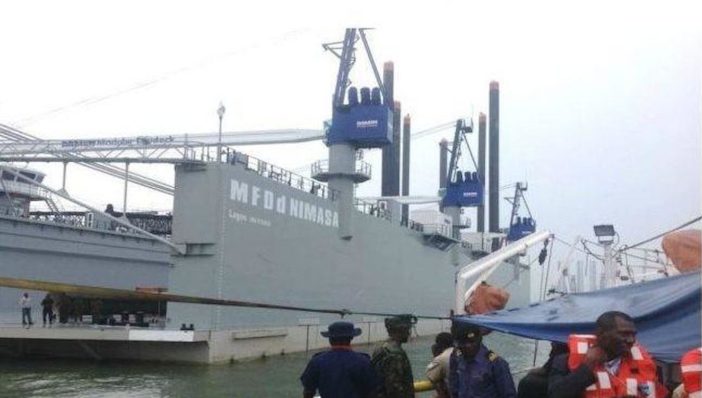
The Nigerian Maritime Administration and Safety Agency (NIMASA) recently said it had concluded an arrangement to put the over N50 billion floating dockyard acquired in 2018 into use by the end of March 2022.
According to the Federal Government agency, the floating dockyard will be handled through a public-private partnership arrangement. This means it would be able to privatise the national asset to enable private investors to positively utilise the dockyard for the good of the nation’s shipping industry.
Currently, the Infrastructure Concession Regulatory Commission (ICRC) has given NIMASA the approval to privatise the modular floating dockyard seen as a bankable and profitable venture.
To hit the ground running, NIMASA sealed a partnership deal with the Nigerian Ports Authority (NPA), which enables the latter to act as the co-partner in the management of the floating dockyard.

Bashir Jamoh, director-general, NIMASA, says the NPA has also agreed to provide the Continental Shipyard in Apapa to serve as a home for anchoring of the dockyard.
Putting the floating dock into use will provide a lot of benefits to the maritime industry. This ranges from conserving foreign exchange to providing employment and boosting indigenous capacity, developing shipping, and providing training exposure for students of the Maritime Academy of Nigeria, Oron, and the Maritime University, Okerenkoko.
Here are five economic benefits that Nigeria expects to gain from privatising the multi-million naira asset:
Reduction in capital flight
To shipowners, putting the floating dockyard into use holds serious positive economic implications for the nation’s shipping business, which presently depends on other countries to dry-dock both Nigerian and foreign-flagged vessels that do business on Nigerian waters.

Currently, there are no serious dry-docking facilities in Nigeria. This is why many Nigerian shipowners go to countries like Ghana, South Africa, Senegal, and Namibia, among others, to repair their vessels in line with the international law as specified by the International Maritime Organization (IMO), which requires every vessel to dry-dock once in three years in order to retain their safety classification and insurance cover.
It is estimated that Nigeria will be saving about N300 billion in losses to capital flight on yearly basis.
Shipowners say it costs between $1.5 million and $1.8 million to tow a vessel to far countries like Singapore for repair, while it costs between $300,000 and $500,000 to dry-dock a vessel in the international market, hence the need for more dry-docking facilities in-country.
Job creation
The privatisation of the NIMASA’s modular floating dockyard and making it operational would help to create employment opportunities for Nigerian youths, particularly engineers and welders.
NIMASA, according to Jamoh, is expecting a job creation for close to 500 Nigerians under five segments of the dockyard operations. He says the dockyard is expected to provide employment to at least 75 workers per department if it begins operations.
Earn/conserve foreign exchange
Pundits believed that having a functional ship repair yards in Nigeria will not only make the country a shipping hub but will also attract vessel repair and maintenance businesses into the country.
With that, countries in the West African region can bring in vessels into Nigeria for repair, and since shipping business is international; such vessel owners would pay for the services in dollars.
Nigerian ship owners, on the other hand, would not be required to export their vessels abroad for repair, thereby conserving such revenue in-country.
Gbolahan Shaba, CEO, LATC Marine, said in a recent forum that a maritime nation like Nigeria must have the capacity to maintain, dry-dock and repair ships in order to compete in the shipping business.
According to Shaba, who believes that lack of functional ship repair yards is one of the reasons Nigeria is not competing favourably in shipping, notes that an environment where there is a lack of capacity for shipyards to take on high-capacity ships cannot be favourable for vessel acquisition and ownership.
Grow government revenue
There are a lot of business opportunities for the private sector partner that would take charge of managing the floating dock. Currently, Cabotage vessels and other vessels flying Nigerian flags take their ships abroad for repair. But with the coming of a dry docking facility that is in-country, owners of such vessels would jump at servicing their vessels in Nigeria.
BusinessDay can recall that NIMASA said earlier that it had signed a memorandum of understanding with the International Oil Companies (IOCs) that are doing business with the Nigerian National Petroleum Corporation (NNPC) to be taking their ships to its dockyard for dry-docking when the dockyard begins full operations, according to Jamoh.
Also, Hadiza Bala Usman, the immediate past managing director of the NPA, said while still in office that the authority would likely be using the dockyard facility to dry-dock NPA’s vessels and other vessels of government agencies.
Training of cadets
When the modular floating dockyard would become operational, it would provide an opportunity for students of the Maritime Academy of Nigeria (MAN) Oron, and their counterparts from the Nigerian Maritime University, Okerenkoko, the opportunity to undergo their internship within the shipyard.
This will give them the needed exposure required to meet up the international training standards required for Nigerian maritime students to compete with their counterparts globally.