Aside from politics and religion. The topic of conversation that raises passions the most in Nigeria is the English Premier League.
Within three decades of its existence, the bugs of the English premier league have caught up with Nigeria’s social scene with a greater percentage of the populace following the competition with passion at the expense of the domestic league.
In Lagos, Nigeria’s commercial capital, the popularity of the Premier League is hard to miss. From commercial buses adorned with club stickers to advertising billboards featuring Premier League stars.
The English Premier League is indisputably the most attractive, the richest and the most marketable football league in the world. It is also the most glamorous employer of labour with so many different professions finding a home in the round leather game.

Each Nigerian fan has a club he/she is aligned with and even flaunts it in what he/she wears – branded jerseys and other accessories of the top clubs such as Manchester United, Chelsea, Liverpool and Arsenal Football Clubs.
This makes the league have a very fast-growing audience and market, which ultimately converts to tons of financial benefits.
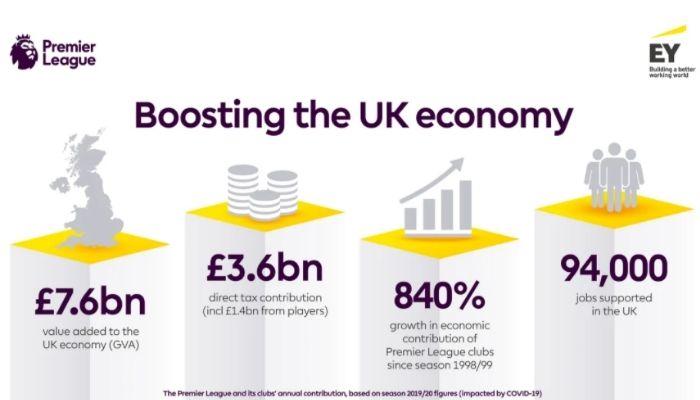
For instance, Despite the pandemic-hit 2019/20 season, English soccer’s top-flight Premier League still contributed $10.4 billion to the UK economy, according to a study by professional services firm Ernst & Young (EY).
According to the economic and social impact report, which was commissioned by the Premier League, the league and its clubs generated a total tax contribution of $4.9 billion) to the UK Exchequer in 2019/20.
Of that amount, $1.9 billion was accounted for by Premier League players. The total tax contribution underpinned by clubs has increased by $4.2 billion since 1998/99.

By comparison, the music industry contributes around £ 5 billion, the arts £ 10.47 billion and the value of all the fish caught in the UK amounts to £ 831 million. The Premier contributes £ 3.6 billion tax and supports 94,000 jobs.
This is a considerable figure given only 33,000 work in the British steel sector and 43,000 in the coal industry. Call centres, however, employ around 900,000 people in the UK.
In 2019-20, Premier clubs generated £ 5.1 billion of income, a large chunk of which came from domestic and overseas broadcasting. At the same time, the league paid out £ 2.9 billion in wages, a ratio of around 57percent.
EY’s study also said the club’s economic activity had grown by 840 per cent since the 1998/99 season.
In addition, the study mentions that the Premier League and clubs have delivered substantial and prolonged employment growth, with 94,000 jobs supported across the UK.
EY adds that the number of club-related jobs has increased from 11,000 in 1998/99 to more than 87,000 in 2019/20, a rise of 650 per cent.
The league’s worldwide appeal was highlighted, as the study shows that there was a cumulative global audience of 3.2 billion in 2019/20, double that of the Uefa Champions League.
Prior to Covid-19’s arrival, stadiums were also a record 97.8 percent full across the Premier League.
All this, the study says, has allowed the Premier League to increase investment into communities nationally and locally, as well as soccer at all levels.
The league provided solidarity and parachute payments to 138 English Football League (EFL) and National League clubs, with a total of $621 million distributed to other leagues and community soccer in 2019/20.
Despite the Covid disruption, the Premier League’s total economic contribution remains equal to pre-pandemic levels and the amount generated in 2016/17, according to EY’s assessment.
The study adds an estimated $1.8 billion was lost in broadcast and matchday revenues during the 2019/20 and 2020/21 seasons due to Premier League games being played behind closed doors.
“The league’s global appeal continues to be a key factor in driving its economic impact, and the league plays a significant role at the heart of clubs’ communities,” said Peter Arnold, EY UK’s chief economist.
“Hundreds of thousands of children, young people and adults benefit from initiatives supported by the league each year and the pandemic has helped pull the role of football within communities across the country into sharper focus than ever before.”
Richard Masters, the Premier League’s chief executive, added: “This new report from EY shows how we and our clubs continue to contribute significantly to the UK economy and have delivered much-needed assistance to all levels of football and communities at a time when the pandemic brought unprecedented challenges and uncertainty for so many.
“We are proud of the level of support we provide the football pyramid, as well as funding community organisations of clubs up and down the country. The importance of their work has been more evident than ever in recent times, providing help to people who needed it the most.”
The Premier League remains the most popular club competition in the football world with a cumulative global audience of 3.2 billion, almost double the UEFA Champions League (1.625 bn), Bundesliga (1.6 bn) and La Liga (1.559 bn).
Data from Nielsen Sports indicates that 69 percent of football fans worldwide are fanatically interested in the Premier.
Interestingly, the league’s central revenues are distributed more equitably than any of the other top European leagues.
The top club in the Premier in 2018-19 (Manchester City) received 1.6 times as much in revenues as the least remunerated club.
Other leagues are far less democratic in this respect, their figures are: La Liga 3.8x; Bundesliga 3.7x; Serie A 3.6x; and Ligue 1 3.1x.
Broadcasters fall over themselves to secure Premier League rights. In fact, the league’s broadcast exports comprise almost half of the UK’s TV exports.
In 2019-20 this amounted to £ 1.4 billion, more than the combined overseas rights of the Bundesliga, La Liga, Ligue 1 and Serie A (£ 1.2 billion).
While some fear the TV bubble may be slowly bursting, there seems plenty of mileage at present.
Despite criticism that money doesn’t always trickle down to the grassroots level, the Premier distributed 15 percent of its 2019-20 revenues to the football pyramid and local communities.
Furthermore, £226 million was paid in transfer fees to EFL clubs by Premier clubs and overall, 48percent of Championship clubs’ 2019-20 revenues were derived from Premier distributions.
Read also: Nigerian students studying in UK surge by 64% in one year
League One (27%) and League Two (24%) also gained a significant percentage of their income from this source.
Since 2012, almost half a billion of academy grants have been paid by the Premier and since 2000, a further £ 164 million has been invested in the Football Stadia Improvement Fund.
Javier Tebas, La Liga’s president, told Marca that clubs like Real Madrid, Barcelona and Juventus see the Premier League as a threat to their existence. “The enemy is not only the Champions League but also the Premier League,” he said.
But overseas visitors are still drawn to the league, as evidenced by more than half a million tourists from abroad, spending £ 442 million, in 2019-20.
In Euro 2020, no league provided more players, with 117 coming from Premier clubs. Germany’s Bundesliga was next with 89 players (source: Twenty-First Group). The league has long attracted top players and coaches, often to the detriment of allowing young talent to fully flourish, but in 2019-20, 48% of total Premier League appearances were made by homegrown players.
The financial strength of Premier League clubs is now starting to reveal itself in the form of Champions League dominance.
In two of the past three seasons, the final has been an all-England affair, with Liverpool beating Tottenham in 2019 and Chelsea narrowly overcoming Manchester City in 2021.
Some might say this was long overdue given the resources the clubs enjoy, but it may be this is a new age of Premier League dominance.
If that is the case, then claims that a super league already exists and resides in the United Kingdom might just be accurate.