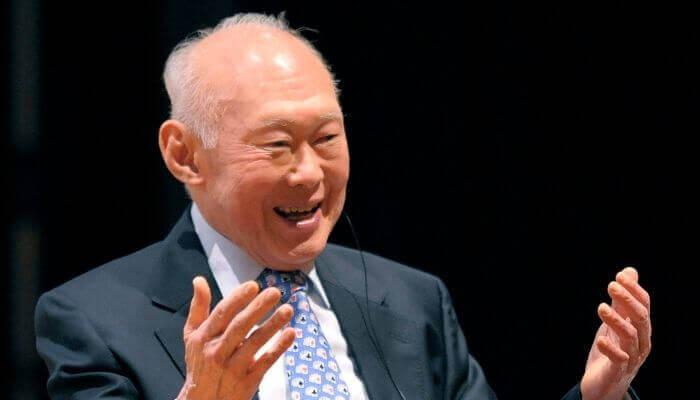
It was Otunba Opeyemi Agbaje, a lawyer and political economist, who first led me into the world of Lee Kuan Yew. It was during one of his sessions on the socio-political environment of business (SPEB), and I was an MBA student in the Lagos Business School then. Otunba Agbaje spoke about Lee Kuan Yew (Lee for short) with so much passion and attention-compelling tone that all of us in the class were involuntarily enraptured into his world of how to build an economy. Agbaje regaled us with so many development lessons that Nigeria could learn from the nation-building principles of Lee.
Curiously, even though I have been long done with SPEB, I’ve always caught myself reminiscing about Lee’s heretofore unmatched prowess for economic transmutation. Lee held sway at Singapore’s leadership helm for 25 years, and within the period, gave Singaporeans something akin to St. Peter’s Mount Tabor visuals as he transfigured the city-state from a petite British colonial outpost to a prosperous global economic hub.
Notably, the per capita GDP stood at US$516.53 in 1965 but spiked 4,517.8 percent to US$23,852.33 in 2000. In 1965, the adult literacy rate in Singapore was 60.2 percent; by 2000 almost all adults were literate as the country had achieved a literacy rate of 92.5 percent. While only nine percent of the people in Singapore lived in their own houses, 90 percent of the people were already living in their own houses by 1990.
Combined with the above indices, giant strides in key sectors of Singapore’s economy have taken the country to the league of top countries in the world from the point of view of global competitiveness and development. The country has one of the most efficient and cleanest governments and public sectors in the world, and its infrastructure facilities are deemed world-class. This is in addition to the fact that many consider Singapore’s public sector as clean, meritocratic, efficient, and well-structured.

Interestingly, the pre-Lee Singapore bore many similarities with Ebonyi State. For instance, the country was part of Malaysia before it became an independent nation, just as Ebonyi State was part of Enugu and Abia States prior to October 1996 when it was created as an independent state. Again, Singapore had one of the lowest populations in the Asian region. Official figures of the National Population commission place Ebonyi State the third least populated state in the country, and the least in South-Eastern Nigeria.
Another point of similarity between Singapore and Ebonyi State is the Human Development Index (HDI) ranking. Prior to independence in 1965, Singapore ranked among the world’s poorest countries in the HDI chart, which measures long-term advancement in three key aspects of human development, that is, a healthy long life, knowledge access, and quality living standard. The latest UNDP HDI report ranks Ebonyi State 24th, the poorest among all the states in Southern Nigeria.
Although the issues of development lie along several fronts, the point of Human Development lies at the core of any efforts at sustainable development. Thus, despite all the plaudits Ebonyi State has garnered in terms of (pseudo-) infrastructural development, the mire of underdevelopment continues to trap it in the poverty region. This is what Lee Kuan Yew emphasized in his programme through which he successfully catapulted Singapore from the rank of undeveloped to a developed country within three decades.
Read also: Is fiscal deficit sustainable for development in Nigeria?
What has left me miffed at the poor pace of development in Ebonyi State is the realization that unlike Singapore had no natural resources, it is blessed with huge deposits of Zinc, Lead, Limestone, and other mineral resources that, if altruistically harnessed, would have made it a runaway leader in all development indices, at least in the SouthEast region. But that was not to be, because obviously, those who held (and who are holding) sway as leaders in the two decades and half of the State’s ‘independence’, never thought like Lee. They’ve focused on areas that had no additive value to the development yearnings of the State.

Consequently, Ebonyi now languishes at the bottom of all normal indices of development. Its poor economic output (real GDP) is better than only those of Yobe and Gombe States; it has the lowest literacy rate in the South-East; it is the poorest state in Nigeria after Sokoto, Taraba, and the Jigawa States. And as its school-age children prowl the streets of major cities in the country hawking basic wares, the State competes for the unenviable reputation of having the highest number of out-of-school children.
I hear someone tell me to lament no more, but I won’t stop until I let the people know that Ebonyi needs a Lee Kuan Yew to save it from a looming catastrophe. So what would Lee do if he were an Ebonyi man?
Unah is a public affairs commentator; he writes from Lagos.