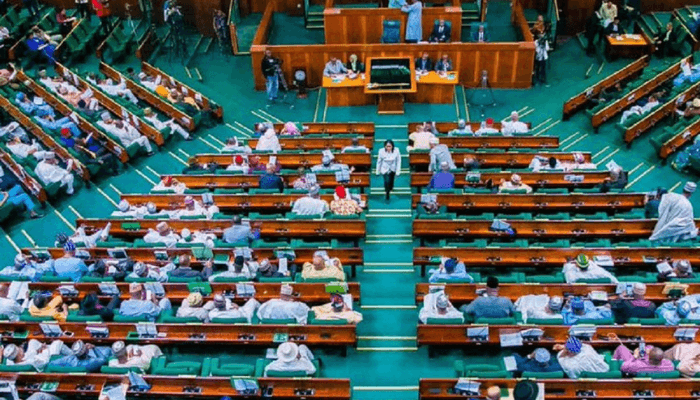
The House of Representatives on Thursday took steps to remove the Code of Conduct Tribunal (CCT) from the control of the executive arm of the Nigerian Government and domicile it in the Judiciary – an independent arm of the Government.
This is as the House passed through second reading, a bill to alter the Constitution of the Federal Republic of Nigeria, 1999 with a view to removing the CCT, an adjudicatory body, from the Executive Arm and placing it under the judiciary as a superior court of record.
Sponsored by Solomon Bob (PDP, Rivers) and Olajide Olatunbosun (APC, Oyo) the bill proposes to amend principally sections 6, 84, 240, 243, 254, 294, 295, 316 of the constitution among others that deal with superior courts of record and sought to incorporate the CCT among them.
Leading debate on the bill, Bob said in a presidential democracy such as Nigeria’s, the three arms of government – the Legislature, Executive and Judiciary are distinct and separate in functions, powers and composition.

He said the distinct separation of powers is intended to secure the independence of each arm and for each to act as a check on the exercise of power by the other, which ultimately enhances the effective discharge of their respective constitutional responsibilities.
“It is not, therefore, by accident that the constitution specifically sets out the powers of each of the three arms as spelt out in sections 4, 5 & 6 for the Legislature, Executive and the Judiciary respectively.
“The Code of Conduct Tribunal – the focal point of this Bill – is undoubtedly a judicial body created by paragraph 15 of the 5th schedule to the constitution and section 20 of the Code of Conduct Bureau and Tribunal Act. It is a statutory body saddled with the responsibility of trying offences under the Code of Conduct Bureau Act.
“However, it is absurd and indeed confounding that a judicial tribunal clothed with enormous powers to sanction public officers found guilty of violating the Code of Conduct Act, including the power to order forfeiture and bar offenders from holding public office, is placed under the Executive rather than the Judiciary, an arm where it rightly belongs,” Bob said.
Read also: #EndSARS Panel report opens window into police brutality

He argued that paragraph 18(2) of the 5th schedule of the Constitution which deals with the powers of the Tribunal provides in extenso; ‘the punishment which the Code of Conduct Tribunal may impose.’
The sanctions include: “Vacation of office or seat in any legislative house, as the case may be; disqualification from membership of a legislative house and from the holding of any public office for a period not exceeding ten years; and Seizure and forfeiture to the state of any property acquired in abuse or corruption of office.”
The lawmaker said these provisions clearly clothe the Tribunal as a judicial body with the powers of a competent court of record, adding that the failure to situate it under the judicial arm of government is contrary to the principle of separation of powers
“To illustrate this point, Mr. Speaker, Honourable colleagues, it is noteworthy to point out here that the highest court of this land has held in the case of Saraki vs FRN (2016) LPELR 46013 SC that the chairman and members of the Code of Conduct Tribunal are not judicial officers. That being the case, they are not subject to the discipline and sanction of the National Judicial Council like other judicial officers.
“Furthermore, the offices of the chairman and members of the Code of Conduct Tribunal are clearly omitted in the judicial oath contained in the 7th schedule to the constitution.
“Honourable colleagues, giving effect to this amendment will, therefore, make members of the Tribunal judicial officers with the attendant protection and privileges which that will afford, besides securing the funding of the Tribunal as its funding will be charged on the consolidated revenue of the federation and released directly to the head as statutory transfers. This will in turn immune them substantially from the manipulation or control of the Executive.
“Honourable Colleagues, under a presidential democracy, one single arm of government ought not exercise executive and judicial powers such as is the case presently. The horrifying consequences or dangers of placing the Tribunal under the Executive as it is today are clear for us all to see. Its independence is non-existent and its instrumentalization by the executive as a weapon against the legislature and the judiciary is evident and undeniable.
“Mr. Speaker, by way of citing a precedent, this Honourable House in the 6th Assembly vide the 3rd Alteration of the constitution similarly took a bold decision and upgraded the National Industrial Court to a superior court of record, which today has helped in no small measure in the dispensation of justice by that court.
“Mr. Speaker, Honourable colleagues, history beckons once again and such legislative intervention is just as desirable, if not more, in the present case in order to fully realize the objectives for which the tribunal was established, enhance its capacity to deliver on those objectives, maintain the very important division of functions among the three arms of government and further entrench and strengthen our democracy,” he added.