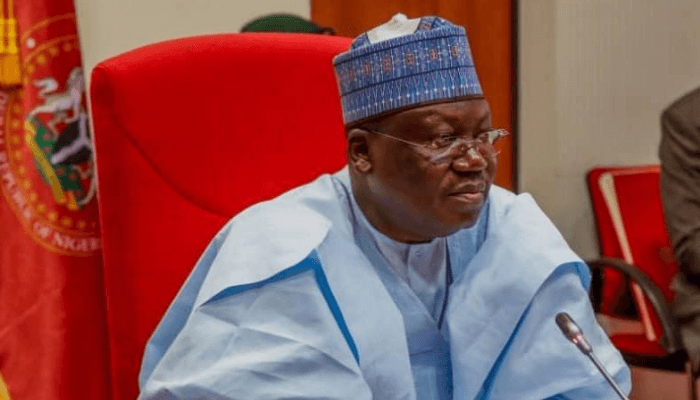
In a bid to reduce Nigeria’s deficit and dependence on external borrowing, the Nigerian Senate has mandated all revenue-generating ministries, departments and agencies (MDAs) to generate and remit N1 trillion annually.
Ahmad Lawan, president of the Senate, said this after the chamber approved President Muhammadu Buhari’s submission of the revised 2022-2024 fiscal framework in Abuja.
The senate president said the National Assembly will mount more pressure on revenue-generating agencies to ensure that they remit the sum to enable the federal government to fund the national budget.
Lawan also alleged that many of the MDAs have been cornering funds that ordinarily should have gone to the treasury, and remitting far less than they generate.

“I’m sure that those MDAs that remitted N400 billion could possibly have remitted N1trn naira if we had pushed harder.
“So, we need to push harder because what this means is a revelation, that many of these MDAs have been cornering funds that ordinarily should have gone to the treasury”, he said.
Read also: Dangote, Nestle, others lift stock market first time in 8 months
“But for many years, they have been taking the funds unfairly and illegally. So, we should not be content with only N400 billion naira. It is a good thing that it happened because that is an exposure of what they have been doing. But we must insist that it goes beyond the N400 billion naira. I’m sure we can get even more than N1 trillion” he further said.
He, therefore called for collaboration between the executive and legislature to ensure compliance.

Speaking further, Lawan acknowledged that Nigeria’s deficit and borrowing are high, but argued that the choice is limited, “because on one breadth we cannot say that we will not borrow because it is becoming too much when we don’t have ways and means of funding infrastructural development in the country.”
“And we cannot say we should just fold our arms and not do anything because the country will never move. So, it’s a catch-22 situation. I believe that we need to be very mindful that we need to reduce the borrowing, but that means we have to improve on the revenue that we receive.
“I believe that the additional revenues that have not been captured like the TETFUND, Bank of Industry and so on, were before just left out of the federal budget. Now, we can see everything, and we need to see more,” Lawan said.
Contributing to the debate on the revised 2022-2024 fiscal framework, Senator Chukwuka Utazi (PDP, Enugu North) advised the federal government to take seriously the issue of diversifying the Nigerian economy.
The lawmaker harped on the need to explore alternative revenue sources such as mining to boost the country’s revenue figures, warning that “the time of oil is over”.
Senator Betty Apiafi (PDP, Rivers West) described the government’s decision to jerk up the 2022 budget projection from 13.98 trillion to N16.45 as over-ambitious and a proposal taken too far.
She added that one of the major challenges confronting the national budget is the absence of funds appropriated for under-recovery.